
CUETMOCK
  • Pricing
  • Mentors
Log inStart freeStart free mocks→

First test, then trust

Try a free CUET mock test.

Join 5,00,000+ students who rehearsed exam day on the exact NTA screen before sitting CUET. On the web and on Android.

Start free mocks →Get the Android app
CUETMOCK

India's #1 CUET Mock Test Platform. Original NCERT-based questions on the exact NTA exam screen — trusted by 5,00,000+ students since CUET 2022.

Get it onGoogle PlayScan to download the CUETMOCK app

Mock tests

  • CUET mock test series
  • Commerce mocks
  • Humanities (Arts) mocks
  • Science mocks
  • Languages & GAT mocks
  • Free practice questions
  • Pricing

Resources

  • CUET exam guide
  • CUET syllabus
  • Universities accepting CUET
  • Expert blogs
  • News & notifications
  • Webinars & counselling
  • CUET score calculator
  • How we estimate your rank
  • FAQs

Company

  • About us
  • Our leadership & team
  • Our toppers
  • Mentors
  • For schools
  • Contact us
  • Terms
  • Privacy
  • Refund policy

Talk to us

+91 7696 6630 56info@cuetmock.comWhatsApp us

Our other platforms

  • JEE Mock — For IIT-JEE aspirants
  • NEET Mock — For NEET aspirants

Newsletter

Exam updates, study material and offers — no spam.

© 2026 NYC Ventures Pvt. Ltd.

701-702, Royal Business Park, Zirakpur, Punjab - 140603

  • Terms of use
  • Privacy policy
  • Refund policy
  • Contact us

iCUETMOCK is an independent preparation platform, not affiliated with the National Testing Agency (NTA). Always check exam details on the official NTA website.

  • Home
  • Mock tests
  • CUET guide
  • Pricing
  • Log in
Home/Practice questions/Chemistry
ChemistryInorganic: Coordination Compounds

The metal to carbon bonding in metal carbonyl, creates an effect whic…

Coordination Compounds

Alfred Werner (1866-1919), a Swiss chemist was the first to formulate his ideas about the structures of coordination compounds. He prepared and characterised a large number of coordination compounds and studied their physical and chemical behaviour by simple experimental techniques. Werner proposed the concept of a primary valence and a secondary valence for a metal ion. The formulas and names adopted for coordination entities are based on the recommendations of the International Union of Pure and Applied Chemistry (IUPAC). Many approaches have been put forth to explain the nature of bonding in coordination compounds viz. Valence Bond Theory (VBT), Crystal Field Theory (CFT), Ligand Field Theory (LFT) and Molecular Orbital Theory (MOT). The Valence Bond Theory (VBT) explains with reasonable success, the formation, magnetic behaviour and geometrical shapes of coordination compounds. It, however, fails to provide a quantitative interpretation of magnetic behaviour and has nothing to say about the optical properties of these compounds. The Crystal Field Theory (CFT) to coordination compounds is based on the effect of different crystal fields (provided by the ligands taken as point charges), on the degeneracy of d orbital energies of the central metal atom/ion. The splitting of the d orbitals provides different electronic arrangements in strong and weak crystal fields. The treatment provides for quantitative estimations of orbital separation energies, magnetic moments and spectral and stability parameters. However, the assumption that ligands constitute point charges creates many theoretical difficulties.

The metal to carbon bonding in metal carbonyl, creates an effect which strengthens the bond between metal and carbonyl that is known as

Answer & explanation+

Correct answer: option 1

The correct answer is Option (1) → Synergic effect

In a metal carbonyl, the σ donation from CO and the π back donation from the metal strengthen each other; this mutual strengthening of the metal–carbon bond is the synergic effect.

Why the other options are incorrect

  • Option (2) Chelation effect — Incorrect. It is the extra stability of a complex in which a polydentate ligand forms a ring with the metal; CO is monodentate.

  • Option (3) Lead poisoning effect — Incorrect. This is not a bonding effect; lead poisoning is treated with the chelating ligand EDTA.

  • Option (4) Planar effect — Incorrect. There is no such bonding effect; metal carbonyls are not even planar (\( \ce{Ni(CO)4} \) is tetrahedral).

NCERT (2026-27 edition):
Bonding in Metal Carbonyls – …
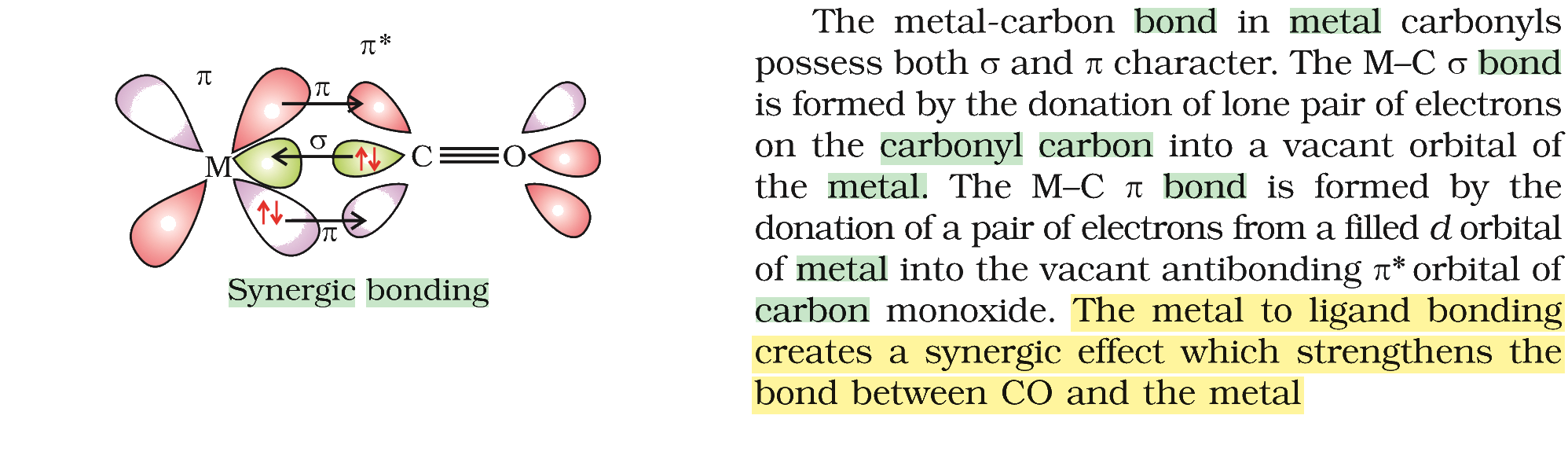
Textbook extract

Advertisement

Practise more on Inorganic: Coordination Compounds

Chapter-wise mocks on the real NTA exam screen, with solutions and your rank. Your first mocks are free.

Start free mocks →

Advertisement

Next questions

  1. Identify the correct sequence of recruitment process:(A) Choosing the most suitable source of labor supply(B) Identification of the differe…Business Studies · Staffing
  2. A steady current ‘I’ flows through a metallic conductor whose area of cross-section ‘A’ increases continuously from one end to the other. T…Physics · Current Electricity
  3. 220 meter long train is running with a speed of 59 km/hr. In what time will it pass a man who is running at 7 km/hr in the direction opposi…General Aptitude Test · Numerical Ability
  4. Identify the correct statements from below:A. Colonel Colin Mackenzie was an antiquarian.B. The name ‘Hampi’ is derived from the local moth…History · Medieval India: An Imperial Capital: Vijayanagara
  5. A method in which cells are bombarded with high velocity micro-particles of gold or tungsten coated with DNA is known as:Biology · Biotechnology -Principles and Processes
  6. Which one of the following statements is incorrect about the genetic code?Biology · Molecular Basis of Inheritance
  7. Which of the following are correct with respect to Rule 3 of the Companies (Incorporation) Rules, 2014 for One Person Company?(A) Only a na…Accountancy Part A · Accounting for Shares
  8. On mixing, benzene and toluene form an ideal solution. At 88 °C, the vapour pressure of the two liquid components (benzene and toluene) are…Chemistry · Physical: Solutions
  9. Choose the option that indicates the closest antonym of the underlined word in the given sentence:Excessively corpulent children and adults…English · Antonyms
  10. 2-Bromopentane reacts with alcoholic KOH to form major product as:Chemistry · Organic: Haloalkanes and Haloarenes