Molecular Basis of Inheritance
Read the following passage carefully and answer the given questions.
A nucleotide has three components – a nitrogenous base, a pentose sugar (ribose in case of RNA and deoxyribose in case of DNA), and a phosphate group. There are two types of nitrogenous bases – Purines (Adenine and Guanine), and Pyrimidines (Cytosine, Uracil and Thymine). The RNA polymerase I transcribes rRNAs (28S, 18S, and 5.8S), whereas the RNA polymerase III is responsible for transcription of tRNA, 5srRNA, and snRNAs (small nuclear RNAs). The RNA polymerase II transcribes precursor of mRNA, the heterogeneous nuclear RNA (hnRNA). It was George Gamow, a physicist, who argued that since there are only 4 bases and if they have to code for 20 amino acids, the code should constitute a combination of bases. He suggested that in order to code for all the 20 amino acids, the code should be made up of three nucleotides. This was a very bold proposition, because a permutation combination of 43 (4 × 4 × 4) would generate 64 codons; generating many more codons than required.
Which one of the following statements is incorrect about the genetic code?
Answer & explanation
Correct answer: option 2
The correct answer is Option (2) → There are punctuations between the codons.
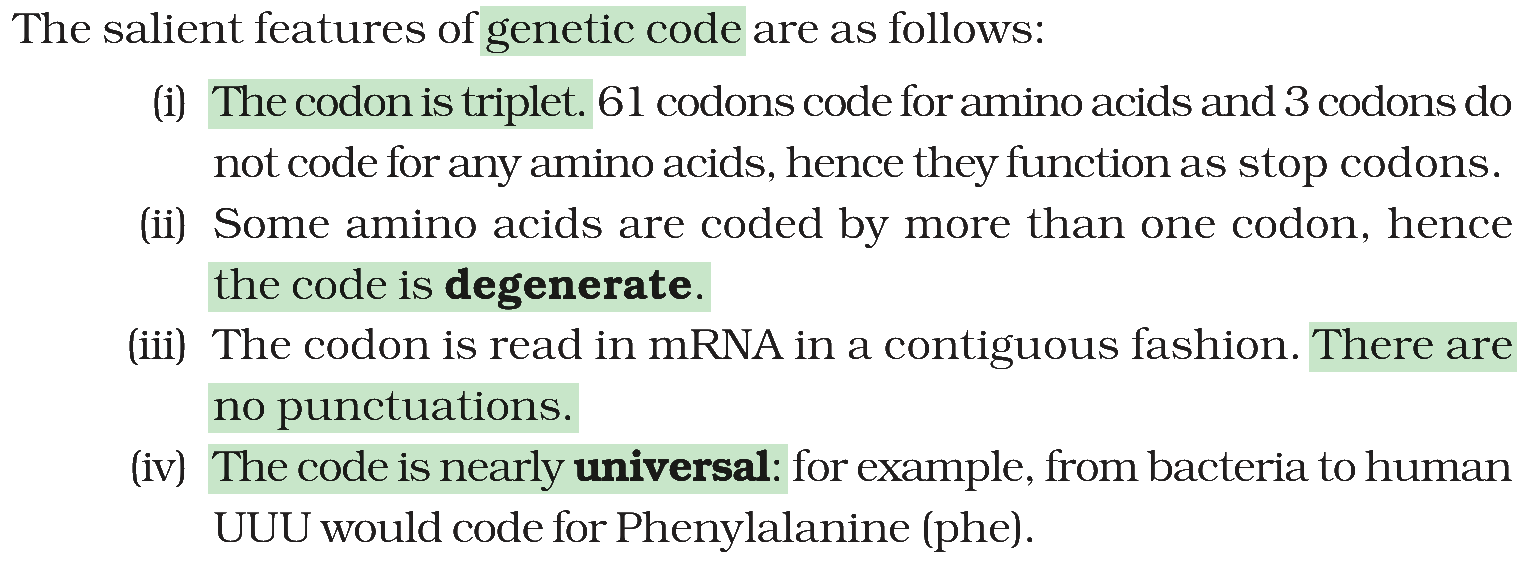
The genetic code is the set of rules by which the order of bases in mRNA decides the order of amino acids in a protein. Its main features are that it is triplet, degenerate, read without punctuation and nearly universal.
(1) The codon is triplet. — A feature of the genetic code. Three bases make one codon. Of the 64 codons, 61 code for amino acids and 3 are stop codons.
(2) There are punctuations between the codons. — Not a feature of the genetic code. There are no gaps or marks between the codons.
(3) The codons are read in a contiguous fashion. — A feature of the genetic code. The mRNA is read codon after codon, one right after the other.
(4) The code is nearly universal. — A feature of the genetic code. From bacteria to human, UUU codes for phenylalanine. A few exceptions are known.
Note: The passage is taken from NCERT. NTA has put lines of the NCERT text together to make it. Most CUET (UG) questions come straight from NCERT, so study the book line by line, including figures and their titles.
NCERT Extract:
Genetic Code – …