2-Bromopentane reacts with alcoholic KOH to form major product as:
Answer & explanation
Correct answer: option 2
The correct answer is Option (2) → Pent-2-ene
When an alkyl halide with a β-hydrogen is heated with alcoholic KOH, a hydrogen from the β-carbon and the halogen from the α-carbon are removed together. This β-elimination (dehydrohalogenation) gives an alkene.
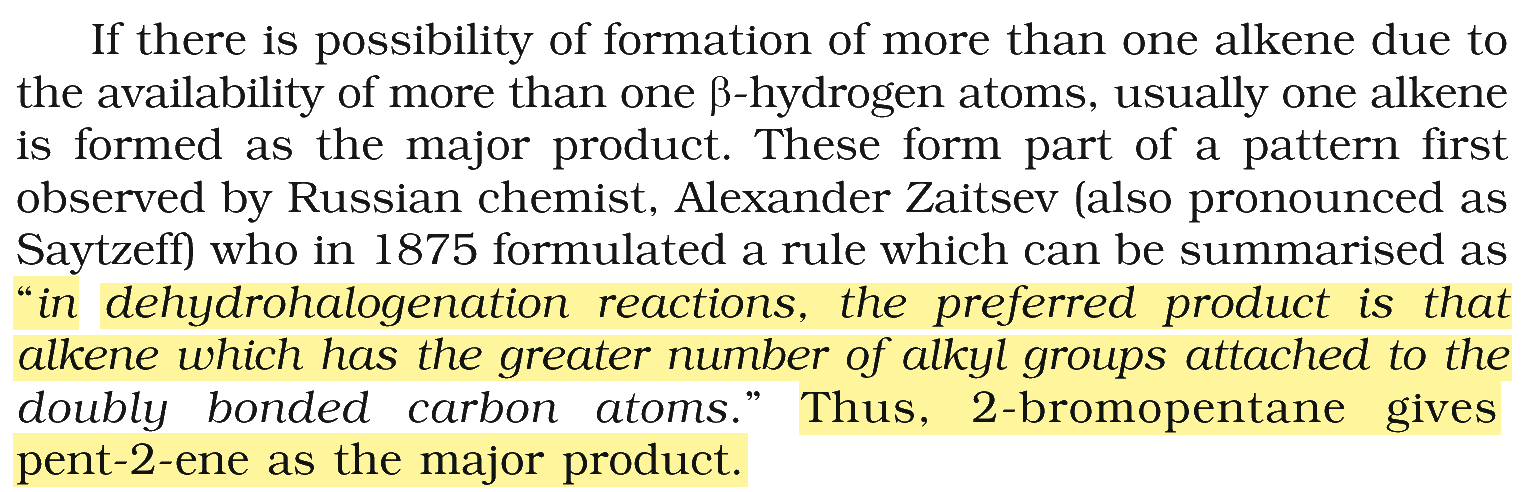
If there are two different β-carbons, two alkenes can form. By the Zaitsev (Saytzeff) rule, the more substituted alkene is the major product.
In 2-bromopentane, the β-carbons are C1 and C3:
\( \displaystyle \ce{CH3-CHBr-CH2-CH2-CH3} \xrightarrow{\text{alc. KOH}} \ce{CH3-CH=CH-CH2-CH3} \) (pent-2-ene, about 81%)
\( \displaystyle \ce{CH3-CHBr-CH2-CH2-CH3} \xrightarrow{\text{alc. KOH}} \ce{CH2=CH-CH2-CH2-CH3} \) (pent-1-ene, about 19%)
Pent-2-ene has two alkyl groups on the double bond, while pent-1-ene has only one. So the major product is pent-2-ene.
Why the other options are incorrect
Option (1) Pent-1-ene — Incorrect. It does form, but only as the minor product, because it is the less substituted alkene.
Option (3) Pent-3-ene — Incorrect. This is not a correct name; numbering from the other end gives the lower locant, so \( \ce{CH3CH2CH=CHCH3} \) is pent-2-ene.
Option (4) Pent-1-ene and Pent-2-ene — Incorrect. Both are formed, but the question asks for the major product, which is pent-2-ene alone.
NCERT (2026-27 edition):
Elimination Reactions – …