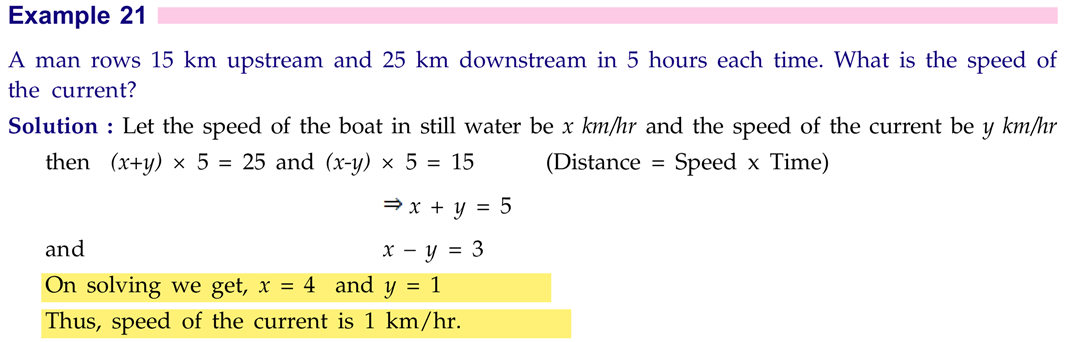
A man rows a boat downstream 30 km and upstream 20 km. It takes him 5 hours to cover each distance. Which of the following are TRUE?
(A) The speed of the boat in still water is 10 km/hr.
(B) The speed of the boat in still water is 5 km/hr.
(C) The speed of the current is 1 km/hr.
(D) The speed of the current is 6 km/hr.
Choose the correct answer from the options given below:
Answer & explanation
Correct answer: option 3
The correct answer is Option (3) → (B) and (C) only
Let the speed of the boat in still water be u km/hr and the speed of the current v km/hr.
\( \displaystyle \text{Downstream speed}=u+v=\frac{30}{5}=6 \)
\( \displaystyle \text{Upstream speed}=u-v=\frac{20}{5}=4 \)
Adding and subtracting the two equations:
\( \displaystyle u=\frac{6+4}{2}=5 \)
\( \displaystyle v=\frac{6-4}{2}=1 \)
So the speed of the boat in still water is 5 km/hr and the speed of the current is 1 km/hr.
Checking the statements
(A) The speed of the boat in still water is 10 km/hr. — Incorrect. It is 5 km/hr; 10 is the sum of the two speeds, before halving.
(B) The speed of the boat in still water is 5 km/hr. — Correct. \( u=\frac{6+4}{2}=5 \).
(C) The speed of the current is 1 km/hr. — Correct. \( v=\frac{6-4}{2}=1 \).
(D) The speed of the current is 6 km/hr. — Incorrect. 6 km/hr is the downstream speed; the current is 1 km/hr.
CBSE Applied Mathematics (Class XII):
Boats and Streams