Arrange the following compounds in the increasing order of their boiling points.
(A) CH3CH2CH2CHO
(B) CH3CH2CH2CH2OH
(C) H5C2-O-C2H5
(D) CH3CH2CH2CH3
Choose the correct answer from the options given below:
Answer & explanation
Correct answer: option 4
The correct answer is Option (4) → (D), (C), (A), (B)
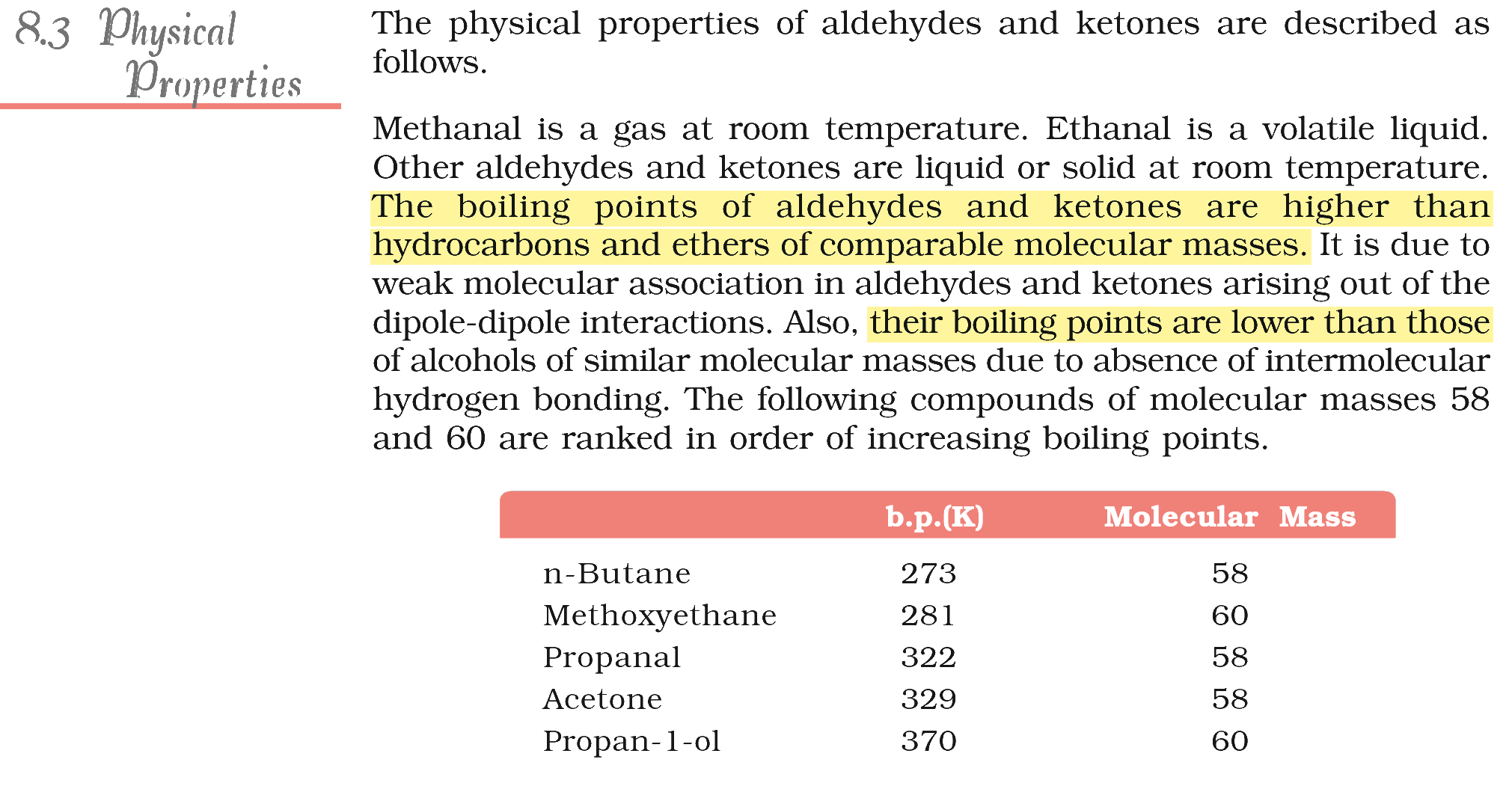
For molecules of similar molar mass (here all have four carbon atoms, 58–74 g mol−1), the boiling point is decided by the strength of the intermolecular forces:
Alkanes: only weak van der Waals (dispersion) forces, so the lowest boiling point.
Ethers: a small dipole from the bent C–O–C group, but no H on oxygen, so no hydrogen bonding between ether molecules.
Aldehydes and ketones: a strongly polar C=O group gives stronger dipole–dipole attractions.
Alcohols: the O–H group forms intermolecular hydrogen bonds, the strongest of these forces, so the highest boiling point.
Matching the given compounds (with boiling points):
(D) \( \ce{CH3CH2CH2CH3} \): n-butane (alkane), about 273 K
(C) \( \ce{H5C2-O-C2H5} \): ethoxyethane (ether), about 308 K
(A) \( \ce{CH3CH2CH2CHO} \): butanal (aldehyde), about 348 K
(B) \( \ce{CH3CH2CH2CH2OH} \): butan-1-ol (alcohol), about 391 K
Shortcut: The alkane (D) boils lowest and the alcohol (B) highest. Only Option (4) starts with (D) and ends with (B).
NCERT (2026-27 edition):
Physical Properties