In coordination compounds, linkage isomerism arises due to the presence of ligand:
Answer & explanation
Correct answer: option 3
The correct answer is Option (3) → NO2
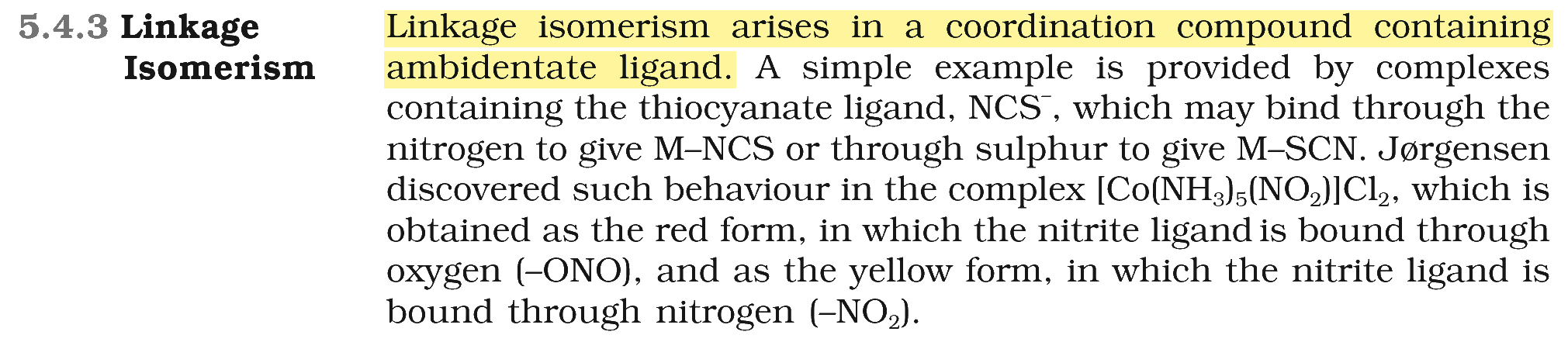
Linkage isomerism arises when a ligand can bind to the metal through either of two different donor atoms. Such a ligand is called ambidentate. The two isomers have the same formula but a different atom attached to the metal.
The nitrite ion, NO2−, can bind through nitrogen (nitrito-N, –\( \ce{NO2} \)) or through oxygen (nitrito-O, –ONO). For example:
\( \displaystyle \ce{[Co(NH3)5(NO2)]Cl2}\ \text{(yellow, N-bonded)}\quad\text{and}\quad \ce{[Co(NH3)5(ONO)]Cl2}\ \text{(red, O-bonded)} \)
So linkage isomerism arises due to NO2.
Why the other options are incorrect
Option (1) (C2O4)2− — Incorrect. Oxalate is didentate; it binds through two O atoms at the same time and forms a chelate ring. It always uses the same donor atoms, so it cannot give linkage isomers.
Option (2) (EDTA)4− — Incorrect. EDTA is hexadentate (two N and four O donors, all used together), not ambidentate.
Option (4) H2NCH2CH2NH2 — Incorrect. Ethane-1,2-diamine is didentate, binding through both N atoms at once.
NCERT (2026-27 edition):
Linkage Isomerism