A device X converts ac input into a unidirectional, pulsating and intermittent output. The device X is a
Answer & explanation
Correct answer: option 3
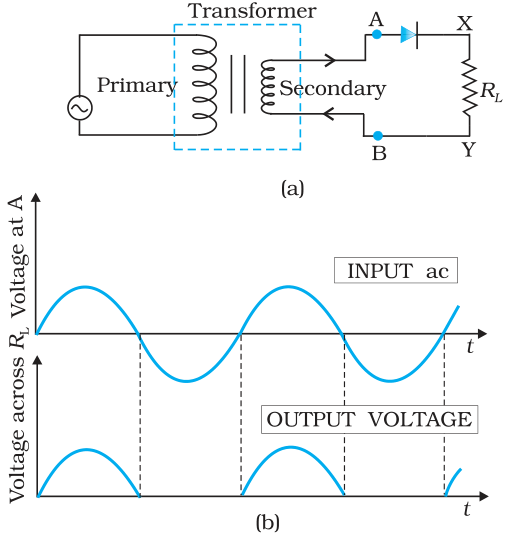
The correct answer is Option (3) → Half Wave Rectifier
A diode conducts only when it is forward biased. In a half-wave rectifier a single diode conducts during one half of each input cycle and blocks the other half. The output is:
\( \text{unidirectional}: \text{the current always flows in one direction} \)
\( \text{pulsating}: \text{its value rises and falls within each half cycle} \)
\( \text{intermittent}: \text{it is zero for every alternate half cycle} \)
Why the other options are incorrect
Option (1) Battery Eliminator — Incorrect. A battery eliminator converts ac mains into a steady dc supply using a rectifier, a filter and usually a regulator; its output is not intermittent.
Option (2) Full Wave Rectifier — Incorrect. A full-wave rectifier gives pulsating output in both half cycles, with no gaps, so it is not intermittent.
Option (4) Alternator — Incorrect. An alternator is an ac generator; it converts mechanical energy into ac, not ac into unidirectional output.
NCERT (2026-27):
Application of Junction Diode as a Rectifier – “… If an alternating voltage is applied across a diode in series with a load, a pulsating voltage will appear across the load only during the half cycles of the ac input during which the diode is forward biased. Such rectifier circuit, … is called a half-wave rectifier. … Therefore, in the positive half-cycle of ac there is a current through the load resistor \( R_L \) and we get an output voltage, as shown in …, whereas there is no current in the negative half-cycle. … Thus, the output voltage, though still varying, is restricted to only one direction and is said to be rectified.”