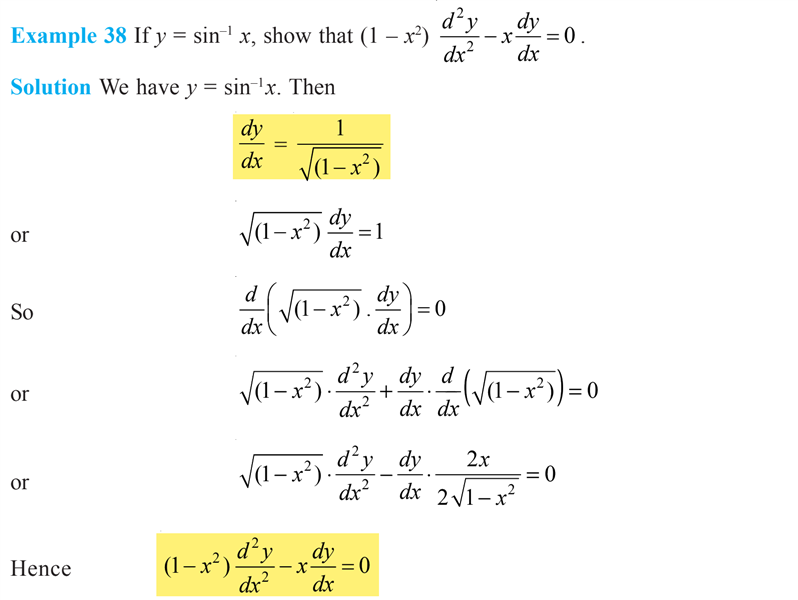
If \( y=\sin^{-1}x \), then \( (1-x^2)\displaystyle\frac{d^2y}{dx^2} \) is equal to :
Answer & explanation
Correct answer: option 4
The correct answer is Option (4) → \( \displaystyle\frac{x}{\sqrt{1-x^2}} \)
Differentiating twice, with the chain rule on the power \( (1-x^2)^{-1/2} \):
\( \displaystyle \frac{dy}{dx}=\frac{1}{\sqrt{1-x^2}}=(1-x^2)^{-1/2} \)
\( \displaystyle \frac{d^2y}{dx^2}=-\frac{1}{2}(1-x^2)^{-3/2}(-2x) \)
\( \displaystyle =\frac{x}{(1-x^2)^{3/2}} \)
Multiplying by \( 1-x^2 \):
\( \displaystyle (1-x^2)\frac{d^2y}{dx^2}=\frac{x(1-x^2)}{(1-x^2)^{3/2}} \)
\( \displaystyle =\frac{x}{\sqrt{1-x^2}} \)
NCERT (2026-27 edition):
Second Order Derivative