
CUETMOCK
  • Pricing
  • Mentors
Log inStart freeStart free mocks→

First test, then trust

Try a free CUET mock test.

Join 5,00,000+ students who rehearsed exam day on the exact NTA screen before sitting CUET. On the web and on Android.

Start free mocks →Get the Android app
CUETMOCK

India's #1 CUET Mock Test Platform. Original NCERT-based questions on the exact NTA exam screen — trusted by 5,00,000+ students since CUET 2022.

Get it onGoogle PlayScan to download the CUETMOCK app

Mock tests

  • CUET mock test series
  • Browse all papers
  • Commerce mocks
  • Humanities (Arts) mocks
  • Science mocks
  • Languages & GAT mocks
  • Free practice questions
  • Pricing

Resources

  • CUET exam guide
  • CUET syllabus
  • Universities accepting CUET
  • Expert blogs
  • News & notifications
  • Webinars & counselling
  • CUET score calculator
  • How we estimate your rank
  • FAQs

Company

  • About us
  • Our leadership & team
  • Our toppers
  • Mentors
  • For schools
  • Contact us
  • Terms
  • Privacy
  • Refund policy

Talk to us

+91 7696 6630 56info@cuetmock.comWhatsApp us

Our other platforms

  • JEE Mock — For IIT-JEE aspirants
  • NEET Mock — For NEET aspirants

Newsletter

Exam updates, study material and offers — no spam.

© 2026 NYC Ventures Pvt. Ltd.

701-702, Royal Business Park, Zirakpur, Punjab - 140603

  • Terms of use
  • Privacy policy
  • Refund policy
  • Contact us

iCUETMOCK is an independent preparation platform, not affiliated with the National Testing Agency (NTA). Always check exam details on the official NTA website.

  • Home
  • Mock tests
  • CUET guide
  • Pricing
  • Log in
Home/Practice questions/Physics
PhysicsCurrent Electricity

Correct temperature dependence of Resistivity of copper ( ρ ) is show…

Correct temperature dependence of Resistivity of copper (\( \rho \)) is shown by

Answer & explanation+

Correct answer: option 1

The correct answer is Option (1)
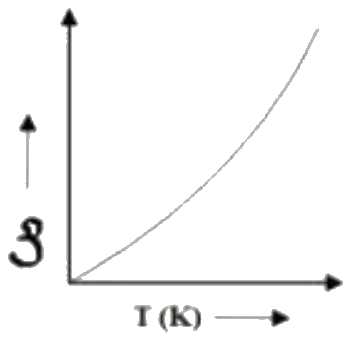
Figure for option 1

Copper is a metal. When it is heated, its ions vibrate more, the electrons collide more often and the relaxation time \( \tau \) falls, so the resistivity \( \rho = m/(ne^{2}\tau) \) increases with temperature.

    \( \displaystyle \rho_T = \rho_0\left[1 + \alpha\,(T - T_0)\right], \quad \alpha \gt 0 \)

Over a wide range the rise is not exactly linear: the curve bends upward, as in Option (1).

NCERT (2026-27):
Temperature Dependence of Resistivity – “… For metals, α is positive. The relation of Eq. (3.26) implies that a graph of ρT plotted against T would be a straight line. At temperatures much lower than 0°C, the graph, however, deviates considerably from a straight line (Fig. 3.8).”
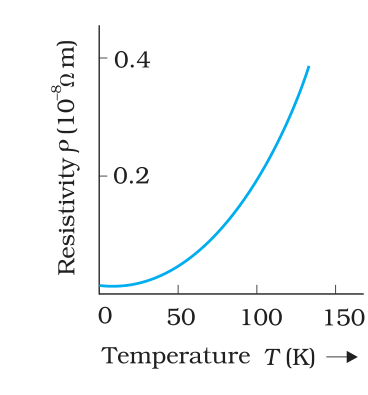
Textbook figure

Advertisement

Practise more on Current Electricity

Chapter-wise mocks on the real NTA exam screen, with solutions and your rank. Your first mocks are free.

Start free mocks →

Advertisement

Next questions

  1. If 200 MeV energy is released in the fission of a single nucleus of uranium-235, how many fissions per second will produce a power of 32 kW?Physics · Nuclei
  2. Performance of 1800 students in grades has been shown in the following pie chart. How many students have got either grade D or grade E ?General Aptitude Test · Quantitative Reasoning
  3. The monthly expenses of all the households of a district have mean μ = Rs. 12,000 and standard deviation σ = Rs. 2,000. A random sample of…Applied Maths. Section B2 · Inferential Statistics
  4. Given below are four sentences. Choose the one which is grammatically correct:English · Grammar: Determiner
  5. After selling 72 articles a man earns a profit equals to selling price of 9 articles. Find the profit %.General Aptitude Test · Numerical Ability
  6. Increasing sales by 15% is an example of which of the following?Business Studies · Planning
  7. Th general solution of the differential equation dy/dx+√((1-y^2)/(1-x^2))=0 isMaths. Section A · Differential Equations
  8. 'मौन' का विलोम शब्द हैHindi · Antonyms
  9. Match List I with List II List I List II A.Second order reaction I. s^-1 B. Fourth order reaction II. mol^-2L^2s^-1 C. First order reaction…Chemistry · Physical: Chemical Kinetics
  10. ∫ e^x(x^2 + 4x + 3) dx is equal to (where C is an arbitrary constant)Applied Maths. Section B2 · Calculus