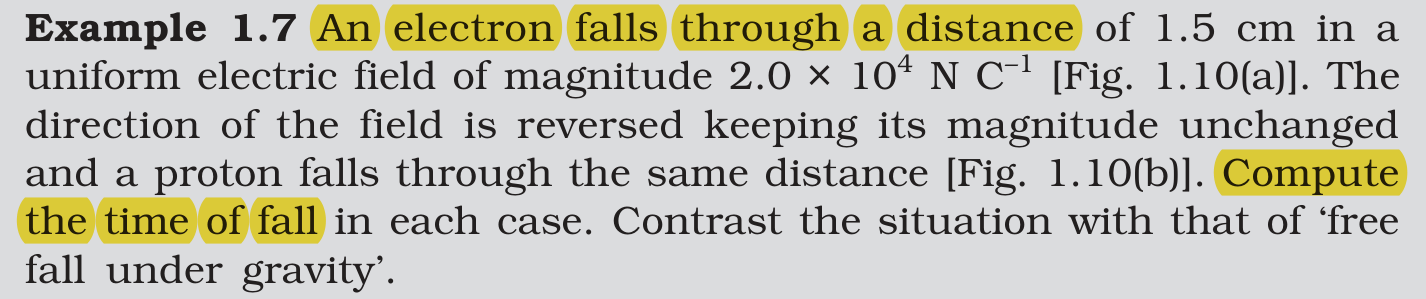
An electron initially at rest falls through a distance of 1.6 m in a uniform electric field of magnitude \( 2\times10^{4} \) N C\( ^{-1} \) directed vertically upwards. Time taken by the electron during the fall is
(Take \( m_{e}\simeq 9\times10^{-31} \) kg and neglect effect of gravity)
Answer & explanation
Correct answer: option 2
The correct answer is Option (2) → \( 3\times10^{-8}\,\mathrm{s} \)
The electron moves under a constant electric force \( F = eE \), so it has a uniform acceleration and starts from rest. The field points upwards, so the force on the negative electron points downwards, which is why it “falls”.
\( e = 1.6\times10^{-19}\,\mathrm{C} \)
\( E = 2\times10^{4}\,\mathrm{N\,C^{-1}} \)
\( m_e = 9\times10^{-31}\,\mathrm{kg} \)
\( s = 1.6\,\mathrm{m} \)
\( \displaystyle a = \frac{eE}{m_e} = \frac{1.6\times10^{-19}\times2\times10^{4}}{9\times10^{-31}} = 3.56\times10^{15}\,\mathrm{m\,s^{-2}} \)
Starting from rest, \( s = \frac{1}{2}at^{2} \):
\( \displaystyle t = \sqrt{\frac{2s}{a}} = \sqrt{\frac{2s\,m_e}{eE}} = \sqrt{\frac{2\times1.6\times9\times10^{-31}}{1.6\times10^{-19}\times2\times10^{4}}} \)
\( \displaystyle t = \sqrt{9\times10^{-16}} = 3\times10^{-8}\,\mathrm{s} \)
Shortcut: Keeping the symbols until the end, \( t^{2} = 2s\,m_e/(eE) \): the factor 2 × 1.6 on top cancels 1.6 × 2 below, leaving \( t^{2} = 9\times10^{-31}/10^{-15} = 9\times10^{-16} \).
Note: NTA picked this question from an NCERT (2026-27) example and changed the figures. Do not ignore NCERT while practising numericals.
NCERT (2026-27):
Physical Significance of Electric Field – …