The order of basic strengths of 1°, 2° and 3° amines in gaseous phase depends on
Answer & explanation
Correct answer: option 4
The correct answer is Option (4) → Inductive effect only.
An amine is basic because the lone pair on nitrogen can accept a proton. Its basic strength depends on the medium:
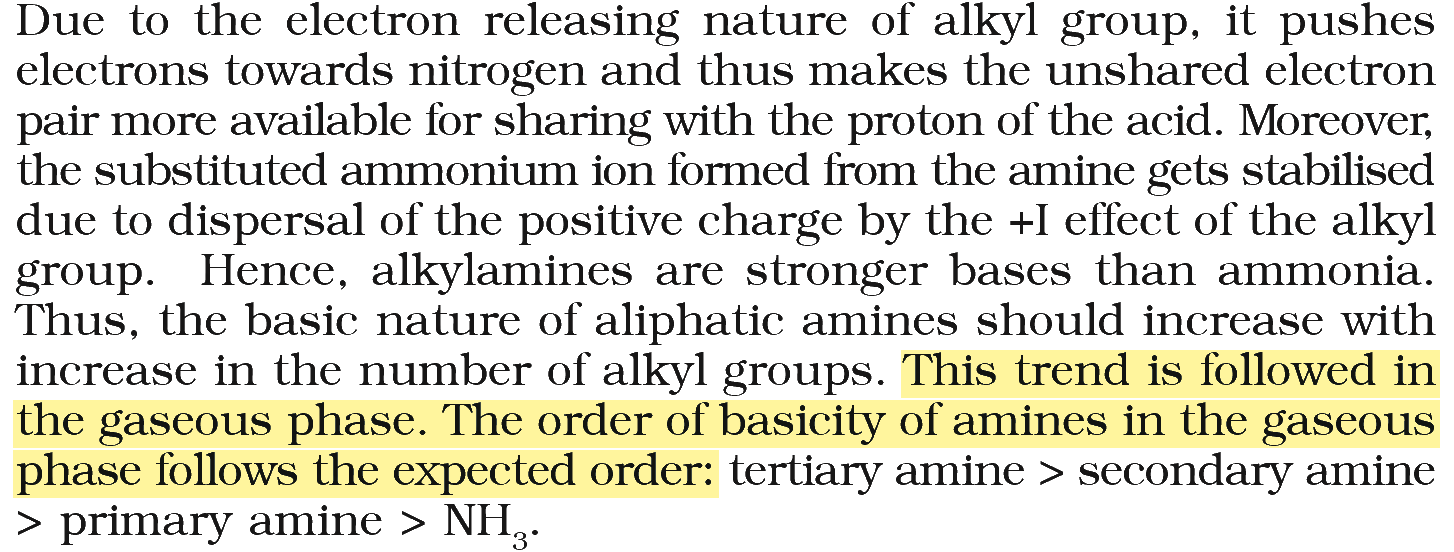
In the gaseous phase there are no solvent molecules, so the only factor is the +I (inductive) effect of the alkyl groups, which pushes electrons towards nitrogen. More alkyl groups mean a stronger base: 3° > 2° > 1° > \( \ce{NH3} \).
In water, the inductive effect acts together with solvation of the protonated amine by hydrogen bonding and steric hindrance to that hydrogen bonding, so the order changes, e.g. \( \ce{(C2H5)2NH} \) > \( \ce{(C2H5)3N} \) > \( \ce{C2H5NH2} \) > \( \ce{NH3} \).
So in the gaseous phase the order of basic strength depends on the inductive effect only.
Why the other options are incorrect
Option (1) Inductive effect and steric hindrance — Incorrect. Steric hindrance matters in water, where it hinders the hydrogen bonding that stabilises the protonated amine; in the gas phase there is no such solvation.
Option (2) Inductive effect and solvation effect — Incorrect. This describes the aqueous phase; there is no solvent in the gaseous phase.
Option (3) Solvation effect only — Incorrect. Solvation is absent in the gaseous phase, and even in water it never acts alone.
NCERT (2026-27 edition):
Structure-Basicity Relationship of Amines – …