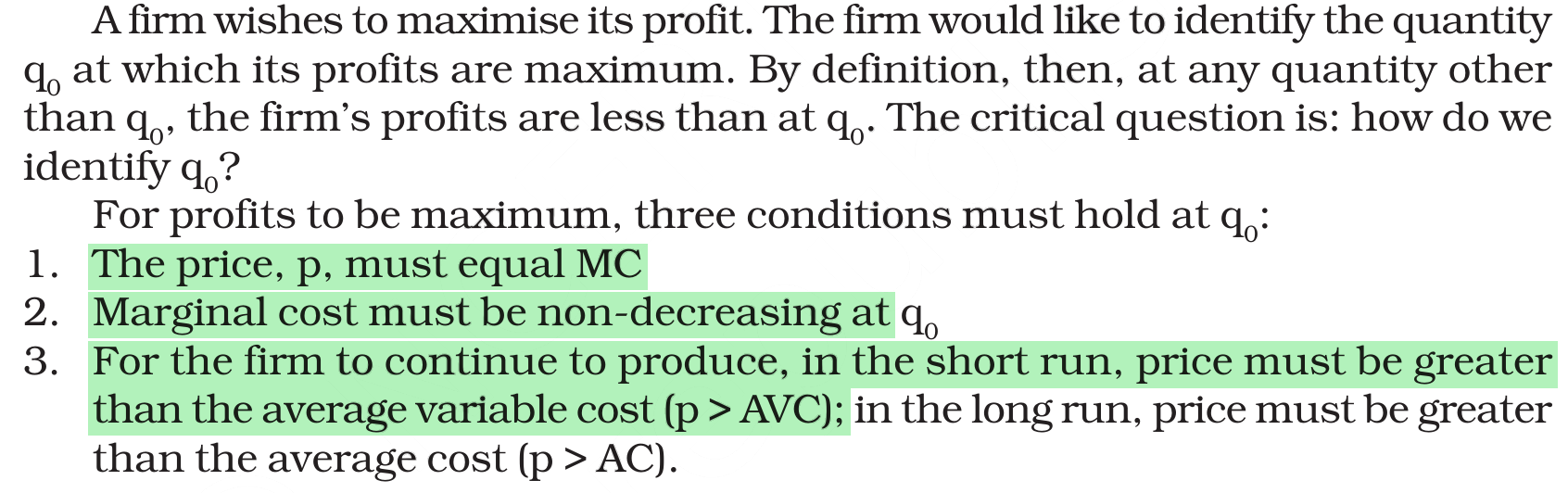
A positive level of output at which a firm’s profit is maximised must hold some conditions, Identify those conditions from the following:
A. The price must equal to marginal cost.
B. Marginal cost must be non-decreasing.
C. Price must be greater than or equal to the average variable cost.
D. The price should less than marginal cost.
Select the correct option from the following:
Answer & explanation
Correct answer: option 1
The correct answer is Option (1) → A, B and C only
A firm chooses the output that gives it the largest profit, the gap between its total revenue and its total cost. It keeps adding units as long as one more unit adds more to revenue (its marginal revenue) than to cost (its marginal cost). For a perfectly competitive firm, which sells every unit at the given market price, marginal revenue is the price itself. So a positive output maximises profit in the short run only if three conditions hold together:
Price equals marginal cost (p = SMC): before this output one more unit still adds to profit; beyond it, one more unit cuts profit.
Marginal cost is not falling at that output: on a falling stretch of SMC, producing a little more would add more to revenue than to cost.
Price covers average variable cost (p ≥ AVC): otherwise the firm loses less by shutting down and bearing only its fixed cost.
Taking the statements one by one:
A. The price must equal to marginal cost. Correct. This is the first condition: for a price-taking firm marginal revenue is the price, so profit is highest where p = SMC.
B. Marginal cost must be non-decreasing. Correct. If SMC were still falling where it equals the price, the next unit would cost less than it brings in, so profit could be raised further; at the profit-maximising output SMC must not be falling.
C. Price must be greater than or equal to the average variable cost. Correct. If price fell below AVC, the firm would not even recover its wages and raw materials and would lose less by shutting down, so a firm producing a positive output must have p ≥ AVC.
D. The price should less than marginal cost. Incorrect. If price is below marginal cost, the last unit adds more to cost than to revenue, so cutting output would raise profit. Profit is maximum where price equals marginal cost, not where it is below it.
Note: A same/similar question was asked in CUET (UG) in the papers below.
| 2026 | 2025 | 2024 | 2023 | 2022 |
| 19-05 S2 24-05 S1* | 30-05 S2* | – | – | – |
* A similar question.
NCERT: Introductory Microeconomics — Chapter 4: The Theory of the Firm under Perfect Competition (2025-26)
|