On the death of a partner, his share of loss in the firm till the date of his death is transferred to:
Answer & explanation
Correct answer: option 4
The correct answer is Option (4) → Credit of Profit & Loss Suspense Account
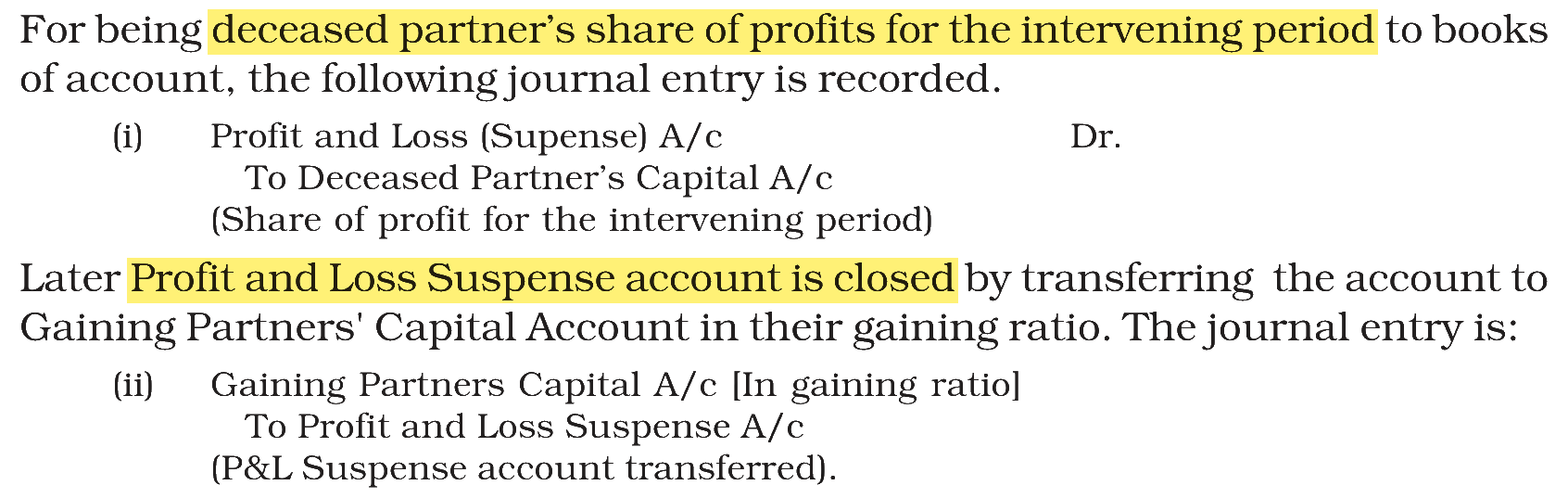
A partner may die at any time during the year, but the books are closed only at the year end. So his share of profit or loss from the last balance sheet date to the date of death is worked out on an agreed basis and brought into the books through the Profit and Loss Suspense Account, without closing the books midway.
For a share of profit, the firm owes the deceased partner more, so his capital account is credited and the suspense account is debited. A share of loss works the other way round: it reduces what is due to him, so
Deceased Partner’s Capital A/c is debited with his share of loss, and
Profit and Loss Suspense A/c is credited.
The suspense account is later closed by transferring it to the capital accounts of the gaining partners in their gaining ratio.
Why the other options are incorrect
Option (1) Debit of Profit & Loss Account — Incorrect. The Profit and Loss Account is prepared only when the books are closed at the year end. The deceased partner’s share for part of the year is recorded without closing the books, through the suspense account.
Option (2) Credit of Profit & Loss Account — Incorrect. For the same reason, the Profit and Loss Account is not used, and a credit would in any case suit a share of profit transferred, not a loss charged to him.
Option (3) Debit of Profit & Loss Suspense Account — Incorrect. This is the entry for a share of profit. A share of loss reverses it, so the suspense account is credited.
NCERT (2026-27 edition):
NCERT (2026-27 edition):
|