Coordination Compounds
Alfred Werner (1866-1919), a Swiss chemist was the first to formulate his ideas about the structures of coordination compounds. He prepared and characterised a large number of coordination compounds and studied their physical and chemical behaviour by simple experimental techniques. Werner proposed the concept of a primary valence and a secondary valence for a metal ion. The formulas and names adopted for coordination entities are based on the recommendations of the International Union of Pure and Applied Chemistry (IUPAC). Many approaches have been put forth to explain the nature of bonding in coordination compounds viz. Valence Bond Theory (VBT), Crystal Field Theory (CFT), Ligand Field Theory (LFT) and Molecular Orbital Theory (MOT). The Valence Bond Theory (VBT) explains with reasonable success, the formation, magnetic behaviour and geometrical shapes of coordination compounds. It, however, fails to provide a quantitative interpretation of magnetic behaviour and has nothing to say about the optical properties of these compounds. The Crystal Field Theory (CFT) to coordination compounds is based on the effect of different crystal fields (provided by the ligands taken as point charges), on the degeneracy of d orbital energies of the central metal atom/ion. The splitting of the d orbitals provides different electronic arrangements in strong and weak crystal fields. The treatment provides for quantitative estimations of orbital separation energies, magnetic moments and spectral and stability parameters. However, the assumption that ligands constitute point charges creates many theoretical difficulties.
Write down the IUPAC name of the given coordination compounds:
a. Hg[Co(SCN)4]
b. K3[Al(C2O4)3]
Answer & explanation
Correct answer: option 2
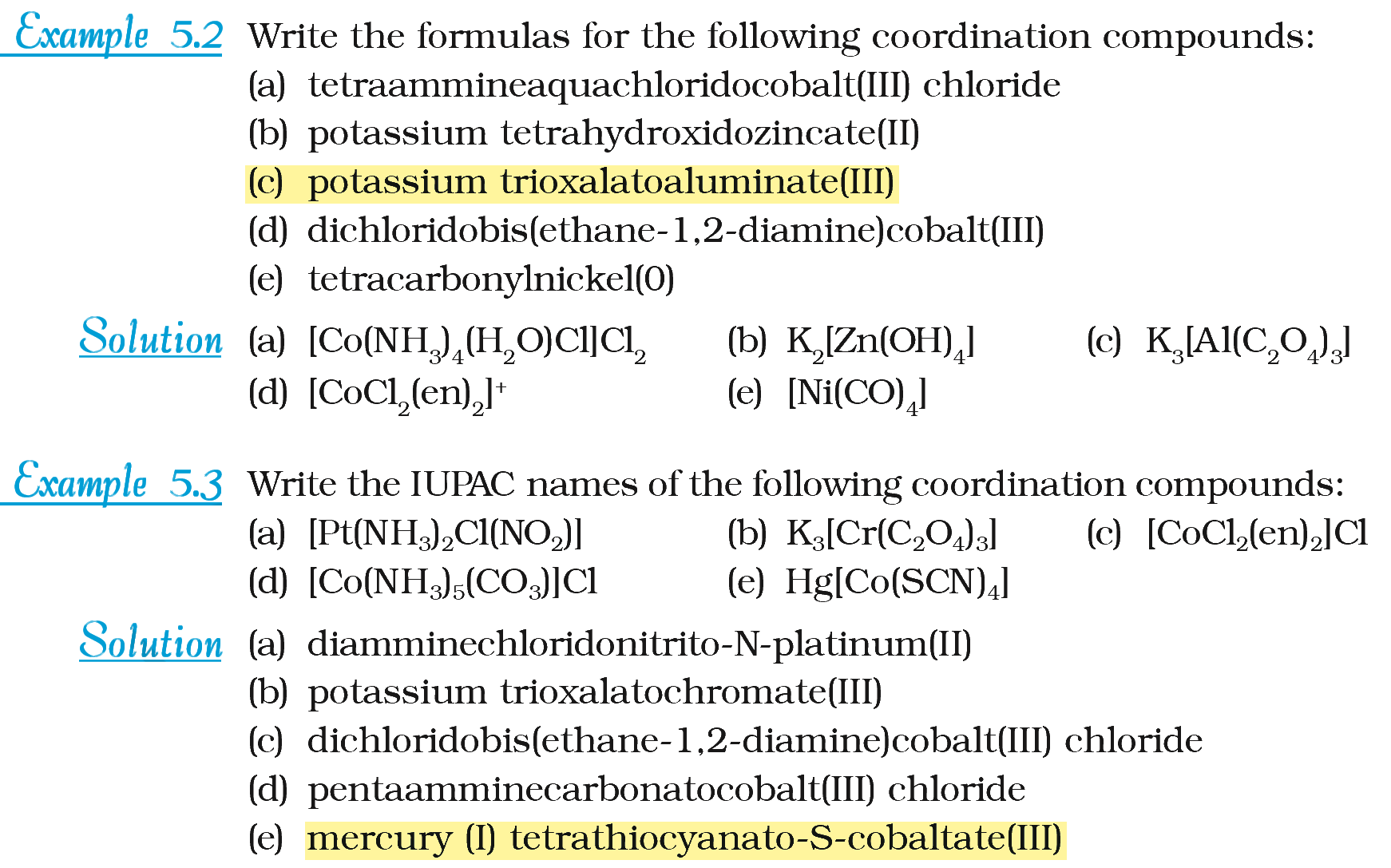
The correct answer is Option (2) → a. Mercury (I) tetrathiocyanato-S-cobaltate (III) b. Potassium trioxalatoaluminate (III)
IUPAC rules for naming coordination compounds:
The cation is named first, then the anion.
Ligands are named before the metal. An anionic ligand’s name ends in -o: oxalato (\( \ce{C2O4^{2-}} \)), thiocyanato (\( \ce{SCN^{-}} \)). For \( \ce{SCN^{-}} \) the donor atom is shown: thiocyanato-S when it binds through sulphur.
When the complex is an anion, the metal name ends in -ate (cobaltate, aluminate), followed by its oxidation state in Roman numerals.
(a) Hg[Co(SCN)4]: with mercury as Hg(I), the complex anion is \( \ce{[Co(SCN)4]^{-}} \):
\( \displaystyle x+4(-1)=-1\quad\Rightarrow\quad x=+3 \)
The four \( \ce{SCN^{-}} \) ligands bind through sulphur, so the name is mercury(I) tetrathiocyanato-S-cobaltate(III).
(b) K3[Al(C2O4)3]: each oxalate is 2−, and the three potassium ions give +3:
\( \displaystyle 3(+1)+x+3(-2)=0\quad\Rightarrow\quad x=+3 \)
So (b) is potassium trioxalatoaluminate(III).
Why the other options are incorrect
Option (1) — Incorrect. Mercury(II) with cobalt(III) adds up to +5, which cannot balance four 1− ligands.
Option (3) — Incorrect. “tetrathiocyanate” uses the ion’s name instead of the ligand name (thiocyanato), and aluminium is +3, not +2.
Option (4) — Incorrect. In part (b) aluminium is given as +2, but in \( \ce{K3[Al(C2O4)3]} \) it is +3, and the ligand is written “oxalate” instead of “oxalato”.
Note: The NCERT book (Example 5.3) names Hg[Co(SCN)4] as mercury (I) tetrathiocyanato-S-cobaltate(III), and the answer follows it. The compound actually contains Hg2+ and the [Co(SCN)4]2− ion (mercury(I) exists as Hg22+, not as Hg+), so its name should read mercury(II) tetrathiocyanato-S-cobaltate(II).
NCERT (2026-27 edition):
Naming of Mononuclear Coordination Compounds – …