Electrochemical Cell
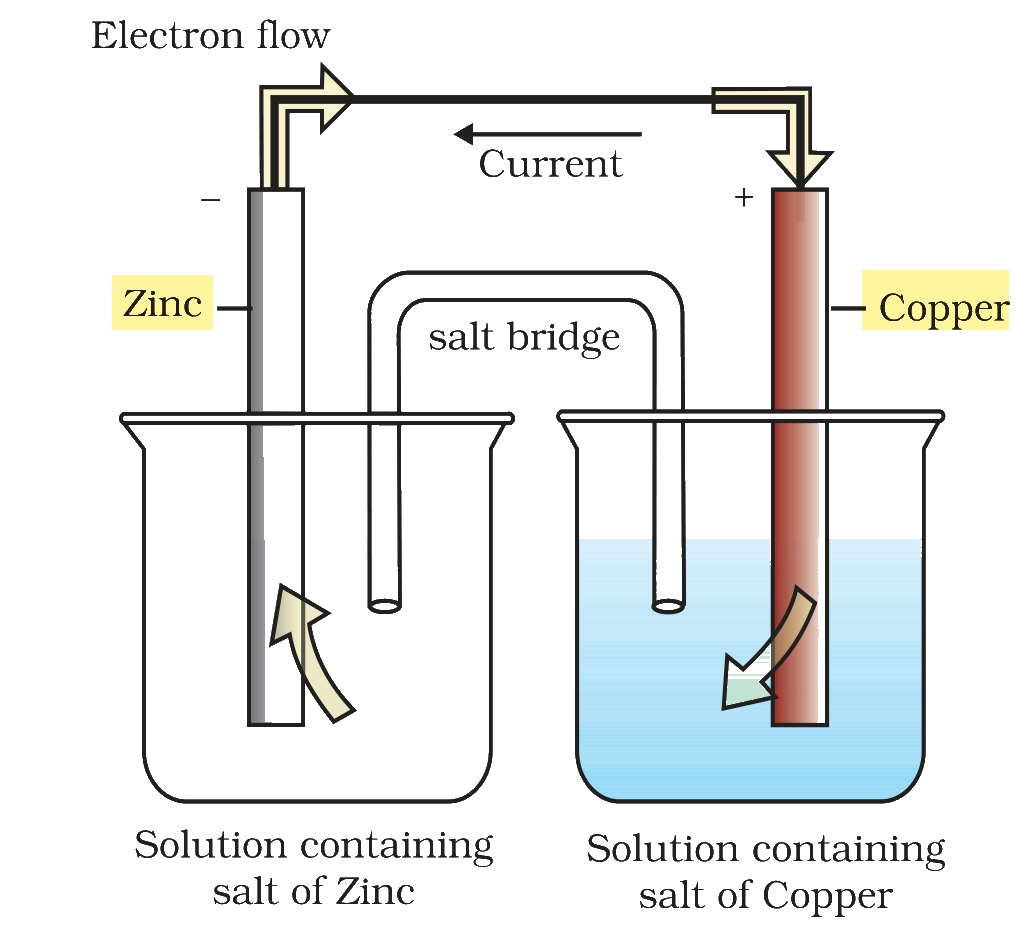
A galvanic cell is an electrochemical cell that converts chemical energy of a spontaneous redox reaction into electrical energy. It consists of two half cells, the half cell in which oxidation takes place is called as anode and the other half cell where reduction takes place is called as cathode. Anode has negative potential with respect to the solution whereas cathode has positive potential with respect to the solution. As soon as the switch is in the on position, the electrons flow from the negative electrode to positive electrode and the direction of current flow is opposite to that of electron flow. The potential difference between two electrodes is called cell potential and is measured in volts. When no current is drawn from the cell, then cell potential is termed as cell electromotive force. The cell potential is given by Nernst equation.
In the Daniell cell,
Answer & explanation
Correct answer: option 1
The correct answer is Option (1) → Anode-Zn is dipped in ZnSO4 Solution; Cathode-Cu is dipped in CuSO4 solution
The Daniell cell is a galvanic cell made of two half cells joined by a salt bridge. Each metal rod dips into a solution of its own ions. Which rod is the anode is decided by the reduction potentials:
E°(\( \ce{Zn^{2+}} \)/Zn) = −0.76 V E°(\( \ce{Cu^{2+}} \)/Cu) = +0.34 V
Zinc has the more negative potential, so it is oxidised and is the anode (negative); \( \ce{Cu^{2+}} \) is reduced on the copper rod, the cathode (positive):
\( \displaystyle \text{Anode: }\ce{Zn(s) -> Zn^2+(aq) + 2e^-} \)
\( \displaystyle \text{Cathode: }\ce{Cu^2+(aq) + 2e^- -> Cu(s)} \)
\( \displaystyle \ce{Zn(s)}|\ce{ZnSO4(aq)}||\ce{CuSO4(aq)}|\ce{Cu(s)} \)
So in the Daniell cell the zinc anode dips in ZnSO4 solution and the copper cathode dips in CuSO4 solution.
Why the other options are incorrect
Option (2) Anode-Cu is dipped in CuSO4 solution; Cathode-Zn is dipped in ZnSO4 Solution — Incorrect. The electrodes are reversed; copper, with the higher E°, is the cathode.
Option (3) Anode-Zn is dipped in CuSO4 solution; Cathode-Cu is dipped in ZnSO4 Solution — Incorrect. Zinc dipped directly in \( \ce{CuSO4} \) would displace copper on its surface, and no current would flow through the wire.
Option (4) Anode-Cu is dipped in ZnSO4 solution; Cathode-Zn is dipped in CuSO4 solution — Incorrect. Both the roles of the electrodes and the solutions are wrong.
NCERT (2026-27 edition):
Electrochemical Cells – …