Among the following, the correct option is
Answer & explanation
Correct answer: option 4
The correct answer is Option (4) → A mixture of acetone and chloroform forms a non-ideal solution with negative deviation.
A solution obeys Raoult’s law when the attraction between unlike molecules (A–B) is the same as between like molecules (A–A and B–B). A non-ideal solution deviates from it:
Positive deviation: A–B attractions are weaker. Molecules escape more easily, so the vapour pressure is higher than expected; ΔmixH is positive and ΔmixV is positive.
Negative deviation: A–B attractions are stronger, often because of new hydrogen bonds. The vapour pressure is lower than expected; ΔmixH is negative and ΔmixV is negative.
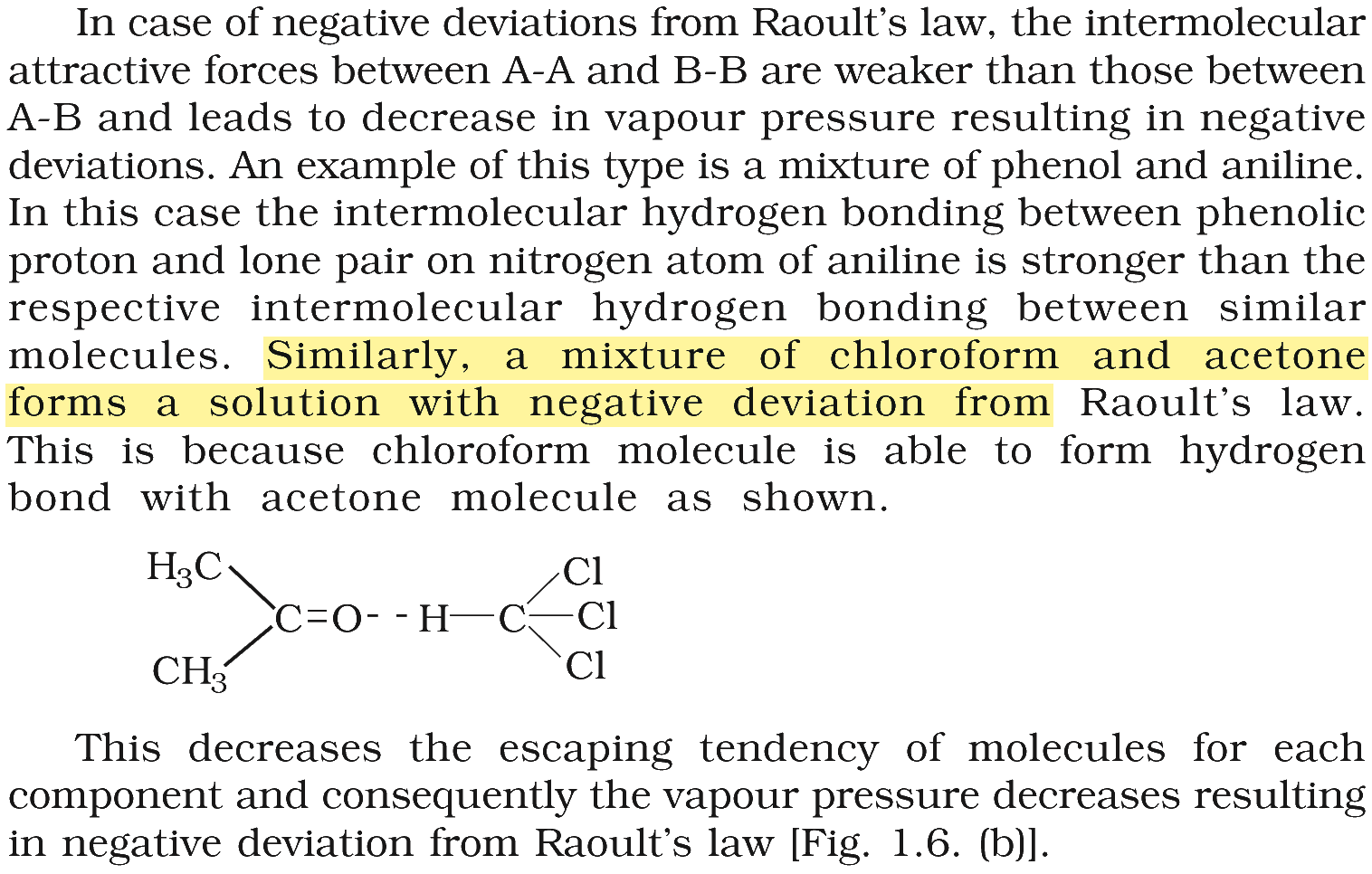
In a mixture of acetone and chloroform, the hydrogen of \( \ce{CHCl3} \) (made slightly positive by three chlorine atoms) forms a hydrogen bond with the oxygen of acetone:
\( \ce{Cl3C-H} \)…\( \ce{O=C(CH3)2} \)
These A–B attractions are stronger than those in the pure liquids, so the solution shows negative deviation.
Why the other options are incorrect
Option (1) A mixture of ethanol and acetone form a non-ideal solution with negative deviation. — Incorrect. Acetone molecules come between ethanol molecules and break some of their hydrogen bonds, so this mixture shows positive deviation.
Option (2) A mixture of acetone and carbon disulfide forms a non-ideal solution with negative deviation. — Incorrect. Non-polar \( \ce{CS2} \) weakens the dipole-dipole attraction between acetone molecules, so this mixture shows positive deviation.
Option (3) A mixture of phenol and aniline forms a non-ideal solution with a positive deviation. — Incorrect. The O–H of phenol forms a hydrogen bond with the nitrogen of aniline, so this mixture shows negative deviation.
NCERT (2026-27 edition):
Non-ideal Solutions – …