
Read the passage and answer the following questions:
The initial clue about the genetic/chromosomal mechanism of sex determination can be traced back to some of the experiments carried out in insects. Henking (1891) could trace a specific nuclear structure all through spermatogenesis in a few insects, and it was also observed by him that 50 per cent of the sperm received this structure after spermatogenesis, whereas the other 50 per cent sperm did not receive it. Henking gave a name to this structure as the X body but he could not explain its significance. Further investigations by other scientists led to the conclusion that the 'X body' of Henking was in fact a chromosome and that is why it was given the name X-chromosome. Due to the involvement of the X-chromosome in the determination of sex, it was designated to be the sex chromosome, and the rest of the chromosomes were named as autosomes.
Which of the following correctly describes sex determination in birds?
Answer & explanation
Correct answer: option 1
The correct answer is Option (1) → Females have one Z and one W chromosome, and the total number of chromosomes is the same in both sexes.
In the XO and XY types the male makes two kinds of gametes (male heterogamety). Birds show the opposite: the female makes two kinds of gametes, so it is called female heterogamety. To keep the two systems apart, the sex chromosomes of birds are called Z and W.
Option (1) Females have one Z and one W chromosome, and the total number of chromosomes is the same in both sexes. — Correct. The female bird has two different sex chromosomes, one Z and one W, and the male has a pair of Z-chromosomes. Since each sex has two sex chromosomes besides the same autosomes, the total number of chromosomes is the same in both.
Option (2) Females have one Z and one W chromosome, and the males have one chromosome fewer than the females. — Incorrect. The female is ZW, but the male is ZZ, so both sexes have the same number of chromosomes. A male with one chromosome fewer than the female is seen in the XO type, as in grasshopper.
Option (3) Males have one Z and one W chromosome, and the females have a pair of Z-chromosomes. — Incorrect. This turns the two sexes round. In birds the male has a pair of Z-chromosomes and it is the female that carries one Z and one W.
Option (4) Males have one Z and one W chromosome, and the total number of chromosomes is the same in both sexes. — Incorrect. The second part is right, but the male is ZZ, not ZW. A heterogametic male (two kinds of gametes) is found in the XY type of humans and Drosophila, not in birds.
NCERT Extract:
Sex Determination – “In some other organisms, e.g., birds, a different mechanism of sex determination is observed (Figure 4.12 c). In this case the total number of chromosome is same in both males and females. But two different types of gametes in terms of the sex chromosomes, are produced by females, i.e., female heterogamety. In order to have a distinction with the mechanism of sex determination described earlier, the two different sex chromosomes of a female bird has been designated to be the Z and W chromosomes. In these organisms the females have one Z and one W chromosome, whereas males have a pair of Z-chromosomes besides the autosomes.”
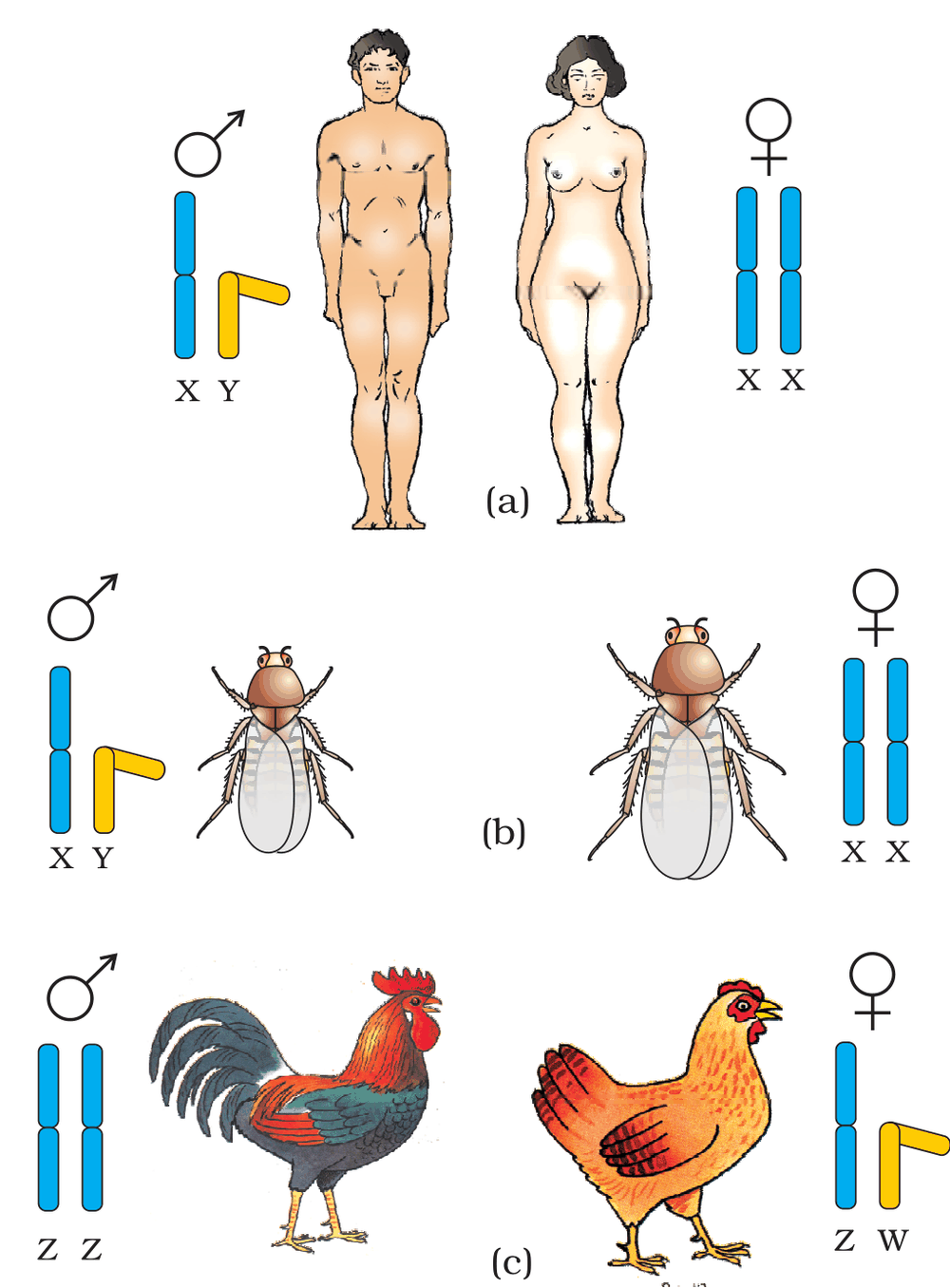
Figure 4.12 Determination of sex by chromosomal differences: (a,b) Both in humans and in Drosophila, the female has a pair of XX chromosomes (homogametic) and the male XY (heterogametic) composition; (c) In many birds, female has a pair of dissimilar chromosomes ZW and male two similar ZZ chromosomes