Arrange the following amines in increasing order of basicity in aqueous solution
(A) \( (CH_3)_2NH \)
(B) \( CH_3NH_2 \)
(C) \( (CH_3)_3N \)
(D) \( NH_3 \)
Choose the correct answer from the options given below.
Answer & explanation
Correct answer: option 4
The correct answer is Option (4) → (D), (C), (B), (A)
An amine is a base because the lone pair on nitrogen accepts a proton. In water three factors decide how strong a base it is:
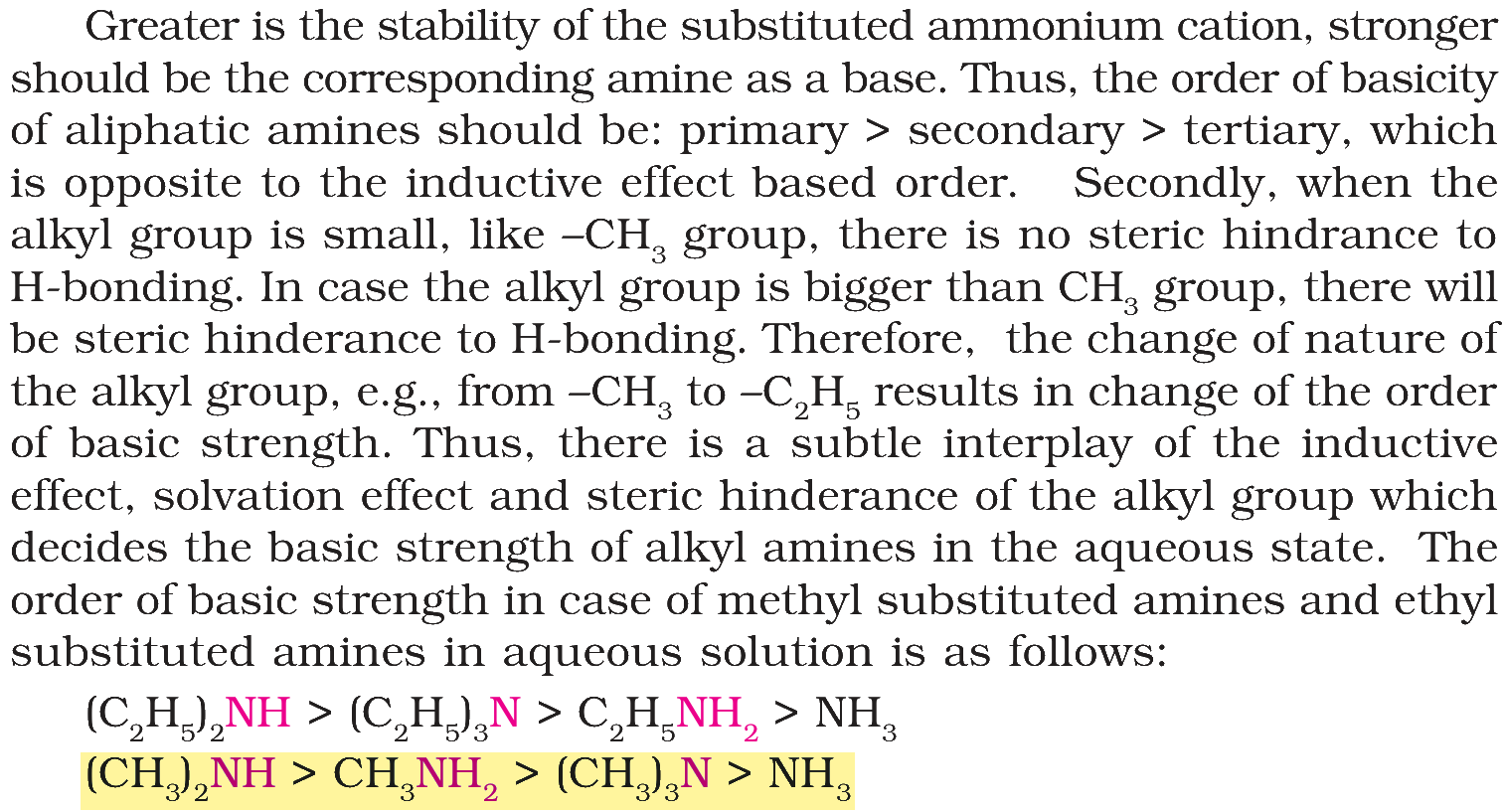
Inductive effect: alkyl groups push electrons (+I) towards nitrogen and make the lone pair more available. On this factor alone the order is 3° > 2° > 1° > \( \ce{NH3} \), which is the order found in the gas phase.
Solvation: the substituted ammonium ion formed is stabilised by hydrogen bonding with water. The more N–H bonds it has, the better it is solvated, so on this factor the order is 1° > 2° > 3°.
Steric factor: bulky groups around nitrogen hinder both the approach of the proton and the hydrogen bonding of the ion.
For the small methyl group the two main effects combine to give secondary > primary > tertiary, and every methyl amine is stronger than ammonia, whose nitrogen has no +I group:
\( \displaystyle \ce{(CH3)2NH} \gt \ce{CH3NH2} \gt \ce{(CH3)3N} \gt \ce{NH3} \)
The pKb values (smaller pKb, stronger base) agree: 3.27, 3.38, 4.22 and 4.75.
(A) \( \ce{(CH3)2NH} \): dimethylamine (2°), the strongest base.
(B) \( \ce{CH3NH2} \): methylamine (1°).
(C) \( \ce{(CH3)3N} \): trimethylamine (3°), poorly solvated.
(D) \( \ce{NH3} \): ammonia, the weakest base.
In increasing order of basicity:
\( \displaystyle \ce{NH3} \lt \ce{(CH3)3N} \lt \ce{CH3NH2} \lt \ce{(CH3)2NH} \)
Shortcut: Ammonia (D) is the weakest base in the list, and only Option (4) starts with (D).
NCERT (2026-27 edition):
Basic Character of Amines – …