
CUETMOCK
  • Pricing
  • Mentors
Log inStart freeStart free mocks→

First test, then trust

Try a free CUET mock test.

Join 5,00,000+ students who rehearsed exam day on the exact NTA screen before sitting CUET. On the web and on Android.

Start free mocks →Get the Android app
CUETMOCK

India's #1 CUET Mock Test Platform. Original NCERT-based questions on the exact NTA exam screen — trusted by 5,00,000+ students since CUET 2022.

Get it onGoogle PlayScan to download the CUETMOCK app

Mock tests

  • CUET mock test series
  • Commerce mocks
  • Humanities (Arts) mocks
  • Science mocks
  • Languages & GAT mocks
  • Free practice questions
  • Pricing

Resources

  • CUET exam guide
  • CUET syllabus
  • Universities accepting CUET
  • Expert blogs
  • News & notifications
  • Webinars & counselling
  • CUET score calculator
  • How we estimate your rank
  • FAQs

Company

  • About us
  • Our leadership & team
  • Our toppers
  • Mentors
  • For schools
  • Contact us
  • Terms
  • Privacy
  • Refund policy

Talk to us

+91 7696 6630 56info@cuetmock.comWhatsApp us

Our other platforms

  • JEE Mock — For IIT-JEE aspirants
  • NEET Mock — For NEET aspirants

Newsletter

Exam updates, study material and offers — no spam.

© 2026 NYC Ventures Pvt. Ltd.

701-702, Royal Business Park, Zirakpur, Punjab - 140603

  • Terms of use
  • Privacy policy
  • Refund policy
  • Contact us

iCUETMOCK is an independent preparation platform, not affiliated with the National Testing Agency (NTA). Always check exam details on the official NTA website.

  • Home
  • Mock tests
  • CUET guide
  • Pricing
  • Log in
Home/Practice questions/Chemistry
ChemistryOrganic: Amines

How do you differentiate between primary, secondary and tertiary amin…

How do you differentiate between primary, secondary and tertiary amines?

A. Reaction with Br2 water.
B. Reaction with sulfonamide.
C. Reaction with Hinsberg's reagent followed by alkali.
D. Reaction with acetic anhydride.

Choose the correct answer from the options given below:

Answer & explanation+

Correct answer: option 1

The correct answer is Option (1) → C only

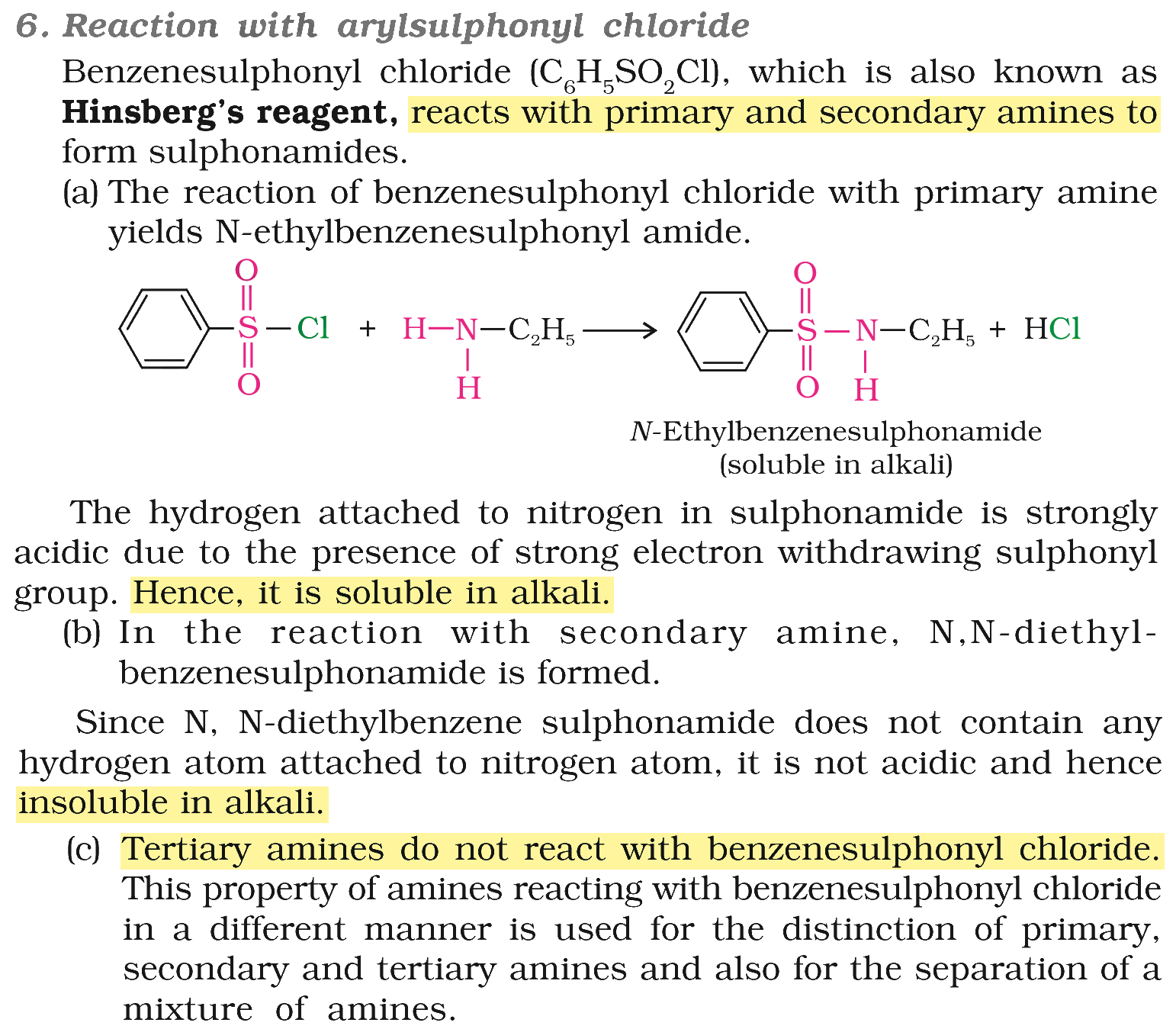
Hinsberg’s reagent, benzenesulphonyl chloride (\( \ce{C6H5SO2Cl} \)), reacts with an N–H bond of an amine, so the three classes of amines give three different results:

    \( \displaystyle \ce{C6H5SO2Cl + H2N-R -> C6H5SO2NH-R + HCl}\quad(1^{\circ}) \)

    \( \displaystyle \ce{C6H5SO2Cl + HNR2 -> C6H5SO2NR2 + HCl}\quad(2^{\circ}) \)

  • A. Reaction with \( \ce{Br2} \) water. — Incorrect. Aniline gives a white precipitate of 2,4,6-tribromoaniline. This tests for an activated aromatic ring, not for the class of an amine.

        \( \displaystyle \ce{C6H5NH2 + 3Br2} \xrightarrow{\ce{H2O}} \ce{C6H2Br3NH2 v + 3HBr} \)

  • B. Reaction with sulfonamide. — Incorrect. A sulphonamide is the product of Hinsberg’s test, not a reagent that reacts with amines.

  • C. Reaction with Hinsberg's reagent followed by alkali. — Correct. The 1° product dissolves in alkali, the 2° product does not, and the 3° amine does not react, so all three classes are told apart.

  • D. Reaction with acetic anhydride. — Incorrect. Both 1° and 2° amines are acylated, because both have an N–H bond, and only 3° amines fail to react, so 1° and 2° amines cannot be told apart.

        \( \displaystyle \ce{R-NH2 + (CH3CO)2O -> R-NHCOCH3 + CH3COOH} \)

NCERT (2026-27 edition):
Reaction with Arylsulphonyl Chloride
Textbook extract

Advertisement

Practise more on Organic: Amines

Chapter-wise mocks on the real NTA exam screen, with solutions and your rank. Your first mocks are free.

Start free mocks →

Advertisement

Next questions

  1. Which of the following does not cause land degradation?Geography · India-People and Economy: Geographical Perspective on selected issues and Problems
  2. The table shows the adult literacy rate in India for two groups, P and Q.Group1990200020112017–18P61.968.47982Q37.945.45966Which option cor…Economics · Indian Economic Development: Human Capital Formation in India
  3. If k be the kinetic energy and m the mass of a moving particle then the de-Broglie wavelength of the particle is :Physics · Dual Nature of Radiation and Matter
  4. Match the following in case of no agreement: A) Interest on partner's loan I) Not payable B) Interest on partner's drawing II) Debit to P &…Accountancy Part A · Accounting for Partnership
  5. Which salt is least likely to be found in minerals?Chemistry · Inorganic: General Principles and Processes of Isolation of Elements
  6. Select the most appropriate meaning of the given idiom. Be left in the lurchEnglish · Grammar: Idioms
  7. निम्नलिखित में से किस विकल्प में 'द्वंद्व समास' नहीं है?Hindi · समास
  8. Arrange the following events in the correct chronological order.A. UN-Pakistan Observer Mission.B. Proclamation of Independence by leaders…Political Science · Contemporary World Politics: Contemporary South Asia
  9. The Probability mass functions of Random variable X is : P(X=x) = (0.6)^x(0.4)^1-x; x=0, 1 The variance of X is :Applied Maths. Section B2 · Probability Distributions
  10. Arrange the wavelengths of the following radiations in the decreasing order: λ_visible,\ λ_X-rays,\ λ_radiowaves,\ λ_γ-raysPhysics · Electromagnetic Waves