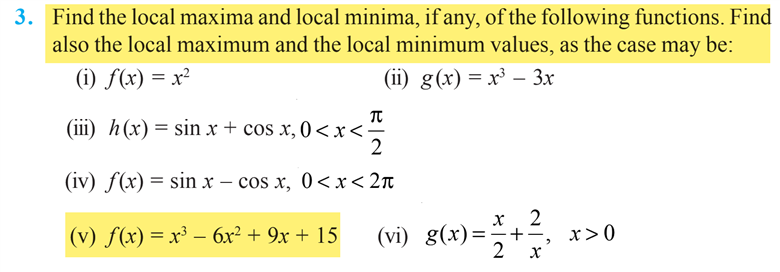
For \( f(x)=x^3-6x^2+9x+15 \), which of the following statements are TRUE?
(A) \( f'(x)=3x^2-12x+15 \) .
(B) The critical points are 3 and 1.
(C) \( x=1 \) is a point of local maxima.
(D) Local minimum value is 19.
Choose the correct answer from the options given below:
Answer & explanation
Correct answer: option 3
The correct answer is Option (3) → (B) and (C) only
Differentiating \( f(x)=x^3-6x^2+9x+15 \):
\( \displaystyle f'(x)=3x^2-12x+9 \)
\( \displaystyle =3(x^2-4x+3) \)
\( \displaystyle =3(x-1)(x-3) \)
\( \displaystyle f''(x)=6x-12 \)
The critical points are x = 1 and x = 3.
\( \displaystyle f''(1)=6-12=-6\lt 0 \)
\( \displaystyle f(1)=1-6+9+15=19 \)
\( \displaystyle f''(3)=18-12=6\gt 0 \)
\( \displaystyle f(3)=27-54+27+15=15 \)
So \( f'(x)=3x^2-12x+9 \), the critical points are 1 and 3, x = 1 is a local maximum (value 19) and x = 3 is a local minimum (value 15).
Checking the statements
(A) \( f'(x)=3x^2-12x+15 \) . — Incorrect. The term 9x differentiates to 9, so \( f'(x)=3x^2-12x+9 \).
(B) The critical points are 3 and 1. — Correct. \( f'(x)=3(x-1)(x-3)=0 \) at x = 1 and x = 3.
(C) \( x=1 \) is a point of local maxima. — Correct. \( f''(1)=-6\lt 0 \).
(D) Local minimum value is 19. — Incorrect. The local minimum value is f(3) = 15; 19 is the local maximum value f(1).
NCERT (2026-27 edition):
Maxima and Minima