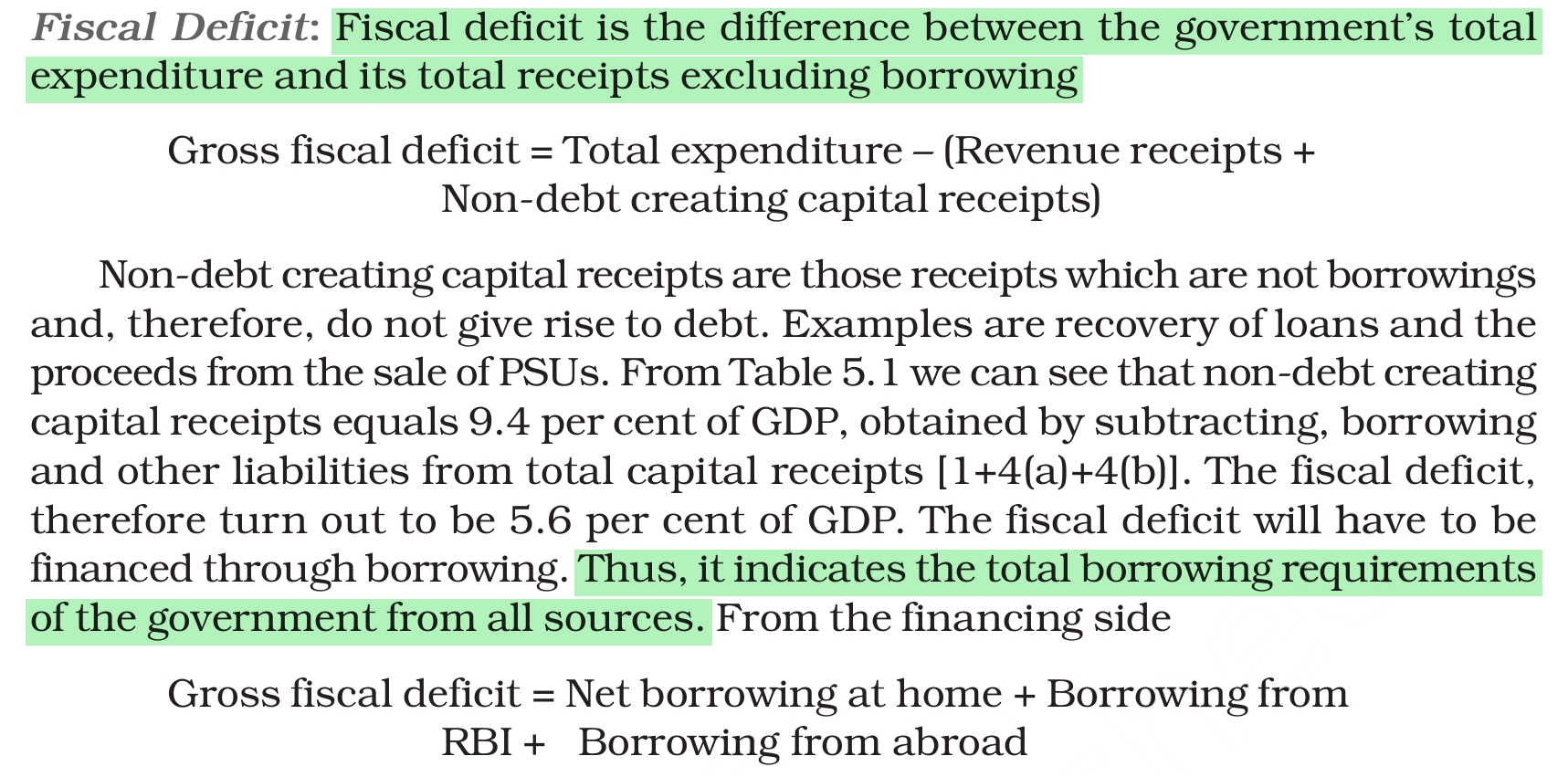
__________ is the difference between the government’s total expenditure and its total receipts excluding borrowing.
Answer & explanation
Correct answer: option 1
The correct answer is Option (1) → Fiscal deficit
When the government spends more than it receives, it has to borrow to fill the gap. Its receipts other than borrowing are its revenue receipts and its non-debt creating capital receipts, such as the recovery of loans and the sale of PSU shares. The gap between total expenditure and total receipts excluding borrowing is the amount it must borrow, the fiscal deficit:
Gross fiscal deficit = Total expenditure − (Revenue receipts + Non-debt creating capital receipts)
Why the other options are incorrect
Option (2) Revenue deficit — Incorrect. The revenue deficit is the excess of revenue expenditure over revenue receipts. It leaves out capital expenditure and capital receipts, so it is not the gap between total expenditure and total receipts.
Option (3) Primary deficit — Incorrect. The primary deficit is the fiscal deficit minus interest payments; it shows the borrowing needed for expenditure other than interest.
Option (4) Capital deficit — Incorrect. There is no such deficit among the measures of the budget.
NCERT: Introductory Macroeconomics — Chapter 5: Government Budget and the Economy (2025-26)
|