
Observe the figures I and II and answer the following questions.
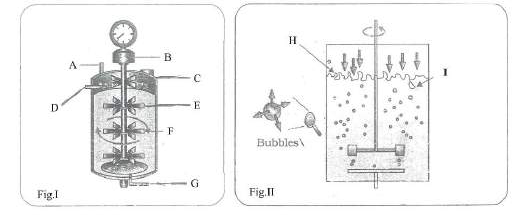
The parameters for optimal growth conditions of living cells in a bioreactor involve:
Answer & explanation
Correct answer: option 3
The correct answer is Option (3) → Temperature, pH, Vitamins, Oxygen, Salts
A bioreactor is a large vessel in which cells are grown to make a product. It must give the cells all the conditions they need at their best values.
Option (1) Temperature, Acids and Oxygen — Incorrect. It leaves out pH, salts and vitamins, and “acids” is not one of the conditions; the acidity is controlled as pH.
Option (2) Temperature, Vitamins, Salts — Incorrect. It leaves out pH and oxygen, which the bioreactor also controls.
Option (3) Temperature, pH, Vitamins, Oxygen, Salts — Correct. Together with the substrate, these are the optimum growth conditions NCERT lists.
Option (4) pH, Oxygen, Salts — Incorrect. pH, oxygen and salts are three of the conditions, but temperature and vitamins are missing. NCERT lists temperature, pH, substrate, salts, vitamins and oxygen as the optimum growth conditions, so this list is incomplete.
NCERT Extract:
Obtaining the Foreign Gene Product – “… Small volume cultures cannot yield appreciable quantities of products. To produce in large quantities, the development of bioreactors, where large volumes (100-1000 litres) of culture can be processed, was required. Thus, bioreactors can be thought of as vessels in which raw materials are biologically converted into specific products, individual enzymes, etc., using microbial plant, animal or human cells. A bioreactor provides the optimal conditions for achieving the desired product by providing optimum growth conditions (temperature, pH, substrate, salts, vitamins, oxygen).”