
CUETMOCK
  • Pricing
  • Mentors
Log inStart freeStart free mocks→

First test, then trust

Try a free CUET mock test.

Join 5,00,000+ students who rehearsed exam day on the exact NTA screen before sitting CUET. On the web and on Android.

Start free mocks →Get the Android app
CUETMOCK

India's #1 CUET Mock Test Platform. Original NCERT-based questions on the exact NTA exam screen — trusted by 5,00,000+ students since CUET 2022.

Get it onGoogle PlayScan to download the CUETMOCK app

Mock tests

  • CUET mock test series
  • Commerce mocks
  • Humanities (Arts) mocks
  • Science mocks
  • Languages & GAT mocks
  • Free practice questions
  • Pricing

Resources

  • CUET exam guide
  • CUET syllabus
  • Universities accepting CUET
  • Expert blogs
  • News & notifications
  • Webinars & counselling
  • CUET score calculator
  • How we estimate your rank
  • FAQs

Company

  • About us
  • Our leadership & team
  • Our toppers
  • Mentors
  • For schools
  • Contact us
  • Terms
  • Privacy
  • Refund policy

Talk to us

+91 7696 6630 56info@cuetmock.comWhatsApp us

Our other platforms

  • JEE Mock — For IIT-JEE aspirants
  • NEET Mock — For NEET aspirants

Newsletter

Exam updates, study material and offers — no spam.

© 2026 NYC Ventures Pvt. Ltd.

701-702, Royal Business Park, Zirakpur, Punjab - 140603

  • Terms of use
  • Privacy policy
  • Refund policy
  • Contact us

iCUETMOCK is an independent preparation platform, not affiliated with the National Testing Agency (NTA). Always check exam details on the official NTA website.

  • Home
  • Mock tests
  • CUET guide
  • Pricing
  • Log in
Home/Practice questions/Chemistry
ChemistryOrganic: Aldehydes, Ketones and Carboxylic Acids

Match List-I with List-II.List-I(Reaction)List-II(Reagent and conditi…

Match List-I with List-II.

List-I
(Reaction)
List-II
(Reagent and conditions)
(A) Aldol reaction of ethanal(I) Freshly prepared ammoniacal silver nitrate, warming
(B) Cannizzaro reaction of benzaldehyde(II) Dilute NaOH
(C) Conversion of benzaldehyde into m-nitrobenzaldehyde(III) \( \ce{HNO3}/\ce{H2SO4} \), 273–283 K
(D) Tollens’ test of an aldehyde(IV) Concentrated NaOH, heating

Choose the correct answer from the options given below:

Answer & explanation+

Correct answer: option 4

The correct answer is Option (4) → A-II, B-IV, C-III, D-I

The same base can start different reactions: its concentration and whether the aldehyde has an α-hydrogen decide whether an aldol or a Cannizzaro reaction takes place.

(A) Aldol reaction of ethanal — This matches (II) Dilute NaOH. Ethanal has α-hydrogens, and dilute alkali acts as the catalyst:

    \( \displaystyle \ce{2CH3CHO <=>[\text{dil. NaOH}] CH3CH(OH)CH2CHO} \)

(B) Cannizzaro reaction of benzaldehyde — This matches (IV) Concentrated NaOH, heating. Benzaldehyde has no α-hydrogen, so on heating with concentrated alkali one molecule is reduced and another oxidised:

    \( \displaystyle \ce{2C6H5CHO + NaOH} \xrightarrow{\Delta} \ce{C6H5CH2OH + C6H5COONa} \)

(C) Benzaldehyde into m-nitrobenzaldehyde — This matches (III) HNO3/H2SO4, 273–283 K. This is electrophilic substitution (nitration) at the ring, and the carbonyl group directs the nitro group to the meta position.

(D) Tollens’ test of an aldehyde — This matches (I) Freshly prepared ammoniacal silver nitrate, warming. Tollens’ reagent is ammoniacal silver nitrate; on warming, the aldehyde is oxidised and silver metal is deposited as a bright silver mirror.

NCERT (2026-27 edition):
8.4 Chemical Reactions – “(i) Aldol condensation: Aldehydes and ketones having at least one α-hydrogen undergo a reaction in the presence of dilute alkali as catalyst to form β-hydroxy aldehydes (aldol) or β-hydroxy ketones (ketol), respectively.”

“(i) Cannizzaro reaction: Aldehydes which do not have an α-hydrogen atom, undergo self oxidation and reduction (disproportionation) reaction on heating with concentrated alkali.”

“(ii) Electrophilic substitution reaction: Aromatic aldehydes and ketones undergo electrophilic substitution at the ring in which the carbonyl group acts as a deactivating and meta-directing group.”

“(i) Tollens’ test: On warming an aldehyde with freshly prepared ammoniacal silver nitrate solution (Tollens’ reagent), a bright silver mirror is produced due to the formation of silver metal.”
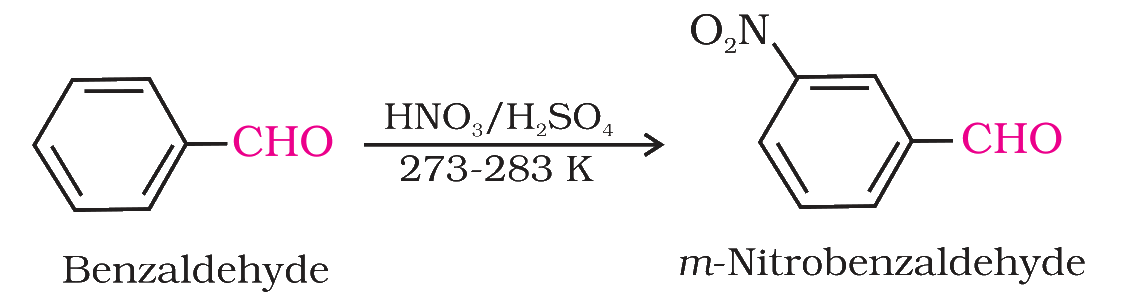
Nitration of benzaldehyde

Advertisement

Practise more on Organic: Aldehydes, Ketones and Carboxylic Acids

Chapter-wise mocks on the real NTA exam screen, with solutions and your rank. Your first mocks are free.

Start free mocks →

Advertisement

Next questions

  1. The function of the retina is to:General Aptitude Test · General Knowledge
  2. The Consumer Protection Act provides a number of reliefs to consumers including replacement of the product, removal of defect, compensation…Business Studies · Consumer Protection
  3. Which of the following sportsperson has won the Men’s Ballon d’Or (Golden Ball Award) 2022?General Aptitude Test · Current Affairs
  4. Dikus of Bihar are-Sociology · Social Change and Development in India: Social Movements
  5. Which of the following is an example of Desktop Database?Accountancy Part A · Database Management System for Accounting
  6. According to the passage, animals in zoos suffer cruelty:English · Comprehension - (Narrative / Factual)
  7. The value of Δ= […] , isMaths. Section B1 · Determinants
  8. If an item whose marked price is ₹1,000 is sold after two successive discounts of l0% and 15%, then find the price at which the item is sol…General Aptitude Test · Numerical Ability
  9. Given below are the examples of current Assets. Identify which of them is highly liquid?Business Studies · Financial Management
  10. Consider the 1M aqueous solution of the following compounds and arrange them in the increasing order of elevation in the boiling points.A.…Chemistry · Physical: Solutions