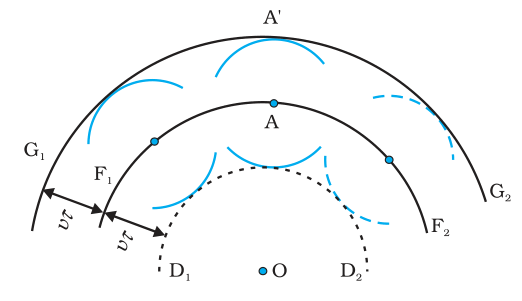
According to Huygens principle, the amplitude of secondary wavelets is
Answer & explanation
Correct answer: option 2
The correct answer is Option (2) → maximum in the forward direction and zero in the backward direction
In Huygens’ principle, every point of a wavefront acts as a source of secondary wavelets, and the new wavefront is their forward envelope. If the wavelets spread equally in all directions, there would also be a backward wave, which is never observed. Huygens therefore assumed that the amplitude of the secondary wavelets is maximum in the forward direction and zero in the backward direction. With this assumption the backwave is absent, and the construction gives the correct forward-moving wavefront.
NCERT (2026-27):
Huygens Principle – “… The above model has one shortcoming: we also have a backwave which is shown as \( D_1D_2 \) in Fig. 10.2. Huygens argued that the amplitude of the secondary wavelets is maximum in the forward direction and zero in the backward direction; by making this adhoc assumption, Huygens could explain the absence of the backwave.”