Read the passage carefully and answer the following questions
Race and Caste – A Cross-Cultural Comparison
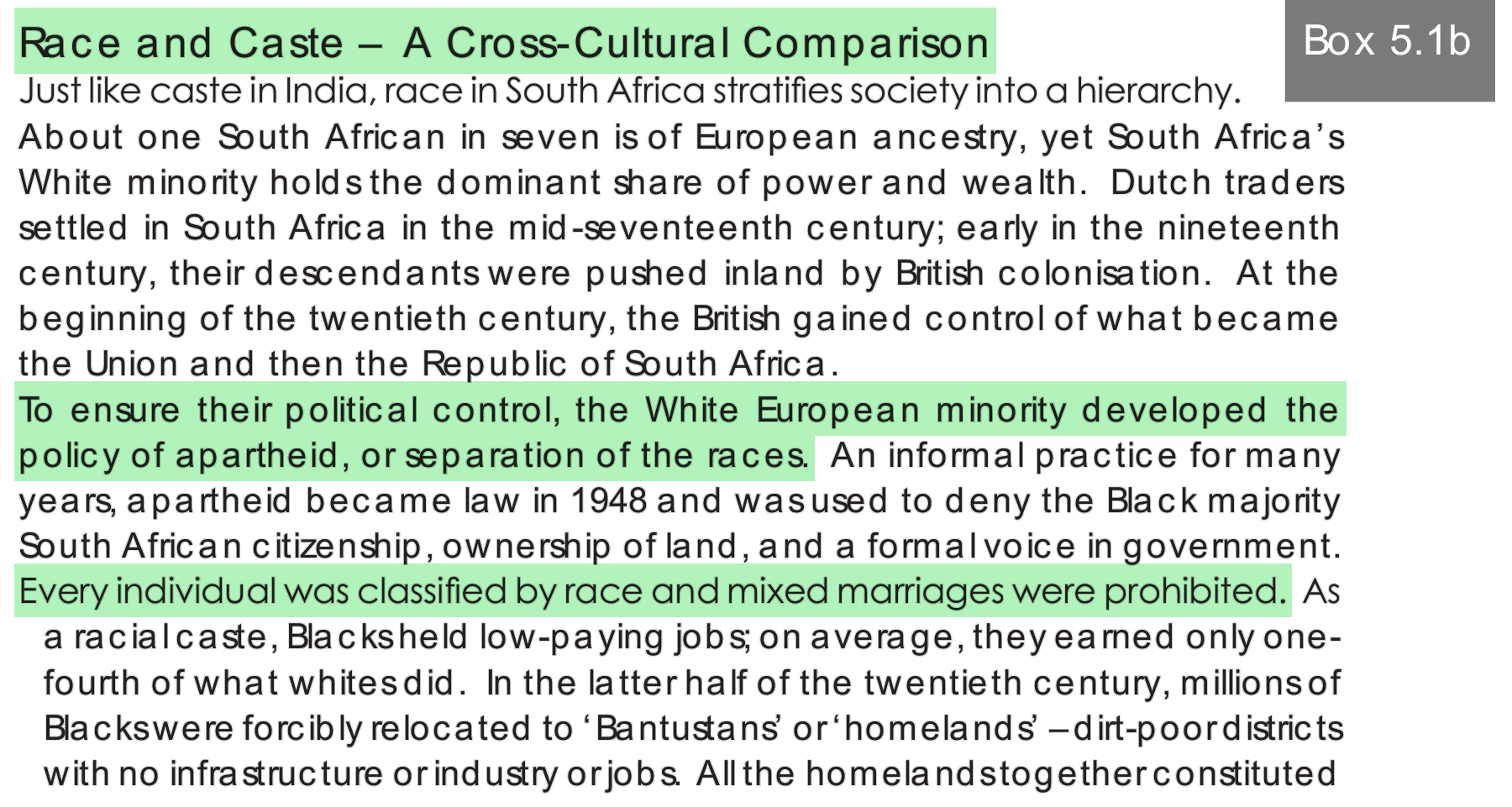
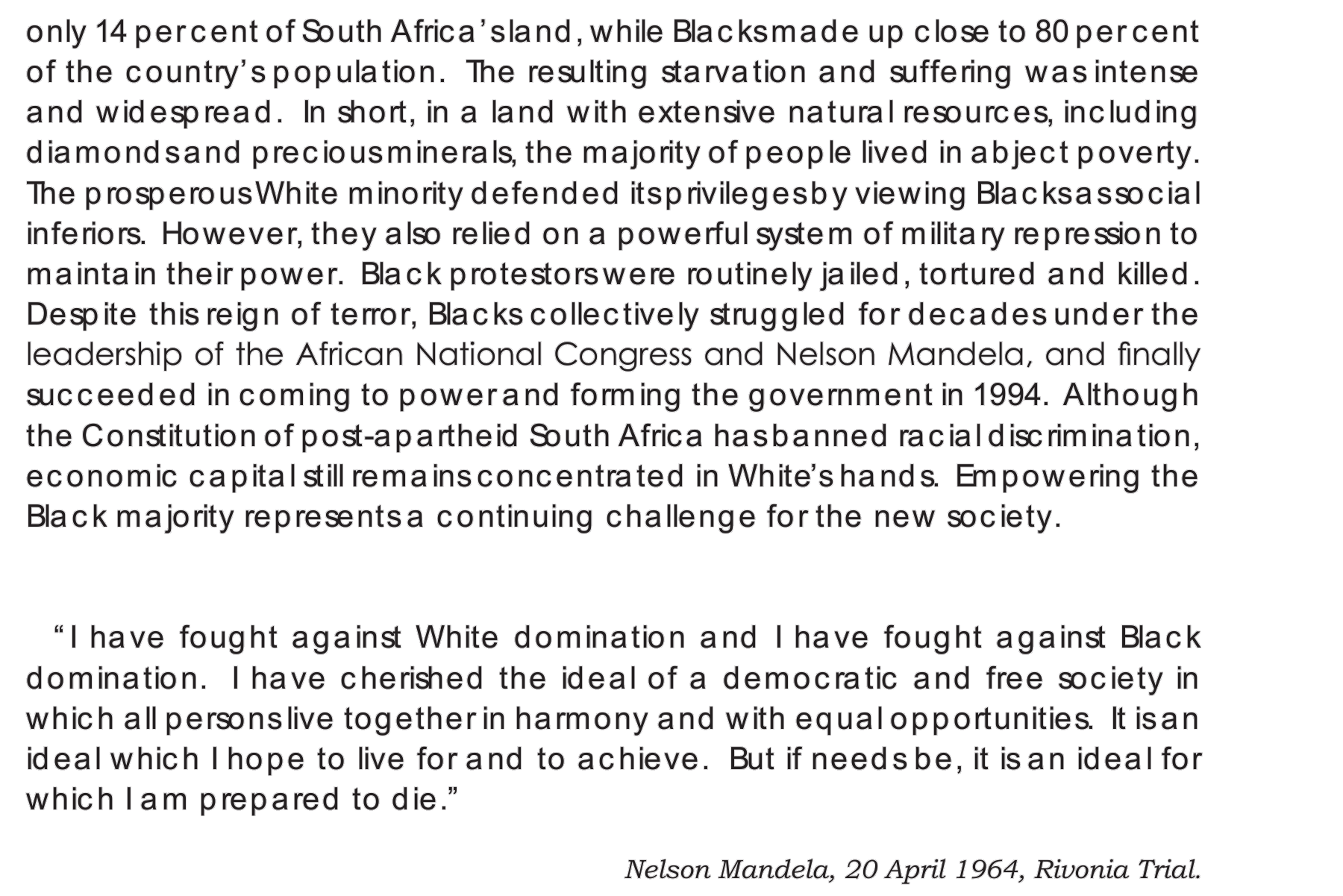
Just like caste in India, race, in South Africa stratifies society into a hierarchy. About one in seven is of European ancestry, yet South Africa’s White minority holds the dominant share of power and wealth. Dutch traders settled in South Africa in the mid-seventeenth century; early in the nineteenth century, their descendants were pushed inland by British colonisation. At the beginning of the twentieth century, the British gained control of what became the Union and then the Republic of South Africa. To ensure their political control, the White European minority developed the policy of apartheid, or separation of the races. An informal practice for many years, apartheid became law in 1948 and were used to deny the Black majority citizenship, ownership of land, and a formal voice in government. Every individual were classified by race, and mixed marriages were prohibited. As a racial caste, Blacks held low-paying jobs; on average, they earned only one-fourth of what whites did. In the latter half of the twentieth century, millions of Blacks were forcibly relocated to ‘Bantustans’ or ‘homelands’ – dirt-poor districts with no infrastructure, industry, or jobs. All the homelands together constituted only 14 percent of South Africa’s land, while Blacks made up close to 80 percent of the country’s population. The resulting starvation and suffering were intense and widespread. In short, in a land with extensive natural resources, including diamonds and precious minerals, the majority of people lived in abject poverty. The prosperous White minority defended its privileges by viewing Blacks as social inferiors. However, they also relied on a powerful system of military repression to maintain their power. Black protestors were routinely jailed, tortured, and killed. Despite this reign of terror, Blacks collectively struggled for decades under the leadership of the African National Congress and Nelson Mandela, and finally succeeded in coming to power and forming the government in 1994. Although the Constitution of post-apartheid South Africa has banned racial discrimination, economic capital still remains concentrated in White hands. Empowering the Black majority represents a continuing challenge for the new society. “I have fought against White domination and I have fought against Black domination. I have cherished the ideal of a democratic and free society in which all persons live together in harmony and with equal opportunities. It is an ideal which I hope to live for and to achieve. But if needs be, it is an ideal for which I am prepared to die.”
What does apartheid refer to:
Answer & explanation
Correct answer: option 1
The correct answer is Option (1) → Bias on the basis of skin colour
Option (1) Bias on the basis of skin colour — Correct. Apartheid means separation of the races. The White minority classified every individual by race, that is, broadly by skin colour, and used the law to deny the Black majority citizenship, land and a voice in government.
Option (2) Bias on the basis of class — Incorrect. Class is a ranking by wealth and income. Under apartheid Blacks were poor because of their race; the basis of the system was race, and class followed from it.
Option (3) Bias on the basis of gender — Incorrect. Gender bias separates men and women; apartheid separated people by race, men and women alike.
Option (4) Bias on the basis of caste — Incorrect. Caste is India’s system of ranked groups by birth. The passage compares race in South Africa with caste in India; apartheid itself was built on race, not caste.
NCERT: Indian Society — Chapter 5: Patterns of Social Inequality and Exclusion (2025-26)
|