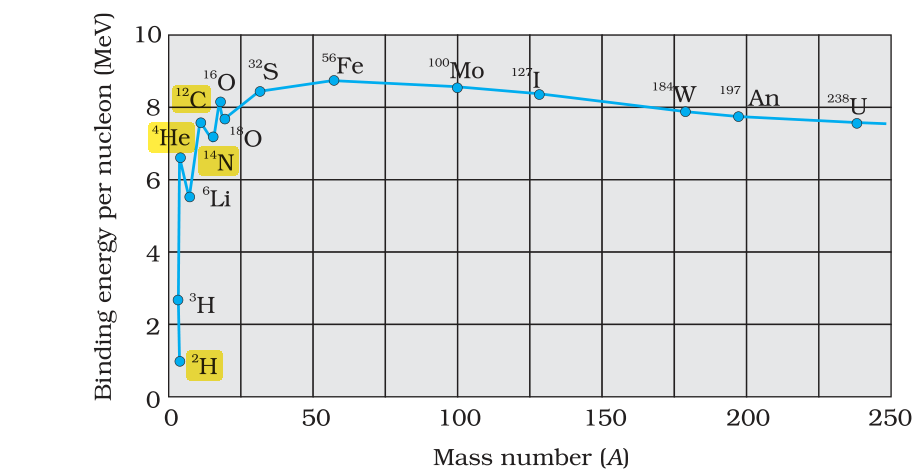
Arrange the average binding energy per nucleon of the following nuclei in descending order
(A) \( {}^{14}N \)
(B) \( {}^{2}H \)
(C) \( {}^{12}C \)
(D) \( {}^{4}He \)
Choose the correct answer from the options given below:
Answer & explanation
Correct answer: option 4
The correct answer is Option (4) → (C), (A), (D), (B)
For light nuclei the binding energy per nucleon rises steeply with mass number, but \( {}^{4}\mathrm{He} \), \( {}^{12}\mathrm{C} \) and \( {}^{16}\mathrm{O} \) sit as peaks above the general curve.
\( \text{(C)}\; {}^{12}\mathrm{C}: \approx 7.68\,\mathrm{MeV} \)
\( \text{(A)}\; {}^{14}\mathrm{N}: \approx 7.48\,\mathrm{MeV} \)
\( \text{(D)}\; {}^{4}\mathrm{He}: \approx 7.07\,\mathrm{MeV} \)
\( \text{(B)}\; {}^{2}\mathrm{H}: \approx 1.11\,\mathrm{MeV} \)
Descending order: (C), (A), (D), (B).
NCERT (2026-27):
Nuclear Binding Energy – “… We can think of binding energy per nucleon as the average energy per nucleon needed to separate a nucleus into its individual nucleons. Figure 13.1 is a plot of the binding energy per nucleon \( E_{bn} \) versus the mass number \( A \) for a large number of nuclei.”