CUETMOCK
  • Pricing
  • Mentors
Log inStart freeStart free mocks→

First test, then trust

Try a free CUET mock test.

Join 5,00,000+ students who rehearsed exam day on the exact NTA screen before sitting CUET. On the web and on Android.

Start free mocks →Get the Android app
CUETMOCK

India's #1 CUET Mock Test Platform. Original NCERT-based questions on the exact NTA exam screen — trusted by 5,00,000+ students since CUET 2022.

Get it onGoogle PlayScan to download the CUETMOCK app

Mock tests

  • CUET mock test series
  • Commerce mocks
  • Humanities (Arts) mocks
  • Science mocks
  • Languages & GAT mocks
  • Free practice questions
  • Pricing

Resources

  • CUET exam guide
  • CUET syllabus
  • Universities accepting CUET
  • Expert blogs
  • News & notifications
  • Webinars & counselling
  • CUET score calculator
  • How we estimate your rank
  • FAQs

Company

  • About us
  • Our leadership & team
  • Our toppers
  • Mentors
  • For schools
  • Contact us
  • Terms
  • Privacy
  • Refund policy

Talk to us

+91 7696 6630 56info@cuetmock.comWhatsApp us

Our other platforms

  • JEE Mock — For IIT-JEE aspirants
  • NEET Mock — For NEET aspirants

Newsletter

Exam updates, study material and offers — no spam.

© 2026 NYC Ventures Pvt. Ltd.

701-702, Royal Business Park, Zirakpur, Punjab - 140603

  • Terms of use
  • Privacy policy
  • Refund policy
  • Contact us

iCUETMOCK is an independent preparation platform, not affiliated with the National Testing Agency (NTA). Always check exam details on the official NTA website.

  • Home
  • Mock tests
  • CUET guide
  • Pricing
  • Log in
Home/Practice questions/Chemistry
ChemistryOrganic: Amines

Match the LIST-I with LIST-II.LIST-IReactionLIST-IIName of the Reacti…

Match the LIST-I with LIST-II.

LIST-I
Reaction
LIST-II
Name of the Reaction/Test
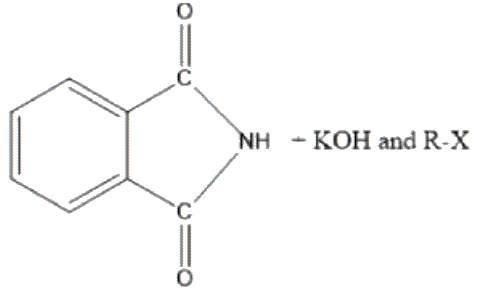
A. Reaction A for Q14I. Gattermann reaction
B. RNH2 + CHCl3 + KOHII. Hinsberg’s test
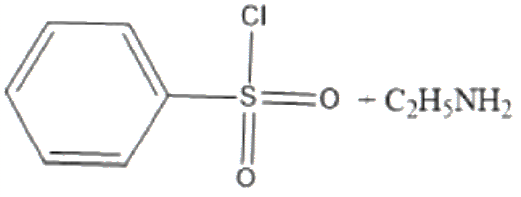
C. Reaction C for Q14III. Gabriel phthalimide synthesis
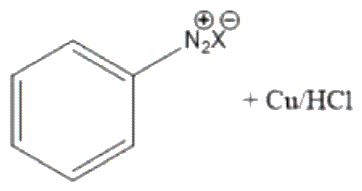
D. Reaction D for Q14IV. Isocyanide test

Choose the correct answer from the options given below:

Answer & explanation+

Correct answer: option 3

The correct answer is Option (3) → A-III, B-IV, C-II, D-I

The named reactions and tests of amines can be grouped by what they are used for:

  • Preparing primary amines: Gabriel phthalimide synthesis — phthalimide + ethanolic KOH, then an alkyl halide, then alkaline hydrolysis gives a pure 1° amine; Hofmann bromamide degradation — an amide + \( \ce{Br2} \)/NaOH gives a 1° amine with one carbon fewer.

  • Tests that distinguish amines: carbylamine (isocyanide) test — only 1° amines with CHCl3 and KOH give a foul-smelling isocyanide; Hinsberg’s test — benzenesulphonyl chloride (\( \ce{C6H5SO2Cl} \)) tells 1°, 2° and 3° amines apart.

  • Replacing the diazo group by halogen: Sandmeyer reaction — diazonium salt + Cu2Cl2/HCl or Cu2Br2/HBr; Gattermann reaction — diazonium salt + copper powder and HCl or HBr. Both give an aryl halide and \( \ce{N2} \).

  • A. Phthalimide + KOH and R-X — This matches III. Gabriel phthalimide synthesis. KOH forms potassium phthalimide, whose nitrogen anion is alkylated by R–X; hydrolysis then releases the primary amine. Aryl amines cannot be made this way, because aryl halides do not undergo this substitution.

        \( \displaystyle \text{phthalimide} \xrightarrow{\text{KOH (alc.)}} \text{K-phthalimide} \xrightarrow{\ce{R-X}} \text{N-alkylphthalimide} \xrightarrow{\ce{NaOH}\text{ (aq)}} \ce{R-NH2} \)

  • B. \( \ce{RNH2} \) + \( \ce{CHCl3} \) + KOH — This matches IV. Isocyanide test. A primary amine heated with chloroform and ethanolic KOH gives an isocyanide (carbylamine) with a very unpleasant smell; 2° and 3° amines do not respond.

        \( \displaystyle \ce{R-NH2 + CHCl3 + 3KOH} \xrightarrow{\text{heat}} \ce{R-NC + 3KCl + 3H2O} \)

  • C. Benzenesulphonyl chloride + \( \ce{C2H5NH2} \) — This matches II. Hinsberg’s test. A primary amine gives an N-alkylbenzenesulphonamide whose N–H is acidic, so it dissolves in alkali.

        \( \displaystyle \ce{C6H5SO2Cl + C2H5NH2 -> C6H5SO2NHC2H5 + HCl} \)

  • D. Benzenediazonium salt + Cu/HCl — This matches I. Gattermann reaction. Copper powder with HCl replaces the –\( \ce{N2^{+}} \) group by chlorine.

        \( \displaystyle \ce{C6H5N2^+X^-} \xrightarrow{\ce{Cu}/\ce{HX}} \ce{C6H5X + N2} \)

Advertisement

Practise more on Organic: Amines

Chapter-wise mocks on the real NTA exam screen, with solutions and your rank. Your first mocks are free.

Start free mocks →

Advertisement

Next questions

  1. Arrange the average binding energy per nucleon of the following nuclei in descending order(A) ^14N (B) ^2H (C) ^12C (D) ^4He Choose the cor…Physics · Nuclei
  2. Choose the option that correctly transforms the given sentence into passive voice:Her meteoric success in the literary world surprised ever…English · Grammar: Active Passive Voice
  3. The area of the region bounded between the line x=3 and the parabola y^2=6x is:Maths. Section A · Application of Integrals (Section A)
  4. An electric dipole is placed in an external uniform electric field. The net electric force on the dipolePhysics · Electric Charges and Fields
  5. Two identical small spheres, each of mass 0.1 g carrying equal and similar charges, are suspended by two non-conducting threads of equal le…Physics · Electric Charges and Fields
  6. Privatisation of the public sector enterprises (PSEs) by selling off part of the equity of PSEs to the public is known as …………Economics · Indian Economic Development: Liberalisation, Privatisation and Globalisation - An Appraisal
  7. Identify the incorrect statement from the following.Chemistry · Physical: Chemical Kinetics
  8. ASEAN was established by signing which one of the following declaration?Political Science · Contemporary World Politics: Contemporary Centres of power
  9. Krishnadeva Raya (ruled 1509-29) composed a work on statecraft in Telugu known as -General Aptitude Test · General Knowledge
  10. The radius of a circle is 14 m. The area of the circle is:General Aptitude Test · Quantitative Reasoning