CUETMOCK
  • Pricing
  • Mentors
Log inStart freeStart free mocks→

First test, then trust

Try a free CUET mock test.

Join 5,00,000+ students who rehearsed exam day on the exact NTA screen before sitting CUET. On the web and on Android.

Start free mocks →Get the Android app
CUETMOCK

India's #1 CUET Mock Test Platform. Original NCERT-based questions on the exact NTA exam screen — trusted by 5,00,000+ students since CUET 2022.

Get it onGoogle PlayScan to download the CUETMOCK app

Mock tests

  • CUET mock test series
  • Browse all papers
  • Commerce mocks
  • Humanities (Arts) mocks
  • Science mocks
  • Languages & GAT mocks
  • Free practice questions
  • Pricing

Resources

  • CUET exam guide
  • CUET syllabus
  • Universities accepting CUET
  • Expert blogs
  • News & notifications
  • Webinars & counselling
  • CUET score calculator
  • How we estimate your rank
  • FAQs

Company

  • About us
  • Our leadership & team
  • Our toppers
  • Mentors
  • For schools
  • Contact us
  • Terms
  • Privacy
  • Refund policy

Talk to us

+91 7696 6630 56info@cuetmock.comWhatsApp us

Our other platforms

  • JEE Mock — For IIT-JEE aspirants
  • NEET Mock — For NEET aspirants

Newsletter

Exam updates, study material and offers — no spam.

© 2026 NYC Ventures Pvt. Ltd.

701-702, Royal Business Park, Zirakpur, Punjab - 140603

  • Terms of use
  • Privacy policy
  • Refund policy
  • Contact us

iCUETMOCK is an independent preparation platform, not affiliated with the National Testing Agency (NTA). Always check exam details on the official NTA website.

  • Home
  • Mock tests
  • CUET guide
  • Pricing
  • Log in
Home/Practice questions/Chemistry
ChemistryOrganic: Aldehydes, Ketones and Carboxylic Acids

Match List I with List II List I List II I. CrO_3 / H_2SO_4 II. H_3O^…

Aldehydes are generally more reactive than ketones in nucleophilic addition reactions due to steric and electronic reasons. Sterically, the presence of two relatively large substituents in ketones hinders the approach of nucleophile to carbonyl carbon than in aldehydes having only one such substituent. Electronically, aldehydes are more reactive than ketones because two alkyl groups reduce the electrophilicity of the carbonyl more efficiently than in the former.

Match List I with List II

List I List II
Figure for Q3 I. \(CrO_3 / H_2SO_4\)
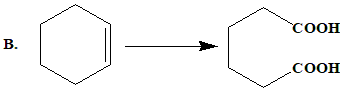
Figure for Q3 II. \(H_3O^+ / \Delta\)
Figure for Q3 III. Ammoniacal silver nitrate
Figure for Q3 IV. \(KMnO_4 - H_2SO_4/\Delta\)

Choose the correct answer from the options given below:

Answer & explanation+

Correct answer: option 2

The correct answer is Option (2) → A-III, B-IV, C-I, D-II

Each conversion is matched with the reagent that does that particular job: a mild oxidant for an aldehyde, a vigorous oxidant to cleave a C=C bond, an acidic chromium(VI) oxidant for a primary alcohol, and acid hydrolysis for an amide.

  • (A) \( \ce{CH3CH2CH2CHO -> CH3CH2CH2COOH} \) — This matches (III) Ammoniacal silver nitrate. An aldehyde is oxidised even by a mild oxidising agent such as Tollens’ reagent; acidification then gives the acid.

        \( \displaystyle \ce{RCHO + 2[Ag(NH3)2]^+ + 3OH^- -> RCOO^- + 2Ag v + 2H2O + 4NH3} \)

  • (B) Cyclohexene → hexane-1,6-dioic acid (adipic acid) — This matches (IV) KMnO4–H2SO4/Δ. Vigorous oxidation cleaves the C=C bond, and each end becomes –COOH.

        \( \displaystyle \ce{C6H10 + 4[O]} \xrightarrow{\ce{KMnO4/H2SO4},\ \Delta} \ce{HOOC(CH2)4COOH} \)

  • (C) \( \ce{CH3CH2CH2CH2OH -> CH3CH2CH2COOH} \) — This matches (I) CrO3/H2SO4. A primary alcohol is oxidised to the acid by chromium trioxide in acid (Jones reagent).

        \( \displaystyle \ce{CH3CH2CH2CH2OH + 2[O]} \xrightarrow{\ce{CrO3/H2SO4}} \ce{CH3CH2CH2COOH + H2O} \)

  • (D) \( \ce{CH3CONH2 -> CH3COOH} \) — This matches (II) H3O+/Δ. An amide is hydrolysed by heating with dilute acid.

        \( \displaystyle \ce{CH3CONH2 + H2O + H+} \xrightarrow{\Delta} \ce{CH3COOH + NH4+} \)

Note: The same/similar question has been asked in different years by NTA as per the details given below:

20262025202420232022
–––12-06 S3
10-06 S1
–

Advertisement

Practise more on Organic: Aldehydes, Ketones and Carboxylic Acids

Chapter-wise mocks on the real NTA exam screen, with solutions and your rank. Your first mocks are free.

Start free mocks →

Advertisement

Next questions

  1. The magnetic moment in transition metals is calculated using the formula...........Chemistry · Inorganic: D and F Block Elements
  2. The value of the integral ∫limits_π / 6^π / 3 (d x)/(1+tan ^5 x) isMaths. Section A · Definite Integration
  3. The values of ‘a’ and ‘b’ such that the function defined by f(x)= […] is a continuous function, are:Maths. Section B1 · Continuity and Differentiability
  4. Economic growth and prosperity achieved through falling dependency ratio is referred to as:Sociology · Indian Society: Demographic Structure of Indian Society
  5. From the options given below mention whose research work, at first, established the case for close relation between humans and apes?English · Comprehension - (Narrative / Factual)
  6. Arrange the number of species of organisms in tropical Amazonian rain forest in decreasing order.(A) Fishes(B) Birds(C) Plants(D) MammalsCh…Biology · Biodiversity and Conservation
  7. स्थूल और मानसिक किसके विभाग हैं?Hindi · Comprehension - (Narrative / Factual)
  8. If 80% of X is 36 more than 60% of Y and 120% of X is equal to Y, then the difference between X and Y is:General Aptitude Test · Numerical Ability
  9. Integrating factor of (xlog_e x)displaystyledy/dx+y=2log_e x is:Maths. Section B1 · Differential Equations
  10. गद्यांश में साइकिल चलाना सीखने वाले बच्चे का उदाहरण किस बात को स्पष्ट करता है?Hindi · अपठित गद्यांश (Comprehension - Prose)