The magnetic moment in transition metals is calculated using the formula...........
Answer & explanation
Correct answer: option 1
The correct answer is Option (1) → \(\mu=\sqrt{n(n+2)}\)
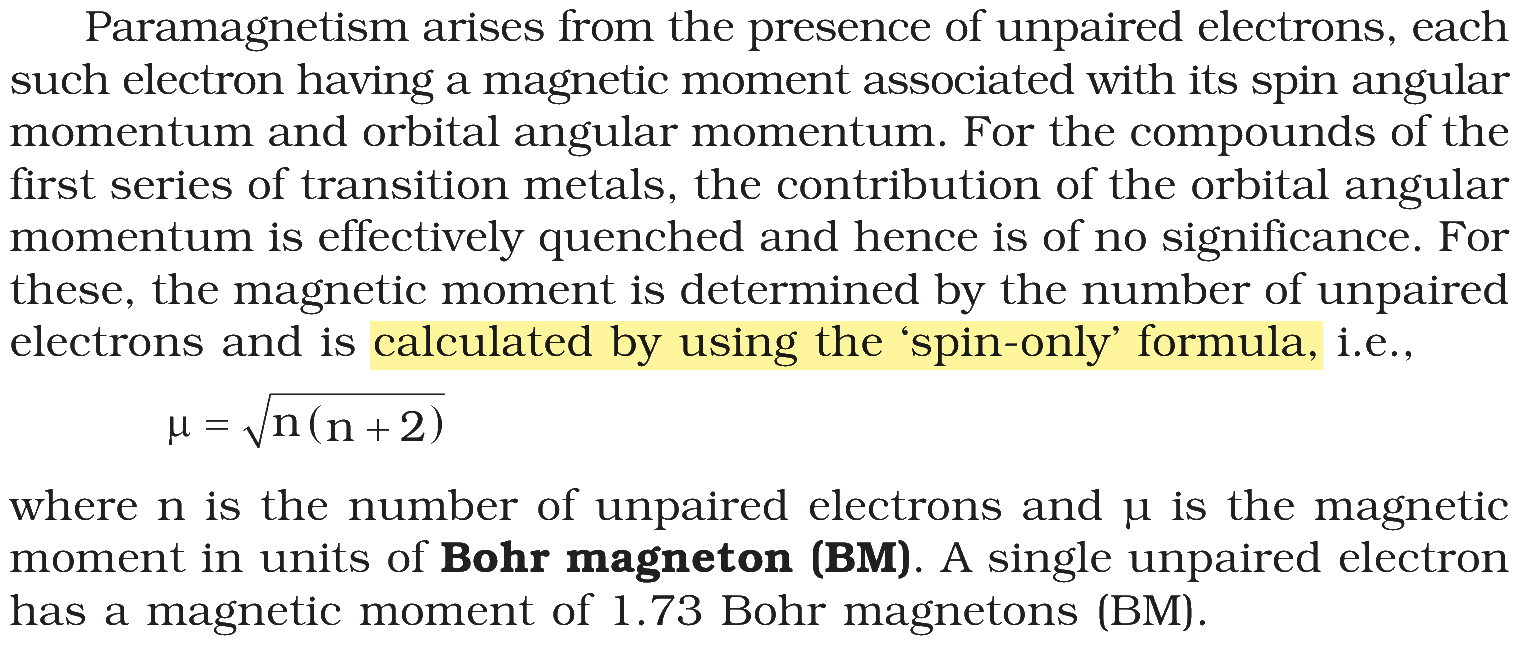
Paramagnetism comes from unpaired electrons. Each one has a magnetic moment from its spin and from its orbital motion. In the compounds of the first transition series, the orbital contribution is effectively quenched, so the magnetic moment depends only on the number of unpaired electrons, n. It is given by the spin-only formula, in Bohr magnetons (BM):
\( \displaystyle \mu = \sqrt{n(n+2)}\ \mathrm{BM} \)
For example, one unpaired electron gives \( \sqrt{1 \times 3} = 1.73\ \mathrm{BM} \), and \( \ce{Mn^2+} \) (3d5, five unpaired electrons) gives \( \sqrt{35} = 5.92\ \mathrm{BM} \).
Why the other options are incorrect
Option (2) \(\mu=n\sqrt{(n+2)}\) — Incorrect. This is not a magnetic moment formula: for one electron it gives 1.73 BM by chance, but for five electrons it gives 13.2 BM instead of 5.92 BM.
Option (3) \(\mu=g\sqrt{J(J+1)}\) — Incorrect. This formula uses the total angular momentum quantum number J. It applies where the orbital contribution is not quenched, as for the lanthanoid ions, not to the transition metal ions here.
Option (4) \(\mu=\sqrt{J(J+1)}\) — Incorrect. It leaves out the factor g of the J-based formula and does not use the number of unpaired electrons.
NCERT (2026-27 edition):
Magnetic Properties – …