Match the LIST-I with LIST-II
| LIST-I Item | LIST-II shown in | ||
|---|---|---|---|
| A. | Profit on realisation | I. | Debit side of Partners' Capital A/c |
| B. | Sale of assets | II. | Debit side of Realisation A/c |
| C. | Fictitious assets | III. | Credit side of Partners' Capital A/c |
| D. | Settlement of unrecorded liability | IV. | Credit side of Realisation A/c |
Choose the correct answer from the options given below:
Answer & explanation
Correct answer: option 4
The correct answer is Option (4) → A-III, B-IV, C-I, D-II
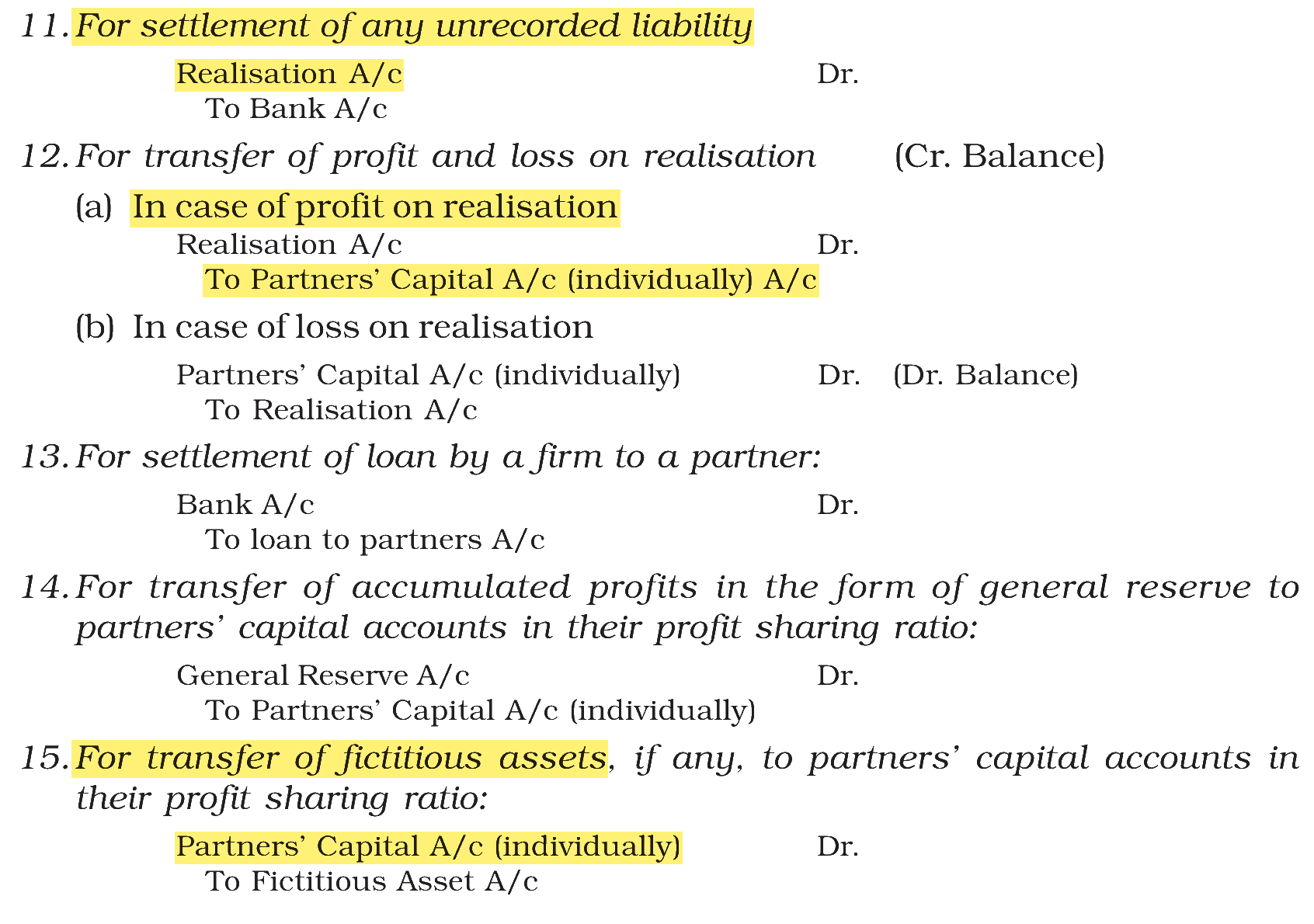
The Realisation A/c records only the assets, the outside liabilities and what is received or paid for them; everything between the firm and its partners goes through the partners’ capital accounts.
(A) Profit on realisation — this matches (III) Credit side of Partners’ Capital A/c. The profit is transferred to the partners in the profit sharing ratio, so their capital accounts are credited.
(B) Sale of assets — this matches (IV) Credit side of Realisation A/c. The assets were debited to the Realisation A/c when transferred, and what they fetch is credited to it (Bank A/c Dr., To Realisation A/c).
(C) Fictitious assets — this matches (I) Debit side of Partners’ Capital A/c. They cannot be sold, so they are written off by debiting the partners’ capital accounts in the profit sharing ratio.
(D) Settlement of unrecorded liability — this matches (II) Debit side of Realisation A/c. Whatever is paid for a liability that was not in the books is a cost of realisation (Realisation A/c Dr., To Bank A/c).
NCERT (2026-27 edition):
|