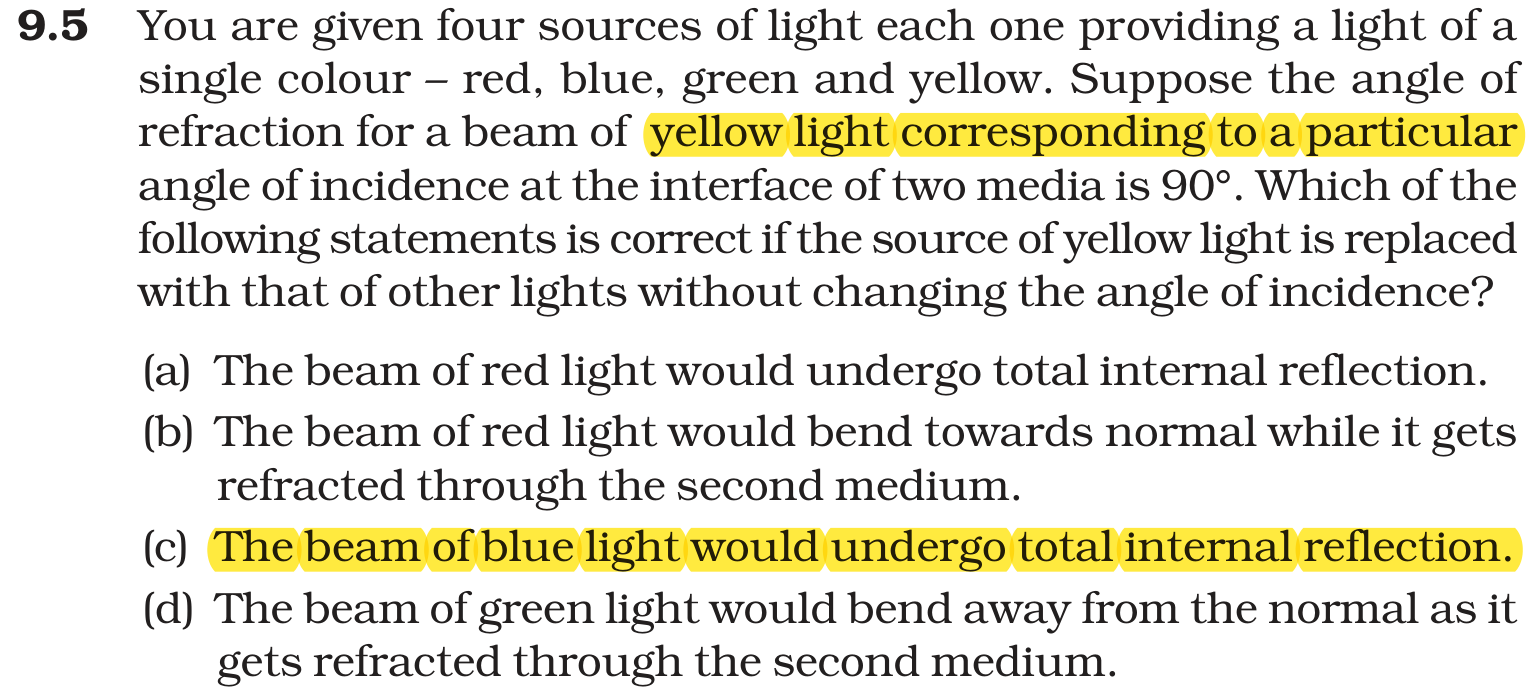
A white light is incident on interface of glass and air at a certain angle. If yellow light is just totally internally reflected, then other colours which will undergo total internal reflection are:
Answer & explanation
Correct answer: option 3
The correct answer is Option (3) → Violet, indigo, green and blue colour light
Light is totally reflected at a glass–air surface when the angle of incidence exceeds the critical angle C.
\( \displaystyle \sin C = \frac{1}{n} \)
The refractive index of glass increases from red to violet, so the critical angle decreases from red to violet.
\( n_{\mathrm{red}} \lt n_{\mathrm{yellow}} \lt n_{\mathrm{violet}} \;\Rightarrow\; C_{\mathrm{red}} \gt C_{\mathrm{yellow}} \gt C_{\mathrm{violet}} \)
Yellow is just totally reflected, so the angle of incidence equals the critical angle for yellow. Green, blue, indigo and violet have smaller critical angles, which this angle of incidence exceeds, so they are also totally reflected. Orange and red have larger critical angles and pass out into air.
Why the other options are incorrect
Option (1) Orange and red colour light — Incorrect. Orange and red have critical angles larger than the angle of incidence, so they are refracted into air.
Option (2) light of all colours of white light except yellow — Incorrect. Not all colours are reflected: orange and red escape into air.
Option (4) Red colour light only — Incorrect. Red light has the largest critical angle, so it is the colour least likely to be totally reflected.
NCERT Exemplar:
Ray Optics and Optical Instruments – …