An electrolytic cell has cell potential of approximately 1.35 V and remains constant during its life. Its overall reaction is represented by
Zn(Hg) + HgO(s) → ZnO(s) + Hg(l)
Find out the reducing and oxidizing agents in the above given cell reaction.
Answer & explanation
Correct answer: option 1
The correct answer is Option (1) → Zinc is the reducing agent and mercury(II) oxide is an oxidizing agent.
In a redox reaction, the substance that is oxidised (loses electrons, so its oxidation number increases) is the reducing agent. The substance that is reduced (gains electrons, so its oxidation number decreases) is the oxidising agent.
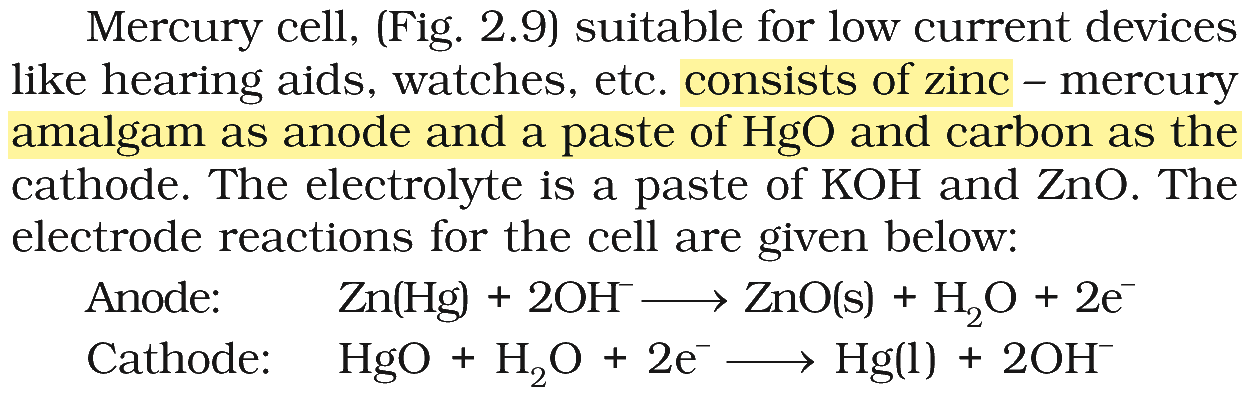
The given reaction is that of the mercury cell. Its anode is zinc–mercury amalgam, and its cathode is a paste of HgO and carbon. The electrode reactions are:
\( \displaystyle \text{Anode: }\ce{Zn(Hg) + 2OH^- -> ZnO(s) + H2O + 2e^-} \)
\( \displaystyle \text{Cathode: }\ce{HgO(s) + H2O + 2e^- -> Hg(l) + 2OH^-} \)
Now follow the oxidation numbers:
\( \displaystyle \mathrm{Zn}:\ 0 \rightarrow +2\quad (\text{oxidised}) \)
\( \displaystyle \mathrm{Hg\ in\ HgO}:\ +2 \rightarrow 0\quad (\text{reduced}) \)
So zinc is the reducing agent and mercury(II) oxide is the oxidising agent.
Why the other options are incorrect
Option (2) Zinc is the reducing agent and mercury (II) is an oxidizing agent. — Incorrect. The oxidising agent is named as the reactant that gets reduced, and that reactant is the compound HgO. There is no separate mercury(II) species in the reaction.
Option (3) Zinc is the oxidizing agent and Mercury (I) oxide is the reducing agent. — Incorrect. Mercury is in the +2 state in HgO, not +1, and the roles of the two reactants are reversed.
Option (4) Zinc is the oxidizing agent and Mercury (II) oxide is the reducing agent. — Incorrect. This reverses the roles. Zinc is oxidised, so it acts as the reducing agent, not the oxidising agent.
Note: It seems that there is a mistake in the original NTA paper. The question calls this an “electrolytic cell”, but a cell with the reaction Zn(Hg) + HgO(s) → ZnO(s) + Hg(l) and a steady potential of about 1.35 V is the mercury cell, which is a galvanic cell (it produces electricity rather than using it).
NCERT (2026-27 edition):
Primary Batteries – …