CUETMOCK
  • Pricing
  • Mentors
Log inStart freeStart free mocks→

First test, then trust

Try a free CUET mock test.

Join 5,00,000+ students who rehearsed exam day on the exact NTA screen before sitting CUET. On the web and on Android.

Start free mocks →Get the Android app
CUETMOCK

India's #1 CUET Mock Test Platform. Original NCERT-based questions on the exact NTA exam screen — trusted by 5,00,000+ students since CUET 2022.

Get it onGoogle PlayScan to download the CUETMOCK app

Mock tests

  • CUET mock test series
  • Commerce mocks
  • Humanities (Arts) mocks
  • Science mocks
  • Languages & GAT mocks
  • Free practice questions
  • Pricing

Resources

  • CUET exam guide
  • CUET syllabus
  • Universities accepting CUET
  • Expert blogs
  • News & notifications
  • Webinars & counselling
  • CUET score calculator
  • How we estimate your rank
  • FAQs

Company

  • About us
  • Our leadership & team
  • Our toppers
  • Mentors
  • For schools
  • Contact us
  • Terms
  • Privacy
  • Refund policy

Talk to us

+91 7696 6630 56info@cuetmock.comWhatsApp us

Our other platforms

  • JEE Mock — For IIT-JEE aspirants
  • NEET Mock — For NEET aspirants

Newsletter

Exam updates, study material and offers — no spam.

© 2026 NYC Ventures Pvt. Ltd.

701-702, Royal Business Park, Zirakpur, Punjab - 140603

  • Terms of use
  • Privacy policy
  • Refund policy
  • Contact us

iCUETMOCK is an independent preparation platform, not affiliated with the National Testing Agency (NTA). Always check exam details on the official NTA website.

  • Home
  • Mock tests
  • CUET guide
  • Pricing
  • Log in
Home/Practice questions/Geography
GeographyFundamentals of Human Geography: Human Geography-Nature and Scope

Where are the Mahua, Palash and Sal trees mainly found?

Read the passage and answer the questions:

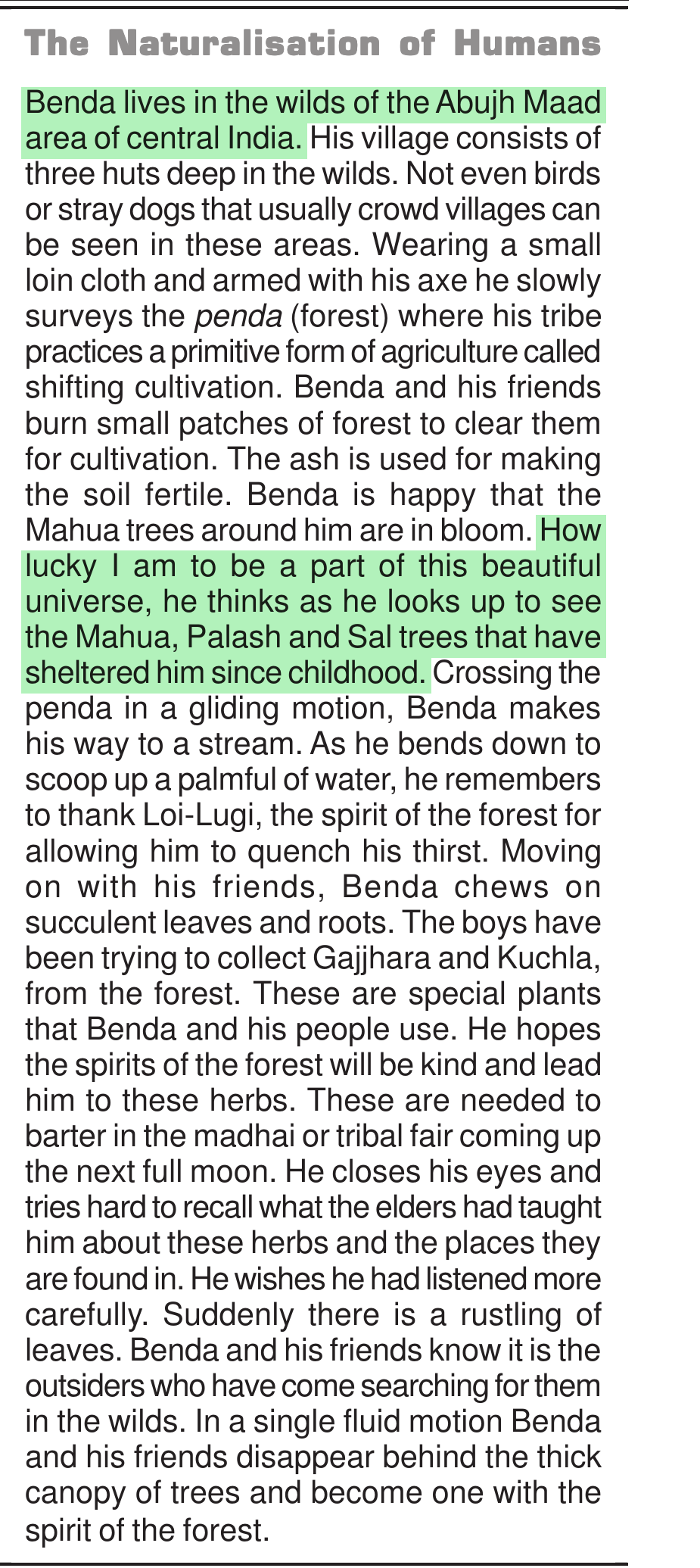
Benda lives in the wilds of the Abujh Maad area of central India. His village consists of three huts deep in the wilds. Not even birds or stray dogs that usually crowd villages can be seen in these areas. Wearing a small loin cloth and armed with his axe he slowly surveys the penda (forest) where his tribe practices a primitive form of agriculture called shifting cultivation. Benda and his friends burn small patches of forest to clear them for cultivation. The ash is used for making the soil fertile. Benda is happy that the Mahua trees around him are in bloom. How lucky I am to be a part of this beautiful universe, he thinks as he looks up to see the Mahua, Palash and Sal trees that have sheltered him since childhood. Crossing the penda in a gliding motion, Benda makes his way to a stream. As he bends down to scoop up a palmful of water, he remembers to thank Loi-Lugi, the spirit of the forest for allowing him to quench his thirst. Moving on with his friends, Benda chews on succulent leaves and roots. The boys have been trying to collect Gajjhara and Kuchla, from the forest. These are special plants that Benda and his people use. He hopes the spirits of the forest will be kind and lead him to these herbs. These are needed to barter in the madhai or tribal fair coming up the next full moon. He closes his eyes and tries hard to recall what the elders had taught him about these herbs and the places they are found in. He wishes he had listened more carefully. Suddenly there is a rustling of leaves. Benda and his friends know it is the outsiders who have come searching for them in the wilds. In a single fluid motion Benda and his friends disappear behind the thick canopy of trees and become one with the spirit of the forest.

Where are the Mahua, Palash and Sal trees mainly found?

Answer & explanation+

Correct answer: option 2

The correct answer is Option (2) → In Central part of India

Benda lives in the Abujh Maad area of central India, where the Mahua, Palash and Sal trees have sheltered him since childhood.

Note: This passage is the story of Benda from the box ‘The Naturalisation of Humans’ in the first chapter of NCERT Fundamentals of Human Geography, word for word. Benda stepped out of a story box in the very first chapter and walked into the exam hall with five questions in his hands. Read the boxes as slowly as the paragraphs around them.


NCERT: Fundamentals of Human Geography — Chapter 1: Human Geography: Nature and Scope, box ‘The Naturalisation of Humans’ (2025-26)

NCERT extract

Advertisement

Practise more on Fundamentals of Human Geography: Human Geography-Nature and Scope

Chapter-wise mocks on the real NTA exam screen, with solutions and your rank. Your first mocks are free.

Start free mocks →

Advertisement

Next questions

  1. People form views and attitudes about situations and others. Attitudes have Affective, cognitive and behavioral components. Apart from that…Psychology · Attitudes and Social Cognition
  2. Choose the most appropriate option to fill in the blank:My father _____ me to join the debate club during my school days and it helped me a…English · Fill Blanks
  3. If area of the triangle formed by A(1, 3), B(0, 0) and C(k, 0) is 3 sq. units, then which of the following is/are TRUE?A. k = 2B. k = −2C.…Maths. Section A · Determinants (Section A)
  4. How many are novelists but not writers?General Aptitude Test · Verbal Reasoning
  5. Who among the following suggested that a magnet must also exert an equal and opposite force on a current-carrying conductor?General Aptitude Test · General Knowledge
  6. Bottle juices are clarified by the use of -(A) Amylases(B) Lipases(C) Pectinases(D) ProteasesChoose the correct answer from the options giv…Biology · Microbes in Human Welfare
  7. Which of the following is not an example of Knowledge Processing Outsourcing?Geography · Fundamentals of Human Geography: Tertiary and Quaternary Activities
  8. Match the expressions given in List I with the appropriate figures of speech given in List II :LIST-I (Phrases)LIST-II (Figures of speech)A…English · Figure of Speech
  9. Six people A, H, K, N, S and U are sitting in a circle facing the centre, not necessarily in the same order. K is the only person sitting b…General Aptitude Test · Verbal Reasoning
  10. The place where amateur artists learned their trade was called ________.English · Comprehension - (Narrative / Factual)