
CUETMOCK
  • Pricing
  • Mentors
Log inStart freeStart free mocks→

First test, then trust

Try a free CUET mock test.

Join 5,00,000+ students who rehearsed exam day on the exact NTA screen before sitting CUET. On the web and on Android.

Start free mocks →Get the Android app
CUETMOCK

India's #1 CUET Mock Test Platform. Original NCERT-based questions on the exact NTA exam screen — trusted by 5,00,000+ students since CUET 2022.

Get it onGoogle PlayScan to download the CUETMOCK app

Mock tests

  • CUET mock test series
  • Commerce mocks
  • Humanities (Arts) mocks
  • Science mocks
  • Languages & GAT mocks
  • Free practice questions
  • Pricing

Resources

  • CUET exam guide
  • CUET syllabus
  • Universities accepting CUET
  • Expert blogs
  • News & notifications
  • Webinars & counselling
  • CUET score calculator
  • How we estimate your rank
  • FAQs

Company

  • About us
  • Our leadership & team
  • Our toppers
  • Mentors
  • For schools
  • Contact us
  • Terms
  • Privacy
  • Refund policy

Talk to us

+91 7696 6630 56info@cuetmock.comWhatsApp us

Our other platforms

  • JEE Mock — For IIT-JEE aspirants
  • NEET Mock — For NEET aspirants

Newsletter

Exam updates, study material and offers — no spam.

© 2026 NYC Ventures Pvt. Ltd.

701-702, Royal Business Park, Zirakpur, Punjab - 140603

  • Terms of use
  • Privacy policy
  • Refund policy
  • Contact us

iCUETMOCK is an independent preparation platform, not affiliated with the National Testing Agency (NTA). Always check exam details on the official NTA website.

  • Home
  • Mock tests
  • CUET guide
  • Pricing
  • Log in
Home/Practice questions/Chemistry
ChemistryOrganic: Aldehydes, Ketones and Carboxylic Acids

What is the name of the orange-red solid?

Organic synthesis and applications

In aldehydes, carbonyl group is bonded to carbon and hydrogen while in ketones, it is bonded to two carbon atoms. The carbonyl carbon atom is sp2-hybridised and a trigonal coplanar structure. The bond angles are approximately 120°. Methanal is gas at room temperature. Ethanal is a volatile liquid. Other aldehydes and ketones are liquid or solid at room temperature. The boiling points of aldehydes and ketones are higher than hydrocarbons and ether of comparable molecular masses. It is due to weak molecular association in aldehydes and ketones arising out of the dipole-dipole interactions. Their boiling points are lower than those of alcohols of similar molecular masses due to absence of intermolecular hydrogen bonding. The lower members of aldehydes and ketones are miscible with water because they form hydrogen bonding with water. However, the solubility of aldehydes and ketones decreases rapidly on increasing the length of alkyl chain.

Aldehydes are generally more reactive than ketones in the nucleophilic addition reactions due to steric and electronic reasons. An organic compound (A) with molecular formula C8H8O forms an orange-red precipitate with 2,4-DNP reagent and gives yellow precipitate on heating with iodine in the presence of sodium hydroxide. It neither reduces Tollens' or Fehling's reagent, nor does it decolourise bromine water or Baeyer's reagent. On drastic oxidation with chromic acid, it gives a carboxylic acid (B) having molecular formula C7H6O2.

What is the name of the orange-red solid?

Answer & explanation+

Correct answer: option 2

The correct answer is Option (2) → 2,4-Dinitrophenylhydrazone

Aldehydes and ketones react with derivatives of ammonia, H2N–Z. The nitrogen adds to the carbonyl carbon and water is lost, giving a compound with a C=N bond:

    \( \displaystyle \ce{R2C=O + H2N-Z -> R2C=N-Z + H2O} \)

The compound in the passage is acetophenone, so with 2,4-DNP it forms acetophenone 2,4-dinitrophenylhydrazone (Ar = 2,4-dinitrophenyl):

    \( \displaystyle \ce{C6H5(CH3)C=O + H2N-NH-Ar -> C6H5(CH3)C=N-NH-Ar + H2O} \)

So the orange-red solid is a 2,4-dinitrophenylhydrazone.

Why the other options are incorrect

  • Option (1) Phenylhydrazone — Incorrect. It forms with phenylhydrazine, which has no nitro groups.

  • Option (3) Thiosemicarbazone — Incorrect. It forms with thiosemicarbazide (\( \ce{NH2NHCSNH2} \)).

  • Option (4) Hydrazone — Incorrect. It forms with hydrazine itself.

NCERT (2026-27 edition):
Chemical Reactions – …
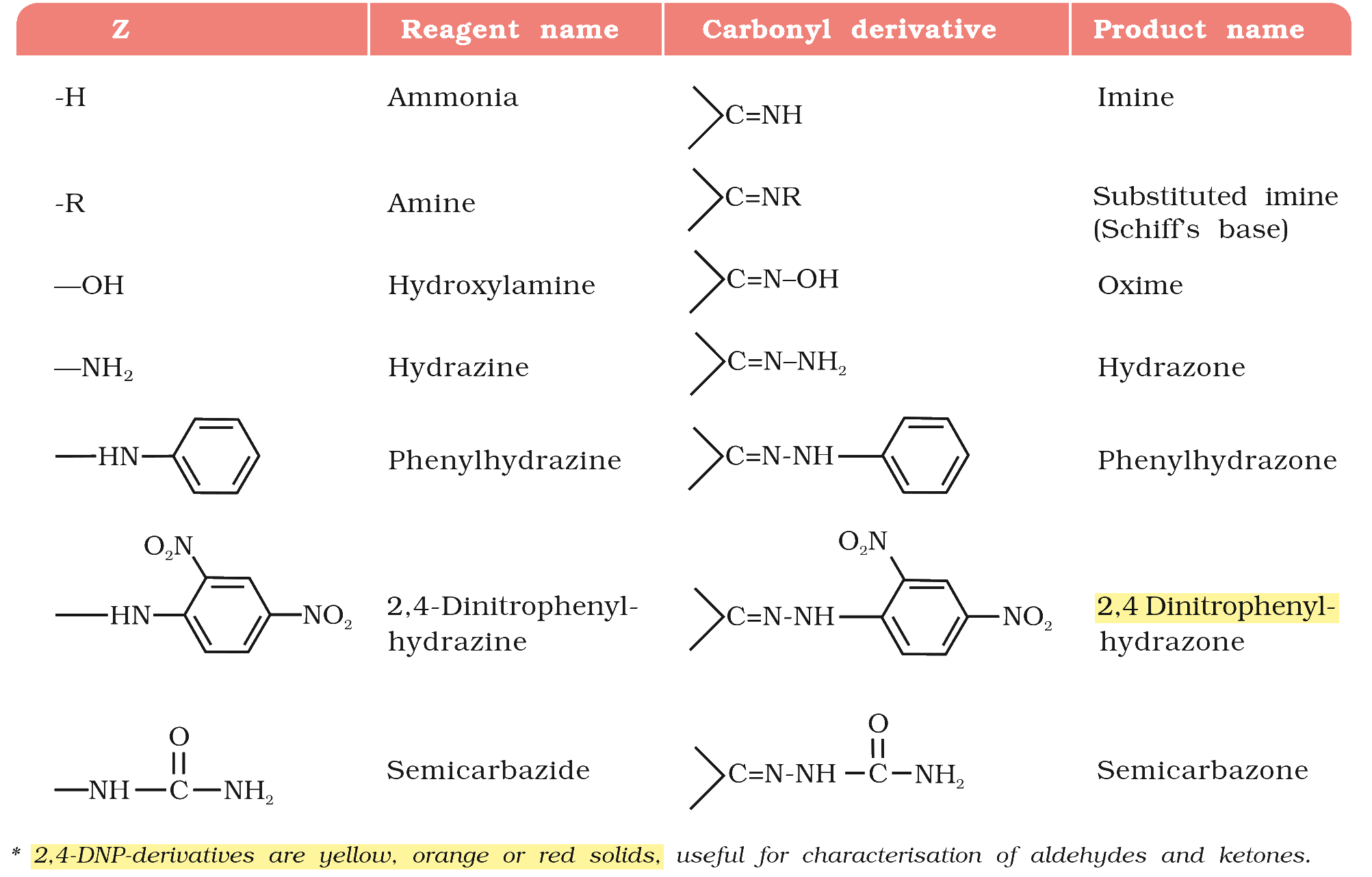
Textbook extract

Advertisement

Practise more on Organic: Aldehydes, Ketones and Carboxylic Acids

Chapter-wise mocks on the real NTA exam screen, with solutions and your rank. Your first mocks are free.

Start free mocks →

Advertisement

Next questions

  1. Humans get Acquired Immuno Deficiency Syndrome (AIDS) when _________ are attacked by Human Immuno Deficiency Virus (HIV).Psychology · Meeting Life Challenges
  2. The various functions performed by a package are as follows:(A) Identification of the Product or Brand(B) Product Protection(C) Grading of…Business Studies · Marketing
  3. Match List-I with List-IIList-I(Events)List-II(Year)(A)Establishment of the Department of Defence Supplies(I)1962(B)Nuclear Non-Proliferati…Political Science · Politics in India Since Independence: India's External Relations
  4. Which one of the following was India's first indigenous, experimental communication satellite launched in 1981?General Aptitude Test · General Knowledge
  5. Choose the most appropriate reported construction of the following sentence :She said to me, "Can you answer this question?" "No", I said.English · Direct/indirect
  6. Which one of the following drugs has a stimulating action on CNS and produces sense of euphoria?Biology · Human Health and Disease
  7. The relation between 'marginal cost (MC)' and 'average cost (AC)' of producing 'x' units of a product isApplied Maths. Section B2 · Calculus
  8. Which of the following statements is false with respect to ideal solutions?Chemistry · Physical: Solutions
  9. For the function f(x)=(x-1)^3(x-2)^2 Match the LIST-I with LIST-IILIST-ILIST-IIA. f(x)≥ 0 I. x∈(-∞,1)∪≤ft(1,displaystyle8/5)∪(2,∞) B. f(x)l…Maths. Section A · Applications of Derivatives
  10. Match the proverbs in List-I with their meanings in List-IILIST-IProverbLIST-IIMeaningA. A watched pot never boilsI. Indulging in angry act…English · Grammar: Idioms