Which of the following statements is false with respect to ideal solutions?
Answer & explanation
Correct answer: option 2
The correct answer is Option (2) → Ideal solutions obey Raoult’s law at very low concentrations only.
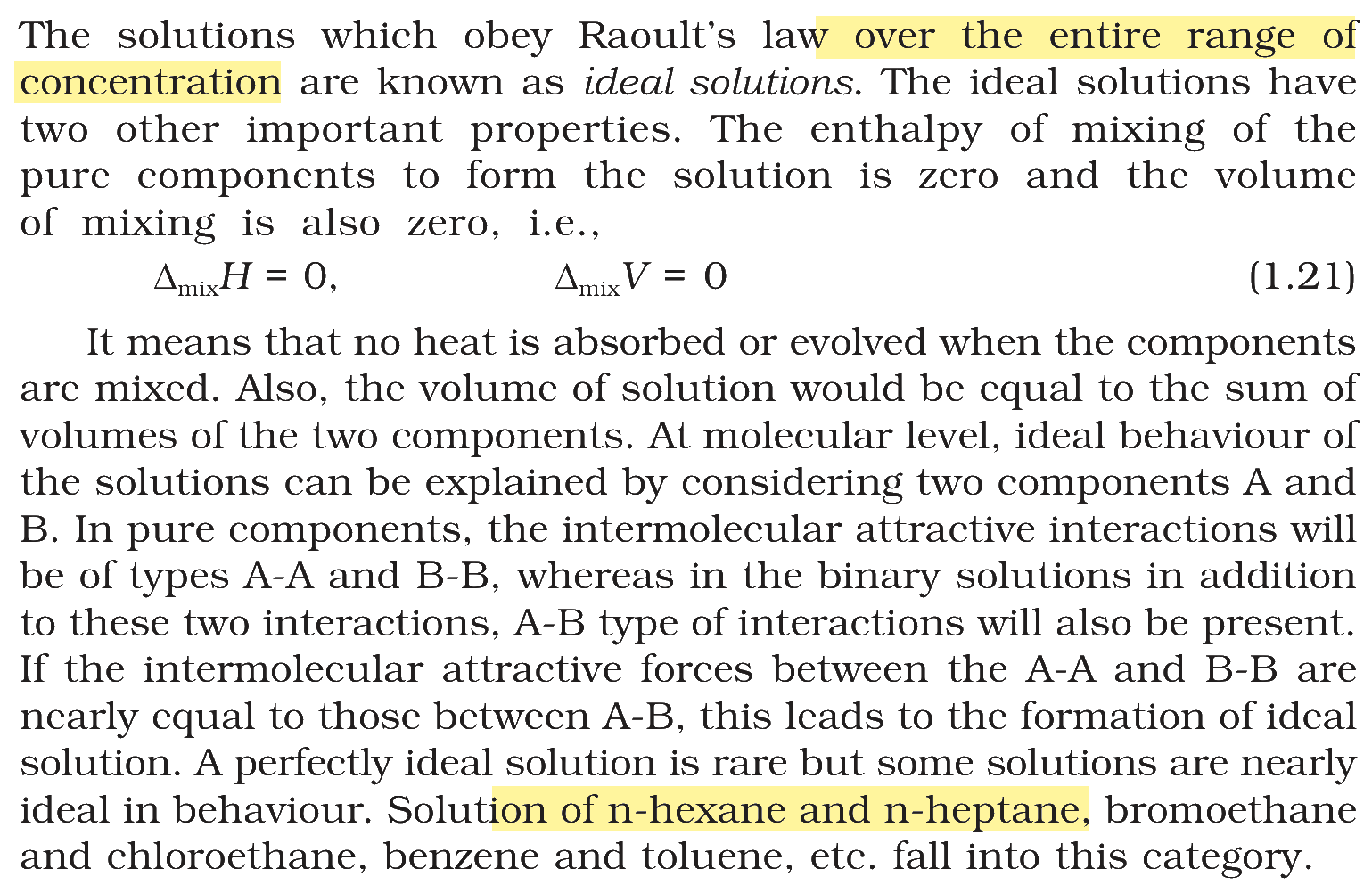
An ideal solution obeys Raoult’s law over the entire range of concentration, and mixing its components causes no heat change and no volume change, \( \Delta_{\text{mix}}H=0 \) and \( \Delta_{\text{mix}}V=0 \).
Option (1) Change in enthalpy of mixing and change in volume of mixing is zero for ideal solutions. — A true statement about ideal solutions. The A–B attractions equal the A–A and B–B attractions, so no heat is absorbed or released and the volumes are additive.
Option (2) Ideal solutions obey Raoult’s law at very low concentrations only. — A false statement about ideal solutions. An ideal solution obeys Raoult’s law at all concentrations; only non-ideal solutions follow it approximately, and only when very dilute.
Option (3) Azeotropic binary solutions cannot be separated by fractional distillation. — A true statement. An azeotrope boils at a constant temperature and its vapour has the same composition as the liquid.
Option (4) A solution of n-hexane and n-heptane is an ideal solution. — A true statement about ideal solutions. The two alkanes are so alike in size and in their weak intermolecular forces that the solution behaves almost ideally.
NCERT (2026-27 edition):
Ideal Solutions