
Select the Incorrect statements about coordination compounds from the following:
(A) The primary valence is equal to the coordination number of metal ion
(B) The secondary valence is equal to the oxidation number of metal ion
(C) The central metal atoms/ions act as Lewis acids
(D) C2O42– is a bidentate and ambidentate ligand.
Choose the correct answer from the options given below:
Answer & explanation
Correct answer: option 1
The correct answer is Option (1) → (A), (B) and (D) only
Werner’s theory describes two kinds of valence for the metal in a coordination compound:
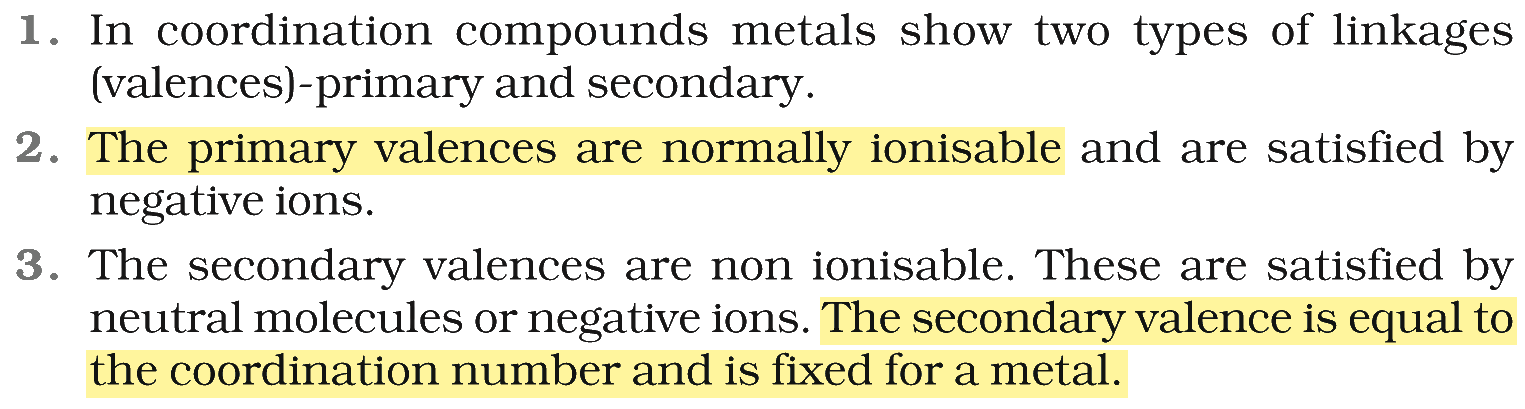
Primary valence: equal to the oxidation number of the metal. It is ionisable and is satisfied by negative ions.
Secondary valence: equal to the coordination number of the metal. It is non-ionisable, is satisfied by ligands (neutral molecules or negative ions), and is fixed for a metal ion, which gives the complex a definite geometry.
Ligands are classified by the way they bind. A didentate ligand binds through two donor atoms at the same time (e.g. en, \( \ce{C2O4^{2-}} \)). An ambidentate ligand has two different donor atoms but binds through only one of them at a time (e.g. \( \ce{NO2^{-}} \)/\( \ce{ONO^{-}} \), \( \ce{SCN^{-}} \)/\( \ce{NCS^{-}} \)).
(A) The primary valence is equal to the coordination number of metal ion — Incorrect. The primary valence equals the oxidation number, not the coordination number.
(B) The secondary valence is equal to the oxidation number of metal ion — Incorrect. The secondary valence equals the coordination number. For example, in \( \ce{[Co(NH3)6]Cl3} \) the oxidation number x of cobalt follows from x + 6(0) + 3(−1) = 0, so x = +3, but its coordination number is 6.
(C) The central metal atoms/ions act as Lewis acids — Correct. Each ligand donates a lone pair of electrons to the metal, so the metal is an electron pair acceptor, that is, a Lewis acid.
(D) C2O42– is a bidentate and ambidentate ligand. — Incorrect. Oxalate binds through both of its oxygen donor atoms together, so it is didentate (and chelating). Both donor atoms are oxygen, so it cannot be ambidentate.
NCERT (2026-27 edition):
Werner’s Theory of Coordination Compounds – …
Ligands – “… When a ligand can bind through two donor atoms as in H2NCH2CH2NH2 (ethane-1,2-diamine) or C2O42– (oxalate), the ligand is said to be didentate … Ligand which has two different donor atoms and either of the two ligetes in the complex is called ambidentate ligand. Examples of such ligands are the NO2– and SCN– ions.”