Aliphatic and aromatic amines are basic in nature. The following amines are in aqueous state.What is the decreasing order of their basic strength?
(A) NH3
(B) (C2H5)2NH
(C) C2H5NH2
(D) (C2H5)3N
Choose the correct answer from the options given below:
Answer & explanation
Correct answer: option 2
The correct answer is Option (2) → (B), (D), (C), (A)
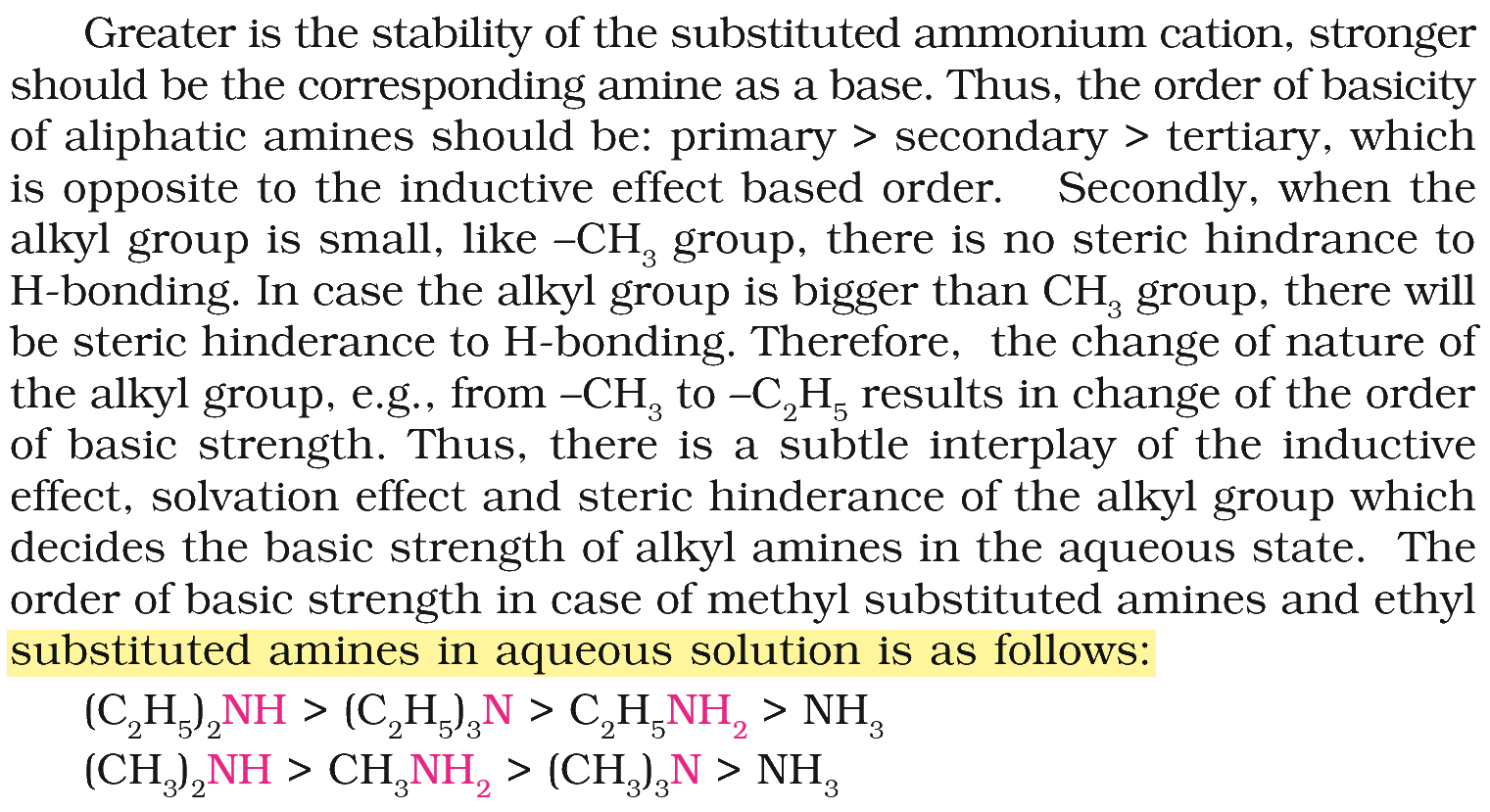
An amine is basic because the lone pair on nitrogen can accept a proton. In water, the basic strength of aliphatic amines is decided by three factors acting together:
Inductive effect (+I): alkyl groups push electrons towards nitrogen and make the lone pair more available. More alkyl groups mean a stronger effect: 3° > 2° > 1°.
Solvation (hydration): the protonated amine (substituted ammonium ion) is stabilised by hydrogen bonding with water. The more N–H hydrogens it has, the better it is stabilised: 1° > 2° > 3°.
Steric hindrance: bulky alkyl groups crowd the nitrogen and hinder this hydrogen bonding. The hindrance is least for 1° amines and greatest for 3° amines, so on this count: 1° > 2° > 3°.
For ethyl-substituted amines, the net result of these opposing factors gives the observed order in water:
\( \displaystyle 2^\circ\ \text{amine} > 3^\circ\ \text{amine} > 1^\circ\ \text{amine} > \mathrm{NH_3} \)
Matching the given compounds:
(B) \( \ce{(C2H5)2NH} \): diethylamine (2°)
(D) \( \ce{(C2H5)3N} \): triethylamine (3°)
(C) \( \ce{C2H5NH2} \): ethylamine (1°)
(A) \( \ce{NH3} \): ammonia
Shortcut: The secondary amine (B) is the strongest and \( \ce{NH3} \) (A) is the weakest. Only Option (2) starts with (B) and ends with (A).
NCERT (2026-27 edition):
Alkanamines versus Ammonia – …