
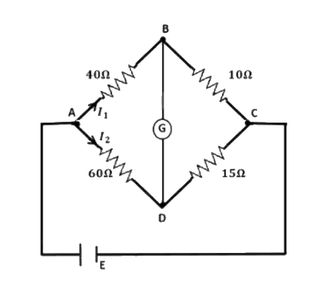
The ratio of heat produced in the four arms of the Wheatstone bridge consisting of 40 Ω, 10 Ω, 60 Ω and 15 Ω, respectively, as shown in the figure given below, is
Answer & explanation
Correct answer: option 1
The correct answer is Option (1) → 6 : 1.5 : 4 : 1
Heat produced in a resistor is \( H = I^{2}Rt \). First check whether current flows through the galvanometer, using the balance condition of the Wheatstone bridge.
\( P/Q = 40/10 = 4 \)
\( R/S = 60/15 = 4 \)
The bridge is balanced, so no current flows through G. Then 40 Ω and 10 Ω carry the same current \( I_1 \), 60 Ω and 15 Ω carry the same current \( I_2 \), and the two branches (50 Ω and 75 Ω) are in parallel across the same potential difference.
\( \displaystyle \frac{I_1}{I_2} = \frac{75\,\Omega}{50\,\Omega} = \frac{3}{2} \)
Take \( I_1 = 3 \) units and \( I_2 = 2 \) units; the time t is the same for all arms.
\( H_{40} \propto 3^{2} \times 40 = 360 \)
\( H_{10} \propto 3^{2} \times 10 = 90 \)
\( H_{60} \propto 2^{2} \times 60 = 240 \)
\( H_{15} \propto 2^{2} \times 15 = 60 \)
\( H_{40} : H_{10} : H_{60} : H_{15} = 360 : 90 : 240 : 60 = 6 : 1.5 : 4 : 1 \)