
CUETMOCK
  • Pricing
  • Mentors
Log inStart freeStart free mocks→

First test, then trust

Try a free CUET mock test.

Join 5,00,000+ students who rehearsed exam day on the exact NTA screen before sitting CUET. On the web and on Android.

Start free mocks →Get the Android app
CUETMOCK

India's #1 CUET Mock Test Platform. Original NCERT-based questions on the exact NTA exam screen — trusted by 5,00,000+ students since CUET 2022.

Get it onGoogle PlayScan to download the CUETMOCK app

Mock tests

  • CUET mock test series
  • Commerce mocks
  • Humanities (Arts) mocks
  • Science mocks
  • Languages & GAT mocks
  • Free practice questions
  • Pricing

Resources

  • CUET exam guide
  • CUET syllabus
  • Universities accepting CUET
  • Expert blogs
  • News & notifications
  • Webinars & counselling
  • CUET score calculator
  • How we estimate your rank
  • FAQs

Company

  • About us
  • Our leadership & team
  • Our toppers
  • Mentors
  • For schools
  • Contact us
  • Terms
  • Privacy
  • Refund policy

Talk to us

+91 7696 6630 56info@cuetmock.comWhatsApp us

Our other platforms

  • JEE Mock — For IIT-JEE aspirants
  • NEET Mock — For NEET aspirants

Newsletter

Exam updates, study material and offers — no spam.

© 2026 NYC Ventures Pvt. Ltd.

701-702, Royal Business Park, Zirakpur, Punjab - 140603

  • Terms of use
  • Privacy policy
  • Refund policy
  • Contact us

iCUETMOCK is an independent preparation platform, not affiliated with the National Testing Agency (NTA). Always check exam details on the official NTA website.

  • Home
  • Mock tests
  • CUET guide
  • Pricing
  • Log in
Home/Practice questions/Chemistry
ChemistryOrganic: Alcohols, Phenols and Ethers

Consider the following reaction chart and identify the correct produc…

Consider the following reaction chart and identify the correct products of the following reaction sequence:
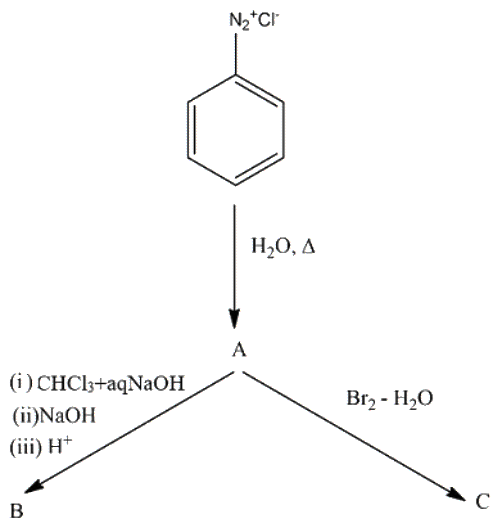
Figure for Q36

Answer & explanation+

Correct answer: option 1

The correct answer is Option (1) → (A) = Phenol (B) = o-Hydroxybenzaldehyde (C) = 2,4,6-tribromophenol

The chart combines three reactions of benzenediazonium chloride and phenol. The related named reactions of phenol are best remembered together:

  • Reimer–Tiemann reaction: phenol + CHCl3 and aqueous NaOH, then acid, puts a –CHO group ortho to –OH, giving salicylaldehyde.

  • Kolbe’s reaction: sodium phenoxide + CO2 (400 K, 4–7 atm), then acid, puts a –COOH group ortho to –OH, giving salicylic acid.

  • Bromination: with bromine water, phenol gives a white precipitate of 2,4,6-tribromophenol; with \( \ce{Br2} \) in a non-polar solvent (\( \ce{CHCl3} \) or \( \ce{CS2} \)) at low temperature, it gives monobromophenols.

Working through the chart:

  • (A) Warming the diazonium salt with water replaces –\( \ce{N2^{+}} \) by –OH, so A is phenol.

        \( \displaystyle \ce{C6H5N2^+Cl^- + H2O} \xrightarrow{\text{warm}} \ce{C6H5OH + N2 + HCl} \)

  • (B) \( \ce{CHCl3} \) + aq NaOH, then NaOH and \( \ce{H^{+}} \), is the Reimer–Tiemann reaction. The –\( \ce{CHCl2} \) group formed at the ortho position is hydrolysed to –CHO, so B is o-hydroxybenzaldehyde (salicylaldehyde).

        \( \displaystyle \ce{C6H5OH} \xrightarrow[\text{(ii) }\ce{NaOH}\text{ (iii) }\ce{H+}]{\text{(i) }\ce{CHCl3}\text{ + aq }\ce{NaOH}} \text{o-}\ce{HO-C6H4-CHO} \)

  • (C) In bromine water the polar solvent ionises phenol, the ring becomes very strongly activated, and all three ortho and para positions are brominated, so C is 2,4,6-tribromophenol.

        \( \displaystyle \ce{C6H5OH + 3Br2} \xrightarrow{\ce{H2O}} \text{2,4,6-tribromophenol (white ppt)} + \ce{3HBr} \)

Advertisement

Practise more on Organic: Alcohols, Phenols and Ethers

Chapter-wise mocks on the real NTA exam screen, with solutions and your rank. Your first mocks are free.

Start free mocks →

Advertisement

Next questions

  1. If the radius of a circle is increasing at the rate of 0.4 cm/sec. Then the rate of increase of its circumference isApplied Maths. Section B2 · Calculus
  2. Why has the military continued its dominance in Pakistan?A. Lack of genuine international support for democratic rule in Pakistan.B. Pakist…Political Science · Contemporary World Politics: Contemporary South Asia
  3. Match the differential equation (List-I) with its order and degree (List-II)List-IList-II(A) (d^3y)/(dx^3)+x^2≤ft((d^2y)/(dx^2))=0 (I)order…Applied Maths. Section B2 · Calculus
  4. A proton and an electron are placed in a uniform electric field.Physics · Electric Charges and Fields
  5. Which among the following statements is correct about the ‘Quit India Movement’?History · Modern India: Mahatma Gandhi and the Nationalist movement
  6. A is the son of B. C, B's sister, has a son D and a daughter E. F is maternal uncle of D. How is A related to D?General Aptitude Test · Verbal Reasoning
  7. Match the LIST-I with LIST-II.LIST-IExpression / unitLIST-IIExplanation(A) 0.693/k (I) Half-life time of zero order reaction(B) mol L−1 s−1…Chemistry · Physical: Chemical Kinetics
  8. Which of the following is correct statement for ammonolysis reaction?Chemistry · Organic: Amines
  9. Which of the following movements was launched by Mahatma Gandhi to unite Hindus and Muslims in a non-violent struggle against British rule…General Aptitude Test · General Knowledge
  10. The vectors from origin to the points A and B are a=2imath-3jmath+2k and b=2imath+3jmath+k respectively , then the area (in Sq. unit) of tr…Maths. Section B1 · Vectors