Amines
Amines can be considered as derivatives of ammonia, obtained by replacement of one, two or all the three hydrogen atoms by alkyl and/or aryl groups. They are classified as primary (1°), secondary (2°) and tertiary (3°) depending upon the number of hydrogen atoms replaced by alkyl or aryl groups in ammonia molecule. In aryl amines, –NH2 group is directly attached to the benzene ring. C6H5NH2 is the simplest example of aryl amine. Amines can be prepared by various synthetic pathways. For example the reduction of nitro compounds with metals in acidic medium produces amines. Reduction with iron scrap and hydrochloric acid is preferred because FeCl2 formed gets hydrolyzed to release hydrochloric acid during the reaction. Thus, only a small amount of hydrochloric acid is required to initiate the reaction.
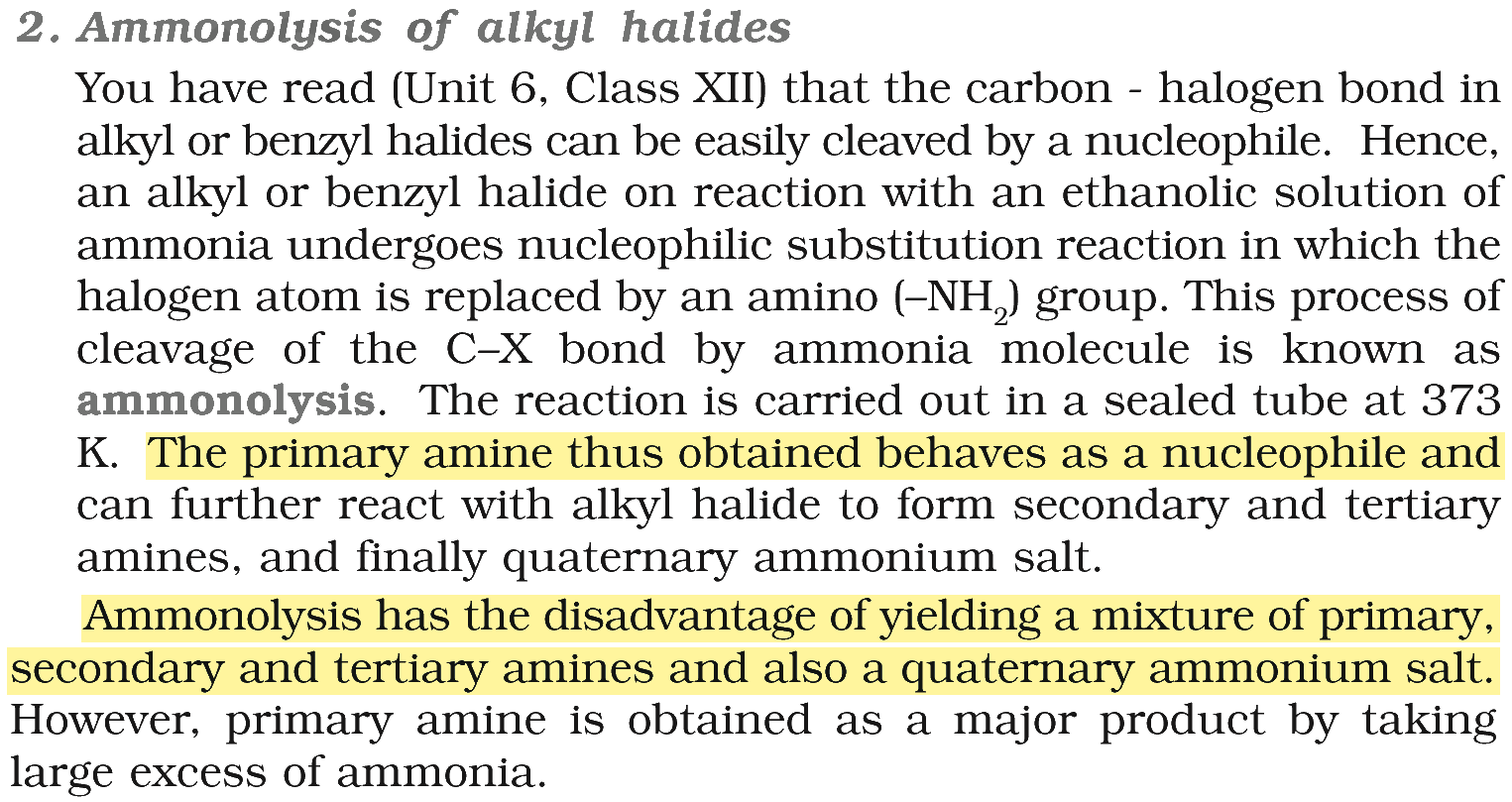
Similarly, an alkyl or benzyl halide on reaction with an ethanolic solution of ammonia undergoes nucleophilic substitution reaction in which the halogen atom is replaced by an amino (–NH2) group. The primary amine thus obtained behaves as a nucleophile and can further react with alkyl halide to form secondary and tertiary amines, and finally quaternary ammonium salt. Reduction of nitriles and amides also yield amines.
Moreover, amines behave as nucleophiles due to the presence of unshared electron pair. Amines, being basic in nature, react with acids to form salts. Basic character of amines can be better understood in terms of their Kb and pKb values. Larger the value of Kb or smaller the value of pKb, stronger is the base. Basicity of amines is related to their structure. Basic character of an amine depends upon the ease of formation of the cation by accepting a proton from the acid. The more stable the cation is relative to the amine, more basic is the amine.
Which of the following is correct statement for ammonolysis reaction?
Answer & explanation
Correct answer: option 4
The correct answer is Option (4) → Mixture of primary, secondary and tertiary amines is formed
In ammonolysis, \( \ce{NH3} \) acts as a nucleophile and replaces the halogen atom of an alkyl halide by an –\( \ce{NH2} \) group:
\( \displaystyle \ce{R-X + NH3 -> R-NH2 + HX} \)
The primary amine is itself a nucleophile, so the substitution goes on:
\( \displaystyle \ce{RNH2} \xrightarrow{\ce{RX}} \ce{R2NH} \xrightarrow{\ce{RX}} \ce{R3N} \xrightarrow{\ce{RX}} \ce{R4N^+X^-} \)
So ammonolysis gives a mixture of primary, secondary and tertiary amines (and also the quaternary ammonium salt).
NCERT (2026-27 edition):
Ammonolysis of Alkyl Halides