
Predict the order of decreasing reactivity of the following compounds towards SN1 reaction:
A. C6H5CH2Br
B. C6H5CH(C6H5)Br
C. C6H5CH(CH3)Br
D. C6H5C(CH3)(C6H5)Br
Choose the correct answer from the options given below:
Answer & explanation
Correct answer: option 4
The correct answer is Option (4) → D, B, C, A
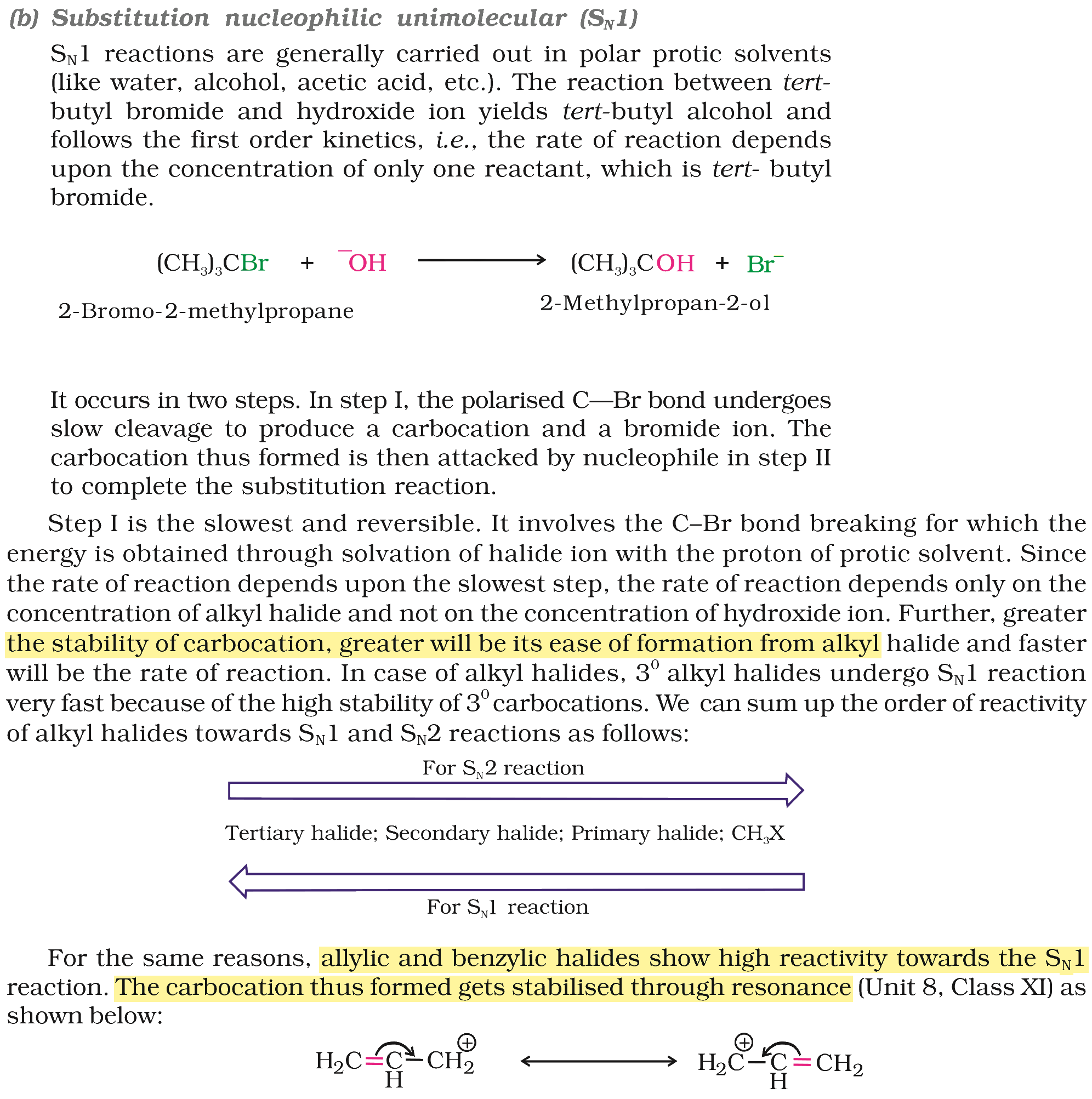
An SN1 reaction takes place in two steps. The slow, rate-determining step is the loss of the halide ion to form a carbocation, so the more stable the carbocation, the faster the reaction. Two factors stabilise the carbocation formed from these benzylic halides:
Resonance with a phenyl group: the positive charge is spread over the benzene ring. Each extra phenyl group on the positive carbon spreads the charge further, so this is the stronger effect.
Alkyl groups (+I effect and hyperconjugation): a methyl group pushes electron density towards the positive carbon, so 3° > 2° > 1°.
Combining the two, the stability of the carbocations decreases as follows:
3° (two phenyls, one methyl) > 2° (two phenyls) > 2° (one phenyl, one methyl) > 1° benzylic
\( \ce{(C6H5)2C^{+}(CH3)} \) > \( \ce{(C6H5)2CH^{+}} \) > \( \ce{C6H5CH^{+}(CH3)} \) > \( \ce{C6H5CH2^{+}} \)
Matching the given compounds:
D. \( \ce{C6H5C(CH3)(C6H5)Br} \): 1-bromo-1,1-diphenylethane (3°, two phenyls)
B. \( \ce{C6H5CH(C6H5)Br} \): bromodiphenylmethane (2°, two phenyls)
C. \( \ce{C6H5CH(CH3)Br} \): 1-bromo-1-phenylethane (2°, one phenyl)
A. \( \ce{C6H5CH2Br} \): benzyl bromide (1°, one phenyl)
Shortcut: D, with two phenyl groups and a methyl group, is the most reactive, and only Option (4) starts with D.
NCERT (2026-27 edition):
Substitution Nucleophilic Unimolecular (SN1)
Note: The same/similar question has been asked in different years by NTA as per the details given below:
| 2026 | 2025 | 2024 | 2023 | 2022 |
|---|---|---|---|---|
| 26-05 S2 11-05 S1 | 29-05 S2 23-05 S2 | – | – | – |