
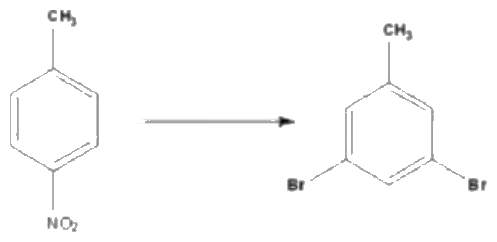
In the following conversion, the correct sequence of reagents used would be:
Answer & explanation
Correct answer: option 2
The correct answer is Option (2) → Fe, H+; Br2; HNO2; H3PO2, H2O
In a multistep aromatic synthesis, the position of a new group is set by the directing effect of groups already on the ring. The –\( \ce{NH2} \) group is a very strong ortho/para director, and after it has done its job it can be removed: diazotisation followed by hypophosphorous acid (H3PO2) replaces –\( \ce{N2^{+}} \) by –H.
The target has two Br atoms meta to –CH3. –\( \ce{CH3} \) directs ortho/para and –\( \ce{NO2} \) directs meta to itself, so direct bromination of 4-nitrotoluene would put Br next to –\( \ce{CH3} \). Instead, the nitro group is turned into –\( \ce{NH2} \), which places Br at the two positions ortho to itself, and is then removed:
First, Fe and acid reduce the nitro group to an amino group:
\( \displaystyle \ce{CH3C6H4NO2 + 6[H]} \xrightarrow{\ce{Fe}/\ce{H^+}} \underset{\text{4-methylaniline}}{\ce{CH3C6H4NH2}} + \ce{2H2O} \)
The para position is taken by –\( \ce{CH3} \), so bromine enters the two positions ortho to –\( \ce{NH2} \):
\( \displaystyle \ce{CH3C6H4NH2 + 2Br2} \xrightarrow{\ce{H2O}} \underset{\text{2,6-dibromo-4-methylaniline}}{\ce{CH3C6H2Br2NH2}} + \ce{2HBr} \)
Nitrous acid, made in situ from \( \ce{NaNO2} \) and HCl, then converts the amino group into a diazonium group in the cold:
\( \displaystyle \ce{CH3C6H2Br2NH2 + NaNO2 + 2HCl} \xrightarrow{\text{273-278 K}} \underset{\text{diazonium salt}}{\ce{CH3C6H2Br2N2^+Cl^-}} + \ce{NaCl + 2H2O} \)
Finally, hypophosphorous acid replaces the diazonium group by hydrogen:
\( \displaystyle \ce{CH3C6H2Br2N2^+Cl^- + H3PO2 + H2O} \rightarrow \underset{\text{3,5-dibromotoluene}}{\ce{CH3C6H3Br2}} + \ce{N2 + H3PO3 + HCl} \)
So the correct sequence is Fe, H+; Br2; HNO2; H3PO2, H2O.
Why the other options are incorrect
Option (1) Br2, Fe; Fe, H+; LiAlH4 — Incorrect. Brominating first puts Br beside –\( \ce{CH3} \) (one Br only), and \( \ce{LiAlH4} \) cannot remove an –\( \ce{NH2} \) group.
Option (3) Br2, H+; LiAlH4; H3O+ — Incorrect. No step removes the nitrogen from the ring.
Option (4) Fe, H+; Br2(aq); HNO2; CuBr — Incorrect. CuBr is the Sandmeyer reagent; it replaces –\( \ce{N2^{+}} \) by –Br and gives 3,4,5-tribromotoluene instead of removing the group.
\( \displaystyle \ce{CH3C6H2Br2N2^+Cl^-} \xrightarrow{\ce{CuBr}/\ce{HBr}} \ce{CH3C6H2Br3 + N2} \)