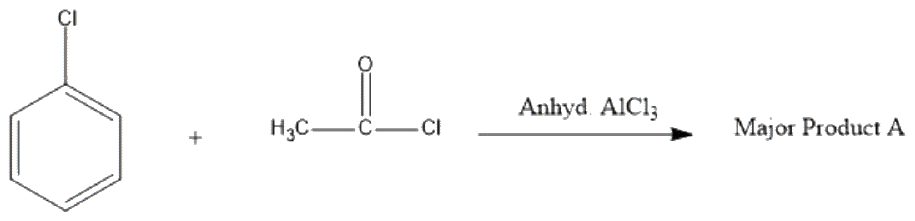
What would be the major product A ?
Answer & explanation
Correct answer: option 4
The correct answer is Option (4) → 4-chloroacetophenone
In Friedel–Crafts acylation, an acyl chloride and anhydrous AlCl3 (a Lewis acid) give the acylium ion, which attacks the benzene ring and puts an acyl group (–COCH3) on it. The product is an aryl ketone.
\( \displaystyle \ce{CH3COCl + AlCl3 -> CH3-C^+=O + AlCl4^-} \)
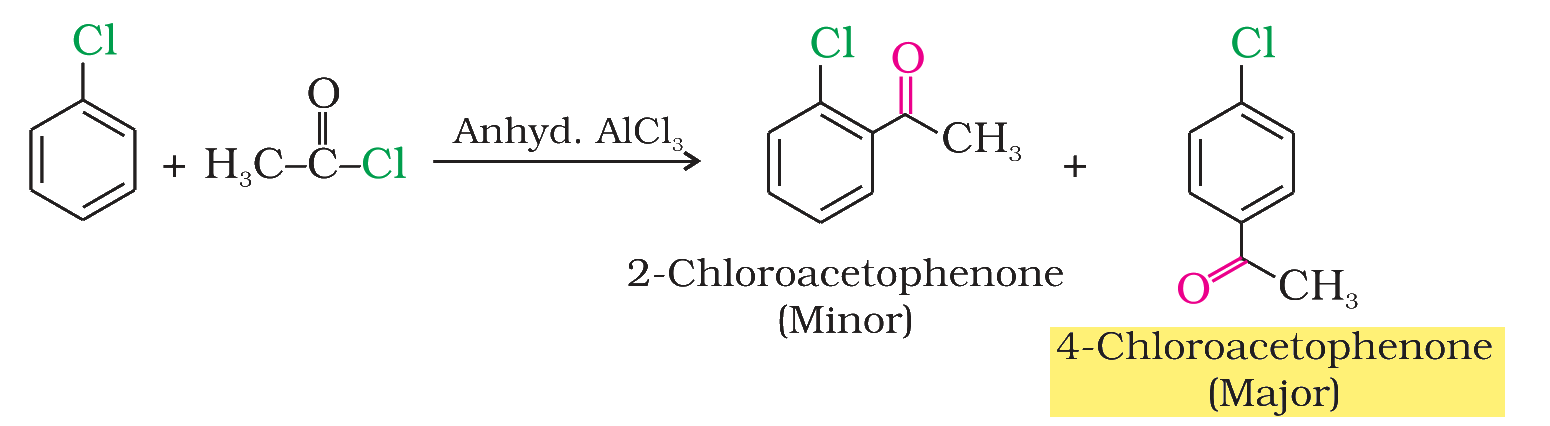
Where the new group goes depends on the group already on the ring. Chlorine is an ortho, para director: it withdraws electrons by its −I effect, so the ring is slightly deactivated, but its lone pairs release electrons by resonance to the ortho and para positions. The para product is the major one, because the ortho position is crowded by the Cl atom next to it.
\( \displaystyle \ce{C6H5Cl + CH3COCl} \xrightarrow{\text{anhyd. }\ce{AlCl3}} \ce{4-ClC6H4COCH3} + \ce{HCl} \)
So the major product A is 4-chloroacetophenone, with 2-chloroacetophenone as the minor product.
Why the other options are incorrect
Option (1) 2-chlorotoluene — Incorrect. It carries a –CH3 group. That comes from Friedel–Crafts alkylation with CH3Cl, not from an acyl chloride, and even then the para isomer would be the major one.
Option (2) 3-chloroacetophenone — Incorrect. This is the meta product. Chlorine sends the incoming group to the ortho and para positions, not to meta.
Option (3) 2-chloroacetophenone — Incorrect. This ortho product does form, but only as the minor product, because the Cl atom next to it hinders attack at the ortho position.
NCERT (2026-27 edition):
Electrophilic Substitution Reactions – “Haloarenes undergo the usual electrophilic reactions of the benzene ring such as halogenation, nitration, sulphonation and Friedel-Crafts reactions. Halogen atom besides being slightly deactivating is o, p- directing; therefore, further substitution occurs at ortho- and para- positions with respect to the halogen atom.”
Friedel-Crafts Reaction