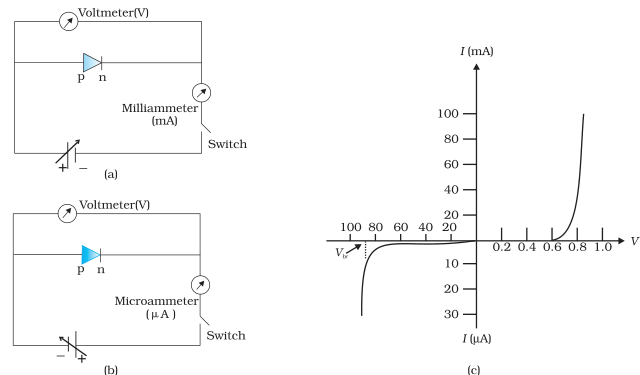
A student wants to study the I-V characteristic of a p-n junction diode under forward bias. Arrange the following steps in the correct order.
(A) Increase the applied forward voltage gradually.
(B) Connect the diode in forward bias (p side to +ve terminal of the battery)
(C) Note the current values, especially after the threshold voltage.
(D) Plot the I-V graph for forward bias.
Choose the correct answer from the options given below:
Answer & explanation
Correct answer: option 3
The correct answer is Option (3) → (B), (A), (C), (D)
An experiment follows a fixed sequence: set up the circuit, vary the input step by step, record the readings, and only then plot the graph.
(B) Connect the diode in forward bias (p side to +ve terminal of the battery) — This comes first, with a voltmeter across the diode and a milliammeter in series.
(A) Increase the applied forward voltage gradually. — Then raise it in small steps.
(C) Note the current values, especially after the threshold voltage. — At each step note the current; it stays very small up to the threshold voltage and rises sharply after it, so readings are taken closely there.
(D) Plot the I-V graph for forward bias. — Finally plot the graph from the readings.
So the correct order is (B), (A), (C), (D).
NCERT (2026-27):
p-n Junction Diode Under Reverse Bias – “… The circuit arrangement for studying the V-I characteristics of a diode, (i.e., the variation of current as a function of applied voltage) are shown in Fig. 14.16(a) and (b). The battery is connected to the diode through a potentiometer (or reheostat) so that the applied voltage to the diode can be changed. For different values of voltages, the value of the current is noted. A graph between V and I is obtained as in Fig. 14.16(c).”