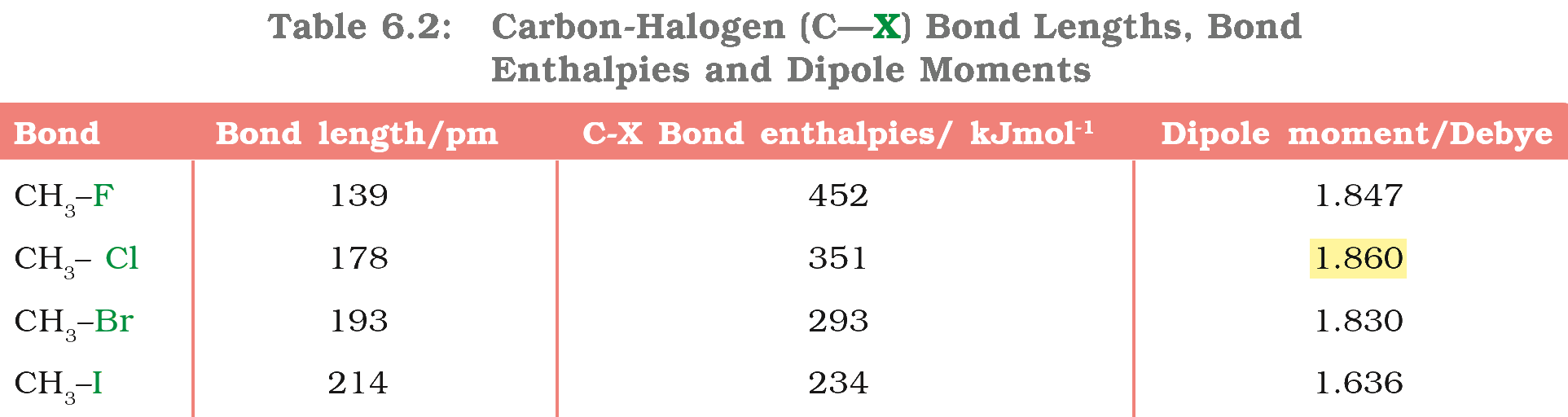
Which of the following compounds will have the highest dipole moment?
Answer & explanation
Correct answer: option 2
The correct answer is Option (2) → Chloromethane
The dipole moment of a bond depends on two things: the size of the charge separation and the distance between the charges.
\( \displaystyle \mu=q\times d \)
In the halomethanes these two factors work against each other. Going from F to I, the electronegativity of the halogen falls, so the charge q falls. But the atom gets bigger, so the C–X bond length d rises.
From F to Cl, the much longer C–Cl bond more than makes up for the smaller charge separation. After Cl, the falling electronegativity wins. So the highest dipole moment belongs to chloromethane.
Why the other options are incorrect
Option (1) Iodomethane — Incorrect. Iodine is the least electronegative halogen, so \( \ce{CH3I} \) has the smallest dipole moment (1.636 D), despite its long bond.
Option (3) Fluoromethane — Incorrect. The C–F bond has the largest charge separation, but it is very short, so μ (1.847 D) is slightly lower than for \( \ce{CH3Cl} \).
Option (4) Bromomethane — Incorrect. The drop in electronegativity from Cl to Br is not balanced by the longer bond, so μ falls to 1.830 D.
NCERT (2026-27 edition):
Nature of C–X Bond – …