Electrochemical cells
We can construct innumerable number of galvanic cells on the pattern of Daniell cell by taking combinations of different half-cells. Each half-cell consists of a metallic electrode dipped into an electrolyte. The two half-cells are connected by a metallic wire through a voltmeter and a switch externally. The electrolytes of the two half-cells are connected internally through a salt bridge. Sometimes, both the electrodes dip in the same electrolyte solution and in such cases we do not require a salt bridge.
For the cell
Ni(s) | Ni2+(aq) || Ag+(aq) | Ag
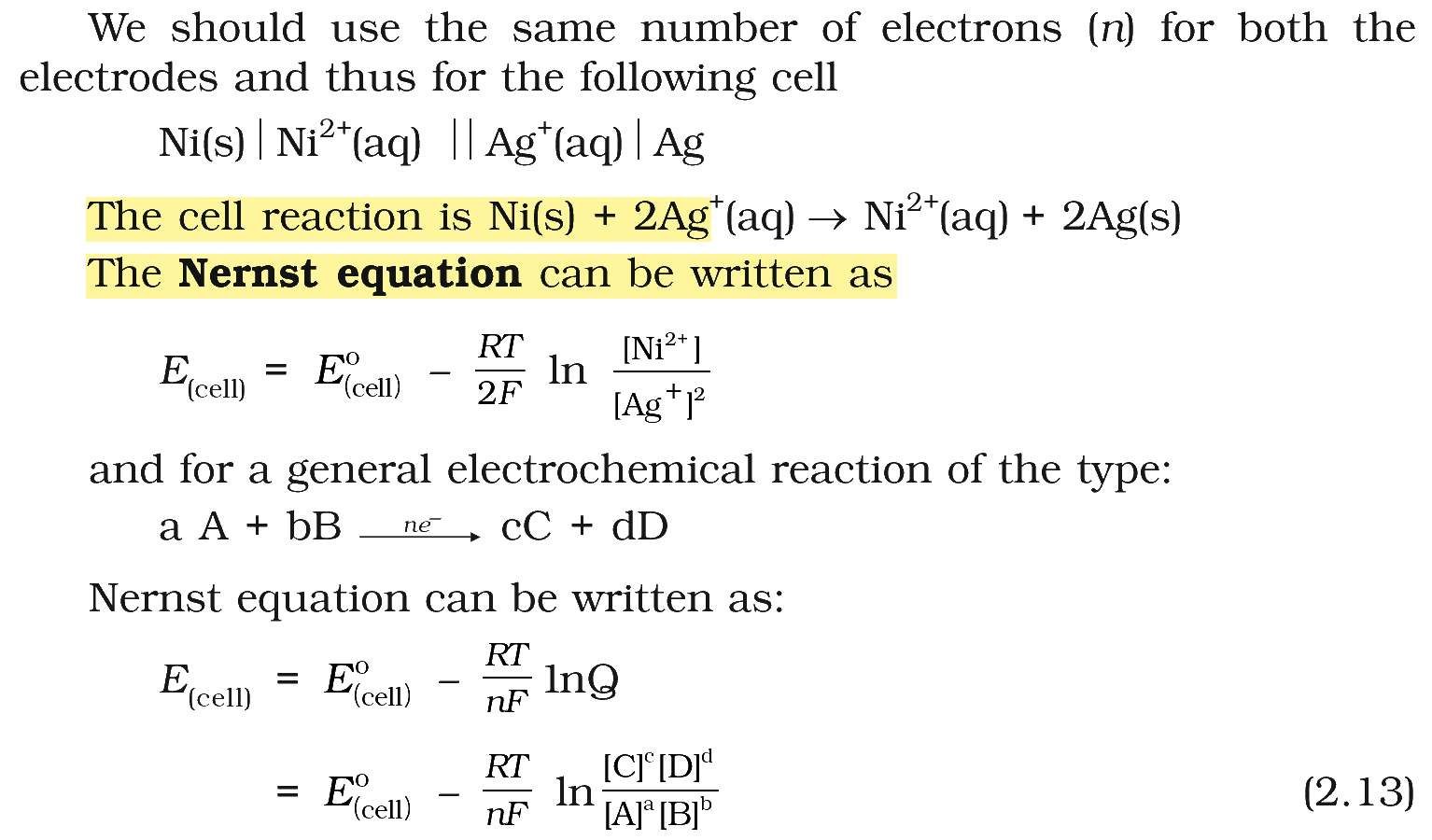
The cell reaction is Ni(s) + 2Ag+ (aq) → Ni2+(aq) + 2Ag(s).
Nernst equation relates the emf of the cell with standard emf and the concentration of reduced and oxidized species.
The Nernst equation for the given reaction
Ni(s) + 2Ag+ (aq) → Ni2+(aq) + 2Ag(s) ; is
Answer & explanation
Correct answer: option 1
The correct answer is Option (1) → \( E_{cell}=E^{\circ}_{cell}-\displaystyle\frac{RT}{2F}\ln\frac{[Ni^{2+}]}{[Ag^{+}]^{2}} \)
The Nernst equation gives the emf of a cell when the concentrations are not standard:
\( \displaystyle E_{cell}=E^{\circ}_{cell}-\frac{RT}{nF}\ln Q \)
To write it correctly:
n is the number of electrons transferred in the balanced cell reaction.
Q is the reaction quotient: product concentrations over reactant concentrations, each raised to the power of its coefficient.
Pure solids such as Ni(s) and Ag(s) have unit activity and are left out.
For Ni(s) + 2Ag+(aq) → Ni2+(aq) + 2Ag(s), two electrons are transferred, so n = 2, and the coefficient of \( \ce{Ag^{+}} \) is 2:
\( \displaystyle Q=\frac{[\ce{Ni^2+}]}{[\ce{Ag^+}]^{2}} \)
At 298 K this can also be written as:
\( \displaystyle E_{cell}=E^{\circ}_{cell}-\frac{0.059}{2}\log\frac{[\ce{Ni^2+}]}{[\ce{Ag^+}]^{2}} \)
Why the other options are incorrect
Option (2) \( E_{cell}=E^{\circ}_{cell}-\displaystyle\frac{RT}{2F}\ln\frac{[Ni^{2+}]}{[Ag^{+}]} \) — Incorrect. \( \ce{[Ag^{+}]} \) is not squared, although the coefficient of \( \ce{Ag^{+}} \) in the reaction is 2.
Option (3) \( E_{cell}=E^{\circ}_{cell}-\displaystyle\frac{RT}{F}\ln\frac{[Ni^{2+}]}{[Ag^{+}]} \) — Incorrect. It uses n = 1 instead of 2 and also leaves \( \ce{[Ag^{+}]} \) unsquared.
Option (4) \( E_{cell}=E^{\circ}_{cell}+\displaystyle\frac{RT}{F}\ln\frac{[Ni^{2+}]}{[Ag^{+}]} \) — Incorrect. The sign is wrong (the term is subtracted), and it also has the wrong n and no square.
NCERT (2026-27 edition):
Nernst Equation – …