What is the order of the reaction?
\( \ce{^{226}_{88}Ra -> ^{4}_{2}He + ^{222}_{86}Rn} \)
Answer & explanation
Correct answer: option 2
The correct answer is Option (2) → First
In radioactive decay, each unstable nucleus breaks down on its own, without colliding with anything. The chance that a given nucleus decays in the next second is fixed, so the rate of decay is proportional to the number of undecayed nuclei (N) present:
\( \displaystyle \text{Rate}=-\frac{dN}{dt}=\lambda N \)
This has the form of a first order rate law, Rate = k[R]1. As with every first order reaction, the half-life (t1/2 = 0.693/λ) is constant and does not depend on the amount of sample. Radioactive decay is also unaffected by temperature and pressure.
The given α-decay of radium balances in mass number and atomic number:
\( \displaystyle \ce{^{226}_{88}Ra -> ^{4}_{2}He + ^{222}_{86}Rn} \)
\( \displaystyle 226=4+222,\quad 88=2+86 \)
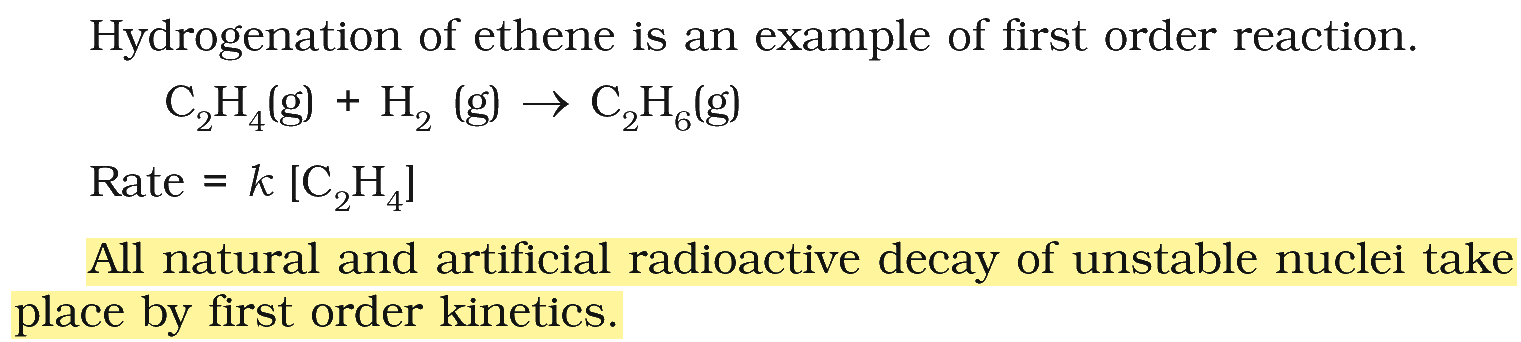
Like all natural and artificial radioactive decay, it is a first order reaction.
NCERT (2026-27 edition):
First Order Reactions – …