Identify the correct statement regarding a liquidity trap.
Answer & explanation
Correct answer: option 4
The correct answer is Option (4) → Everyone expects a future rise in interest rates and a fall in bond prices.
People can hold their wealth as money, which earns nothing, or as bonds, which earn interest. The price of an existing bond moves opposite to the rate of interest: when the market rate rises, new bonds pay more, so an old bond with a lower fixed return sells for less. People who expect the rate of interest to rise therefore expect bond prices to fall and a capital loss on bonds, and they prefer to hold money. This is the speculative demand for money, and it is larger the lower the rate of interest.
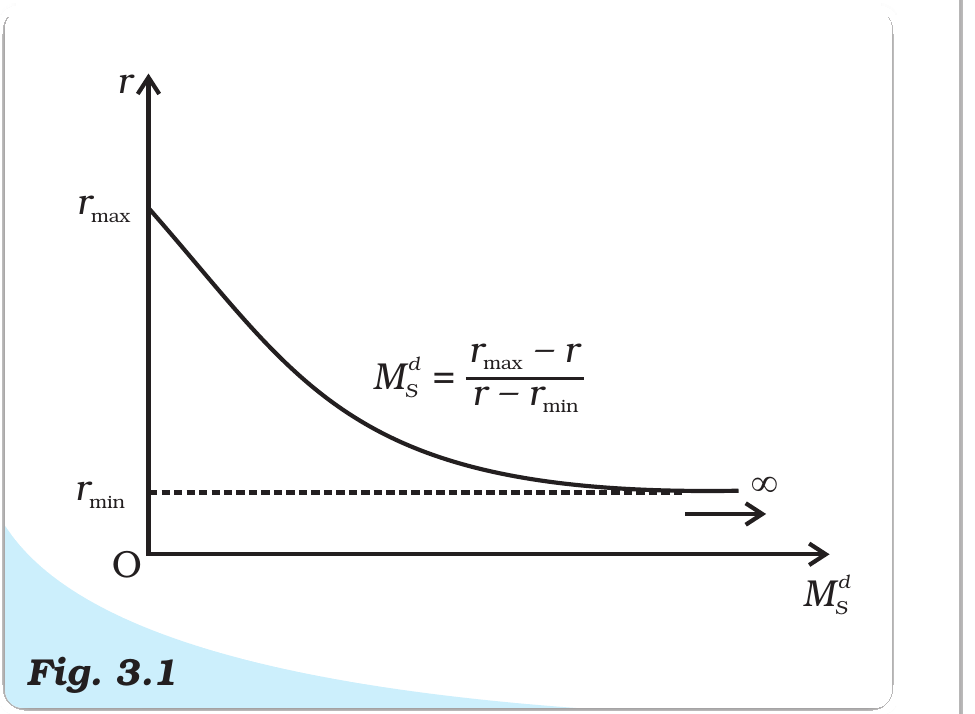
Now let the rate of interest fall to a very low level, its floor rmin. From there it can only go up, so everybody expects it to rise in future and bond prices to fall. This situation is the liquidity trap:
Nobody wishes to hold bonds; everyone keeps their wealth in money.
Any extra money put into the economy is just held, without raising the demand for bonds or lowering the rate of interest further, so the speculative demand for money becomes infinitely elastic.
Why the other options are incorrect
Option (1) Demand for bonds will increase, bond prices will rise, and rate of interest will rise. — Incorrect. In the liquidity trap nobody wants to hold bonds. Besides, bond prices and the rate of interest move in opposite directions, so the two cannot rise together.
Option (2) The speculative money demand function is inelastic in this context. — Incorrect. The speculative demand for money is infinitely elastic in a liquidity trap, the opposite of inelastic: people absorb any amount of money at the same rate of interest.
Option (3) The speculative money demand function is unitary elastic here. — Incorrect. Unit elasticity would mean demand changes in proportion to the rate of interest; in the liquidity trap the demand curve is flat at rmin, so the elasticity is infinite.
NCERT (2025-26): “The Speculative Motive … However, if the market rate of interest is already low enough so that everybody expects it to rise in future, causing capital losses, nobody will wish to hold bonds. Everyone in the economy will hold their wealth in money balance and if additional money is injected within the economy it will be used up to satiate people’s craving for money balances without increasing the demand for bonds and without further lowering the rate of interest below the floor rmin. Such a situation is called a liquidity trap. The speculative money demand function is infinitely elastic here.… …In Fig. 3.1 the speculative demand for money is plotted on the horizontal axis and the rate of interest on the vertical axis. When r = rmax, speculative demand for money is zero. The rate of interest is so high that everyone expects it to fall in future and hence is sure about a future capital gain. Thus everyone has converted the speculative money balance into bonds. When r = rmin, the economy is in the liquidity trap. Everyone is sure of a future rise in interest rate and a fall in bond prices. Everyone puts whatever wealth they acquire in the form of money and the speculative demand for money is infinite.…”
|