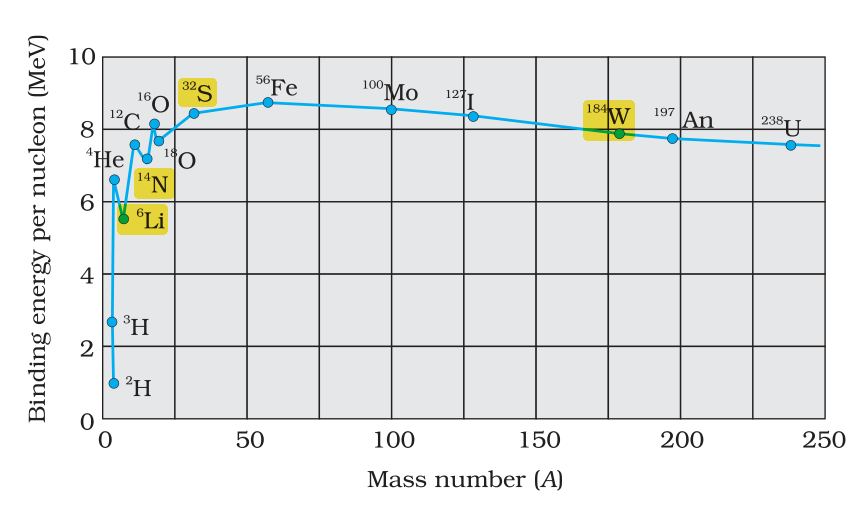
Arrange the following nuclei in decreasing order of their binding energy per nucleon.
(A) \( {}^{32}\mathrm{S} \)
(B) \( {}^{184}\mathrm{W} \)
(C) \( {}^{14}\mathrm{N} \)
(D) \( {}^{6}\mathrm{Li} \)
Choose the correct answer from the options given below:
Answer & explanation
Correct answer: option 2
The correct answer is Option (2) → (A), (B), (C), (D)
The binding energy per nucleon rises steeply for light nuclei, reaches a broad maximum of about 8.75 MeV near A = 56 (iron), and then falls slowly for heavy nuclei. Approximate values:
\( {}^{32}\mathrm{S}\text{ (A)}: \ 8.5\,\mathrm{MeV} \)
\( {}^{184}\mathrm{W}\text{ (B)}: \ 8.0\,\mathrm{MeV} \)
\( {}^{14}\mathrm{N}\text{ (C)}: \ 7.5\,\mathrm{MeV} \)
\( {}^{6}\mathrm{Li}\text{ (D)}: \ 5.3\,\mathrm{MeV} \)
Sulphur is closest to the peak; tungsten is heavy but on the slowly falling part of the curve, so it is still above the light nuclei. Decreasing order: (A), (B), (C), (D).
NCERT (2026-27):
Nuclear Binding Energy – “… Figure 13.1 is a plot of the binding energy per nucleon Ebn versus the mass number A for a large number of nuclei. We notice the following main features of the plot: (i) the binding energy per nucleon, Ebn, is practically constant, i.e. practically independent of the atomic number for nuclei of middle mass number (30 < A < 170). The curve has a maximum of about 8.75 MeV for A = 56 and has a value of 7.6 MeV for A = 238. (ii) Ebn is lower for both light nuclei (A<30) and heavy nuclei (A>170).”