
CUETMOCK
  • Pricing
  • Mentors
Log inStart freeStart free mocks→

First test, then trust

Try a free CUET mock test.

Join 5,00,000+ students who rehearsed exam day on the exact NTA screen before sitting CUET. On the web and on Android.

Start free mocks →Get the Android app
CUETMOCK

India's #1 CUET Mock Test Platform. Original NCERT-based questions on the exact NTA exam screen — trusted by 5,00,000+ students since CUET 2022.

Get it onGoogle PlayScan to download the CUETMOCK app

Mock tests

  • CUET mock test series
  • Commerce mocks
  • Humanities (Arts) mocks
  • Science mocks
  • Languages & GAT mocks
  • Free practice questions
  • Pricing

Resources

  • CUET exam guide
  • CUET syllabus
  • Universities accepting CUET
  • Expert blogs
  • News & notifications
  • Webinars & counselling
  • CUET score calculator
  • How we estimate your rank
  • FAQs

Company

  • About us
  • Our leadership & team
  • Our toppers
  • Mentors
  • For schools
  • Contact us
  • Terms
  • Privacy
  • Refund policy

Talk to us

+91 7696 6630 56info@cuetmock.comWhatsApp us

Our other platforms

  • JEE Mock — For IIT-JEE aspirants
  • NEET Mock — For NEET aspirants

Newsletter

Exam updates, study material and offers — no spam.

© 2026 NYC Ventures Pvt. Ltd.

701-702, Royal Business Park, Zirakpur, Punjab - 140603

  • Terms of use
  • Privacy policy
  • Refund policy
  • Contact us

iCUETMOCK is an independent preparation platform, not affiliated with the National Testing Agency (NTA). Always check exam details on the official NTA website.

  • Home
  • Mock tests
  • CUET guide
  • Pricing
  • Log in
Home/Practice questions/Chemistry
ChemistryOrganic: Aldehydes, Ketones and Carboxylic Acids

Choose the reagent that converts compound ‘A’ to ‘B’.

CARBONYL COMPOUNDS

In aldehydes, the carbonyl group is bonded to a carbon and hydrogen while in the ketones, it is bonded to two carbon atoms. Aldehydes and ketones undergo nucleophilic addition reactions. A nucleophile attacks the electrophilic carbon atom of the polar carbonyl group from a direction approximately perpendicular to the plane of sp2 hybridized orbitals of carbonyl carbon. The hybridization of carbon changes from sp2 to sp3 in the nucleophilic addition. Aldehydes give Fehling’s test positive while aromatic aldehydes do not respond to this test .

An organic compound ‘A’ with molecular formula C3H5N, undergoes Stephen reaction to produce another compound ‘B’. Compound ‘B’ gives orange precipitate with 2,4-DNP but it does not undergo Haloform reaction. However, the reaction of compound B with dilute alkali produces a compound ‘C’ which is β-hydroxy compound with increased number of carbon atoms.

Choose the reagent that converts compound ‘A’ to ‘B’.

Answer & explanation+

Correct answer: option 1

The correct answer is Option (1) → SnCl2 + HCl

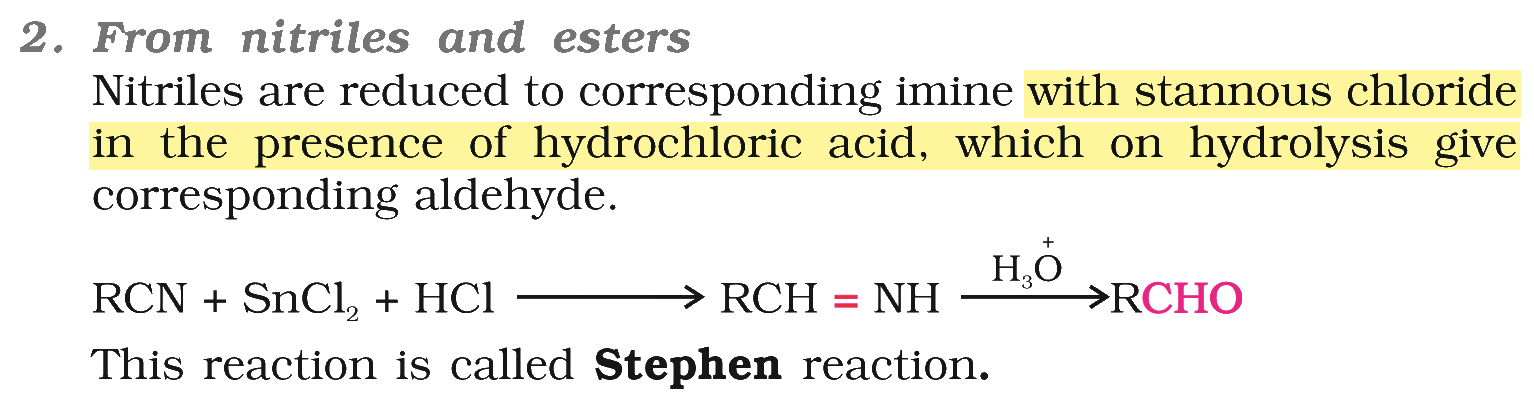
Compound A is propanenitrile and B is propanal. The change is the Stephen reaction: the nitrile is reduced by stannous chloride in the presence of hydrochloric acid to an imine, and the imine is hydrolysed by water to the aldehyde:

    \( \displaystyle \ce{CH3CH2CN} \xrightarrow{\ce{SnCl2 + HCl}} \ce{CH3CH2CH=NH} \xrightarrow{\ce{H3O^+}} \ce{CH3CH2CHO} \)

\( \ce{SnCl2} \)/HCl is a mild reducing agent, so the reduction stops at the imine stage and the aldehyde is obtained after hydrolysis. So the reagent is SnCl2 + HCl.

Why the other options are incorrect

  • Option (2) FeCl2 + HCl — Incorrect. FeCl2 is too weak a reducing agent to reduce a nitrile; the reagent is stannous chloride, SnCl2, with HCl.

  • Option (3) LiAlH4 — Incorrect. It is a strong reducing agent and reduces the nitrile fully to the primary amine.

        \( \displaystyle \ce{CH3CH2-C#N} \xrightarrow[\text{(ii) }\ce{H2O}]{\text{(i) }\ce{LiAlH4}} \ce{CH3CH2CH2NH2} \)

  • Option (4) CrO2Cl2 — Incorrect. Chromyl chloride is the oxidising agent of the Etard reaction (toluene to benzaldehyde); it does not reduce a nitrile.

        \( \displaystyle \ce{C6H5CH3} \xrightarrow{\ce{CrO2Cl2}\text{, }\ce{CS2}} \ce{C6H5CH(OCrOHCl2)2} \xrightarrow{\ce{H3O+}} \ce{C6H5CHO} \)

NCERT (2026-27 edition):
From Nitriles and Esters
Textbook extract

Advertisement

Practise more on Organic: Aldehydes, Ketones and Carboxylic Acids

Chapter-wise mocks on the real NTA exam screen, with solutions and your rank. Your first mocks are free.

Start free mocks →

Advertisement

Next questions

  1. The fragments of DNA are separated by:Biology · Biotechnology -Principles and Processes
  2. Match the LIST-I with LIST-IILIST-I(UN Reforms)LIST-II(Year)A.UN Secretary-General Kofi Annan initiated an inquiry on UN reformsI.1965B.Hum…Political Science · Contemporary World Politics: International Organisations
  3. In the given question, figure (X) is embedded in any one of the four alternative figures (1), (2), (3) and (4). Find the correct option whi…General Aptitude Test · Non-Verbal Reasoning
  4. What would be the geometrical shape of [NiCl4]2− and [PtCl4]2− compounds?Chemistry · Inorganic: Coordination Compounds
  5. If A is a square matrix […] such that A^2=pA , then the value of p is,Applied Maths. Section B2 · Algebra
  6. What is the mutual inductance of two conducting concentric circular loops of radii R_1 and R_2\ (R_2 lt R_1) ?Physics · Electromagnetic Induction
  7. Arrange the following structures of spermatogenesis in the correct sequence.A. Primary spermatocyteB. SpermatogoniaC. SpermatidD. Secondary…Biology · Human Reproduction
  8. The reagent used in the Stephen reaction isChemistry · Organic: Aldehydes, Ketones and Carboxylic Acids
  9. In India, human activities cause which of the following land degradations?A. Degraded shifting cultivation areaB. Mining and industrial was…Geography · India-People and Economy: Geographical Perspective on selected issues and Problems
  10. The most common objections to advertising include:A. Inculcates social valuesB. Adds to the costsC. Confuses the sellersD. Encourages sale…Business Studies · Marketing